Clear Sky Science · en
Study on the effects of hydrological connectivity on the dispersal and driving factors of macroinvertebrate communities
Why breaking small dams matters for river life
Across the world, thousands of aging small dams are being removed to restore rivers. But what actually happens to the tiny animals that live on the riverbed when the water begins to flow freely again? This study followed those creatures—called macroinvertebrates—in a steep mountain river in China before and after two small hydropower dams were taken out. By watching how these animals drifted with the current, the researchers were able to see, almost in real time, how reconnecting a river helps wildlife move, recolonize, and rebuild a healthier ecosystem.
Watching a mountain river before and after
The team worked on the Jiuchong River in Shennongjia National Park, a fast, rocky stream with very little human disturbance apart from three small hydropower stations. Two of these dams, each only a few meters high, were demolished at the end of 2022 as part of a regional effort to clean up small hydropower. For a full year before removal and a full year after, the researchers visited five river sites every month—one untouched reference site and four sites affected by the dams. Using underwater nets left in place for 24 hours, they collected drifting invertebrates and the bits of leaves and other organic particles that serve as their food, while also measuring flow speed, depth, width, and other water conditions.
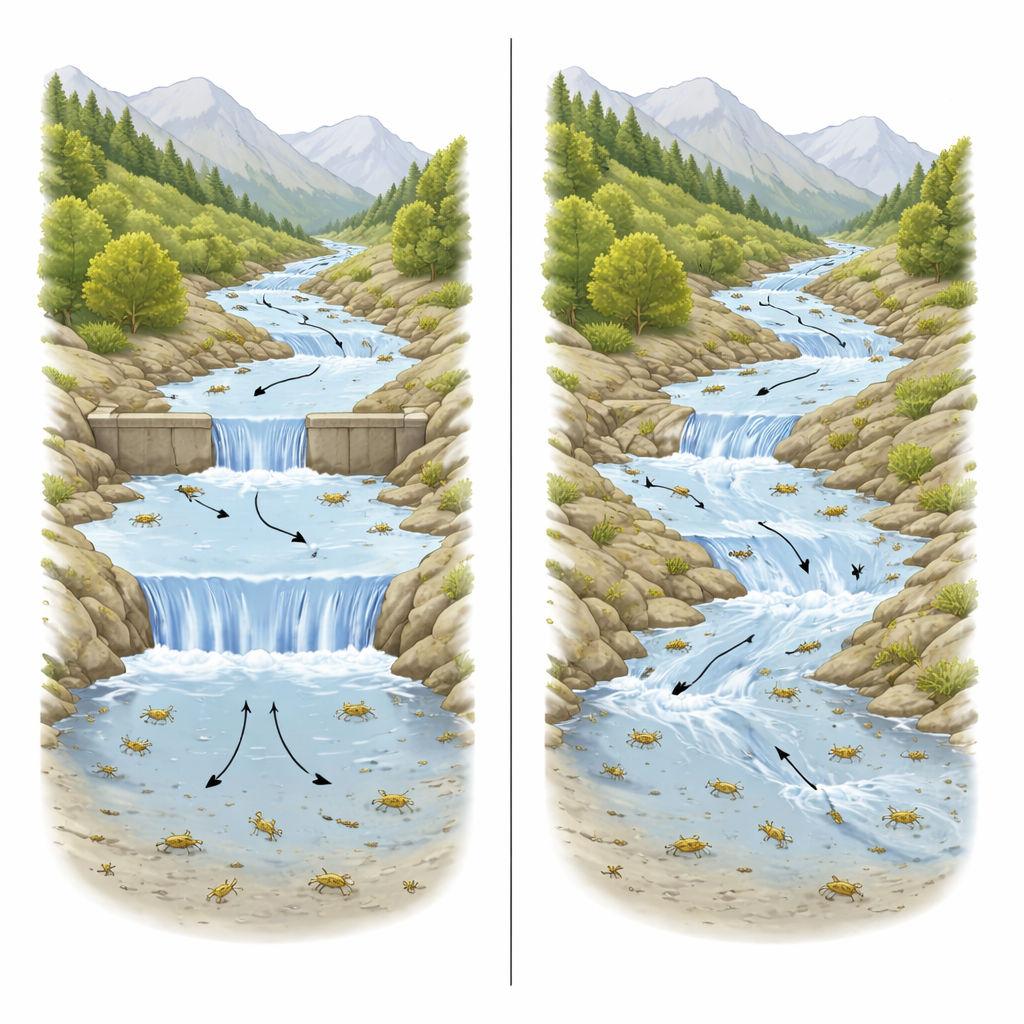
How river flow and food changed
Once the dams were removed, the river’s physical character changed quickly in the formerly impaired reaches. Discharge increased, the channel became deeper and wider, and the water moved faster. At the same time, the amount of coarse and fine organic particles—shredded leaves and other detritus—rose sharply downstream of the former dams. This happened because the restored current could now carry material that had been stored in quiet sections and also bring fresh organic matter from upstream. Interestingly, chemical properties like temperature, dissolved oxygen, and salinity hardly changed, reflecting the small size and short lifetime of the dams. The reference site, which had never been dammed, stayed stable across all measurements.
Riverbed creatures on the move
The community of drifting animals responded strongly to this new flow regime. Overall, the scientists identified 116 types of macroinvertebrates, including mayflies, caddisflies, and midges. At the undisturbed reference site, the number of kinds of animals and individuals remained similar before and after dam removal. In contrast, at the sites once blocked by dams, both the variety of taxa and the number of drifting individuals shifted. Before removal, families such as Hydropsychidae and Heptageniidae were dominant; afterward, their share dropped, while Chironomidae (non-biting midges) and Ephemerellidae (certain mayflies) became much more common. The most strongly impacted site—downstream of two dams—showed the greatest recovery, with its richness and abundance rising toward the reference condition once the barriers disappeared.
From weak travelers to strong wanderers
To make sense of how easily different animals move, the researchers used an index of “dispersal capacity” that scores each kind of invertebrate according to how prone it is to drift actively or passively in the water. Before dam removal, the fauna was dominated by weak and weak‑to‑medium dispersers. After the river was reconnected, taxa with strong dispersal ability increased sharply, while weak dispersers declined in relative importance. A community‑level metric of dispersal capacity rose at nearly all formerly impaired sites and became more similar to the reference site over time. In the first months after removal, this index jumped as “fugitive” species—good movers but poor competitors—rapidly colonized newly available habitats, before later stabilizing as competition and habitat sorting took over.
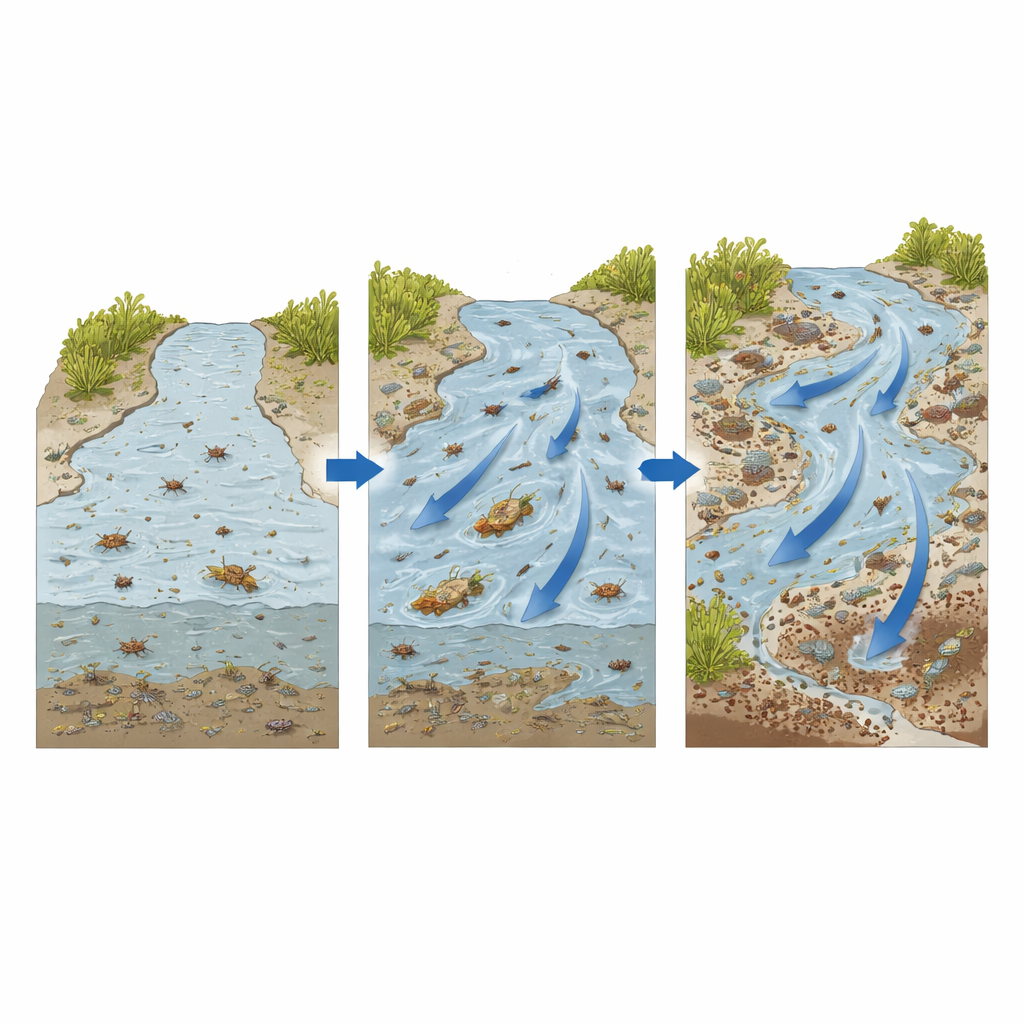
What drives the new patterns
To untangle cause and effect, the team used a statistical model that links environmental changes to the observed dispersal shifts. They found that increases in flow speed and in coarse organic matter tended to boost the community’s overall dispersal capacity, by scouring animals from the riverbed and by sending pulses of food downstream that strong dispersers could track. In contrast, greater channel width and higher levels of fine organic particles tended to dampen dispersal, by encouraging more sideways spreading within the channel and by favoring locally abundant but weakly mobile taxa such as certain midges. Together, these pathways showed that hydrological connectivity—how continuously and energetically the river flows—is the key driver shaping how far and how fast macroinvertebrates can move.
What this means for restoring rivers
For non-specialists, the take‑home message is straightforward: even small dams can fragment river life, and taking them out can quickly help tiny but vital creatures recolonize and rebound. In this study, reconnecting a short mountain river stretch restored a more natural mix of drifting invertebrates and strengthened their ability to spread along the channel. Because these animals sit at the base of the food web and are widely used as indicators of stream health, their improved dispersal after dam removal signals broader ecological recovery. The authors argue that simple measures of dispersal capacity should become a standard part of river health assessments, helping managers judge whether removing small barriers is truly allowing life to flow again.
Citation: Zhang, Y., Zhang, B., Wang, H. et al. Study on the effects of hydrological connectivity on the dispersal and driving factors of macroinvertebrate communities. Sci Rep 16, 11521 (2026). https://doi.org/10.1038/s41598-026-41441-2
Keywords: dam removal, river restoration, aquatic invertebrates, hydrological connectivity, biodiversity