Clear Sky Science · en
Bacterially expressed recombinant TMOF induces mortality and gut microbial alterations in Aedes albopictus larvae
Why tiny mosquitoes matter to us
Mosquitoes may be small, but their impact on human health is enormous. Species like the Asian tiger mosquito, Aedes albopictus, help spread dengue, chikungunya, Zika, and other infections that sicken millions of people every year. Many of the chemicals used to control mosquitoes are losing effectiveness and can harm the environment and other animals. This study explores a biological alternative: using harmless bacteria to mass-produce a small natural molecule that specifically kills mosquito larvae and even disturbs the microbes living in their guts, while sparing other creatures.
A new way to weaken mosquito larvae
The work centers on a short protein fragment called TMOF, originally found in female mosquitoes. Inside mosquitoes, TMOF acts like a brake on digestion by shutting down production of trypsin, a key gut enzyme needed to break down food. Without proper digestion, mosquito larvae stop feeding, starve, and die. The researchers engineered common laboratory bacteria, Escherichia coli, to produce a fusion form of TMOF. They first built a DNA copy of the TMOF code that was optimized so bacteria could read it efficiently, then inserted it into a plasmid vector designed for safe, high-level protein production. Only bacteria that successfully replaced a built‑in toxin gene with the TMOF gene survived, helping ensure that most survivors were good TMOF producers. 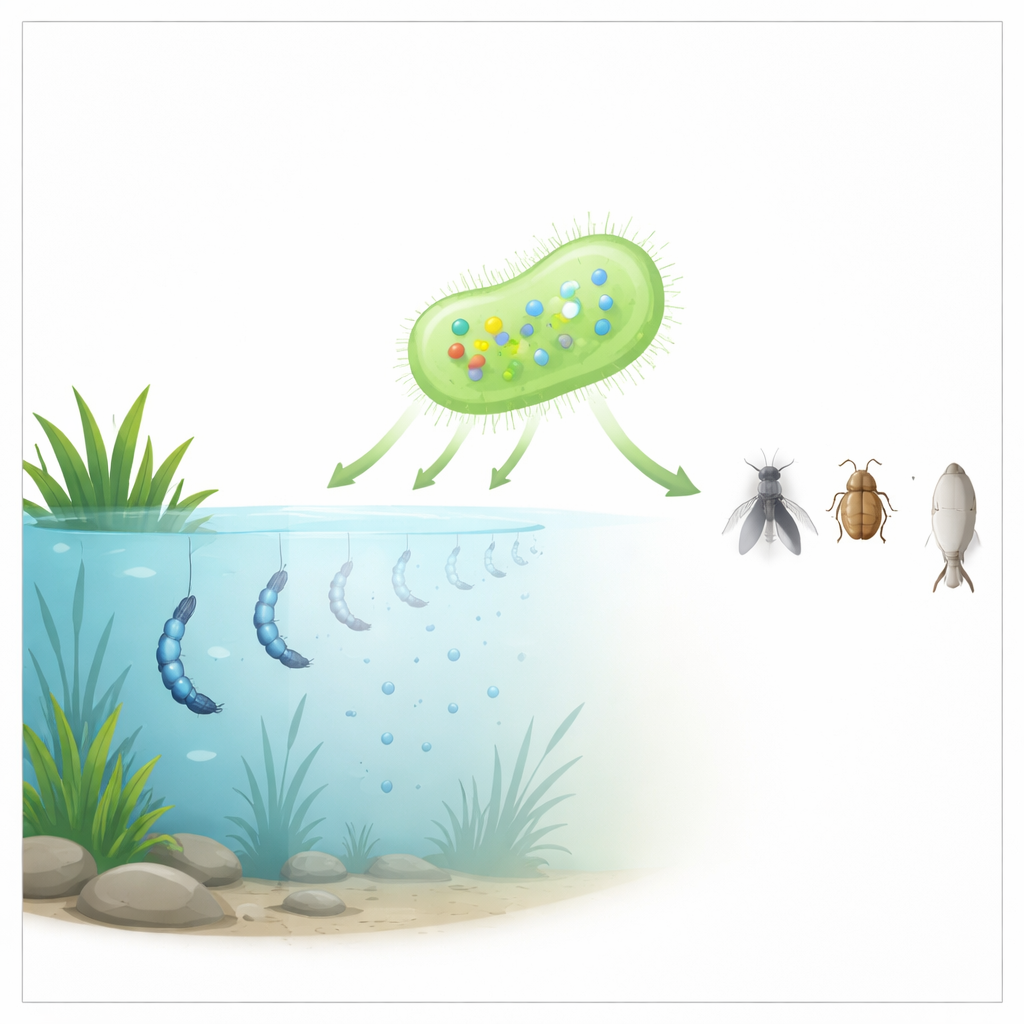
From bacterial factories to dead larvae
Once the modified bacteria were grown in culture and triggered to make the fusion protein, the team broke open the cells and used the liquid part, called the lysate, to test toxicity against second‑stage Aedes albopictus larvae. The more protein-rich lysate the larvae received, the more of them died; the concentration that killed half the larvae in two days was about 242 micrograms per milliliter. When the researchers purified the TMOF fusion protein using a nickel-based column, removing most other bacterial proteins, it became far more potent: only about 2.1 micrograms per milliliter were needed to reach the same level of killing, over one hundred times greater efficiency than the crude lysate. Similar effects were seen in Culex mosquito larvae, showing that the approach can act on more than one mosquito species.
How the tiny molecule does its damage
To confirm that TMOF itself was responsible, the team showed that cutting the fusion protein with the digestive enzyme trypsin released an active fragment that still killed larvae, and that a deliberately mis‑framed version of the gene lost all toxic effect. They then measured trypsin activity in the guts of larvae exposed to the recombinant protein and found it dropped by nearly half, fitting with the idea that TMOF blocks new enzyme production. In treated larvae, development was delayed, many pupae died, and adults that did emerge survived only a day or two. These findings match a picture in which the engineered protein is eaten, trimmed into active TMOF pieces in the alkaline larval gut, and then switches off the machinery that would normally make digestive enzymes. 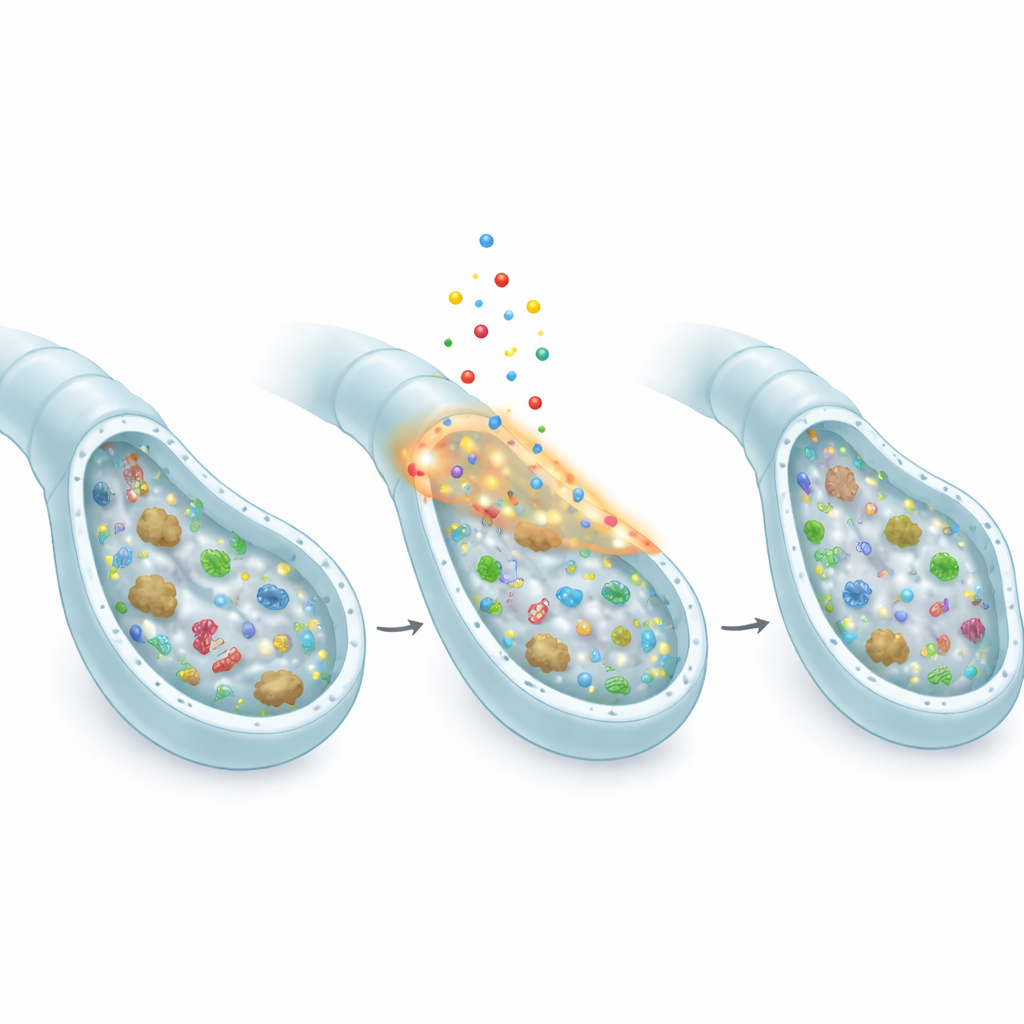
Friendly to bystanders, harsh on gut microbes
Any new control method must be safe for other organisms. When the same TMOF-containing lysate was given to fruit flies, a common beetle, and a small fish species, there were no signs of illness or unusual behavior, even over long observation periods. This matches earlier work suggesting that TMOF’s target is found only in mosquitoes and a few related insects. The team also asked what happens to the bacteria that naturally live inside mosquito larvae. Using DNA sequencing of gut microbes from treated and untreated larvae, they found that overall diversity dropped after exposure to TMOF. Two major groups of microbes, Pseudomonadota and Bacillota, became less abundant, while another group, Actinomycetota, increased. Many common genera and species were replaced by different ones, showing that disrupting digestion with TMOF reshapes the gut ecosystem, which may further weaken the larvae.
What this could mean for mosquito control
Overall, the study shows that harmless bacteria can be turned into efficient factories for a natural mosquito hormone-like molecule that selectively kills mosquito larvae at very low doses. The method is inexpensive, scalable, and appears safe for non-target species tested so far. By both starving larvae and altering the balance of microbes in their guts, TMOF-based treatments could offer an environmentally friendly tool to help reduce disease-carrying mosquito populations. Before such an approach is used outside the lab, however, longer-term field trials will be needed to confirm its safety, stability, and real‑world effectiveness, and to refine delivery methods such as attaching the protein to particles that larvae readily filter from water.
Citation: Deepthi, M., Vadakkadath Meethal, K. Bacterially expressed recombinant TMOF induces mortality and gut microbial alterations in Aedes albopictus larvae. Sci Rep 16, 14494 (2026). https://doi.org/10.1038/s41598-026-41440-3
Keywords: mosquito control, biological larvicide, Aedes albopictus, gut microbiome, recombinant peptide