Clear Sky Science · en
Transport and retention of laundry microplastic fibres in slow sand filtration systems
Why tiny threads from our clothes matter
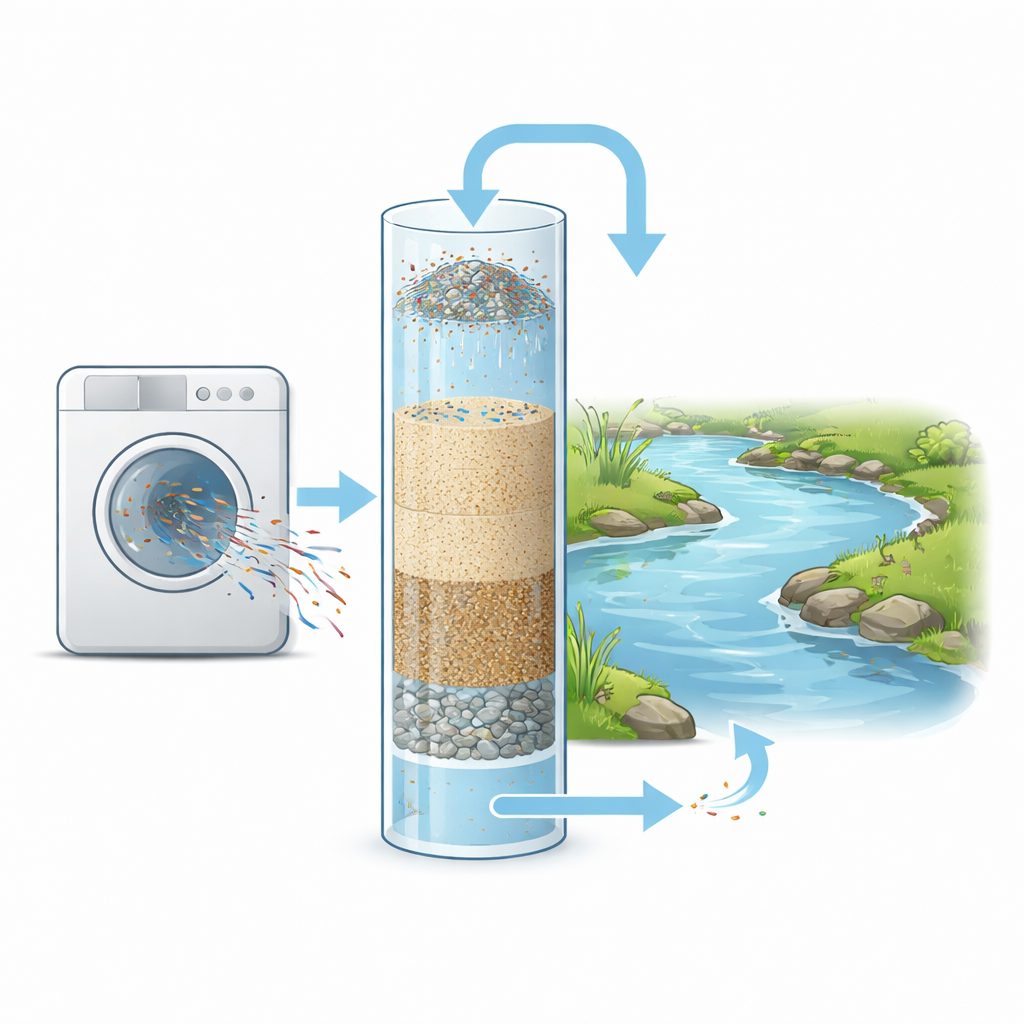
Every time we do laundry, thousands of microscopic plastic threads shed from synthetic fabrics and are washed down the drain. These near-invisible fibres can slip through treatment plants and end up in rivers, oceans, and even the air we breathe and the water we drink. This study explores whether a simple, low-energy technology—slow sand filtration—can act as a practical barrier to stop these laundry fibres before they reach the wider environment.
Small plastic threads in everyday water
Microplastic fibres, especially from polyester clothing, are now found almost everywhere: in lakes and seas, soils, the atmosphere, and human lungs. A single synthetic blanket or garment can release tens of thousands of fibres in a single wash, and conventional wastewater treatment does not reliably remove the smallest ones. These fibres are worrisome not only because they can be inhaled or swallowed, but also because their large surface area lets them ferry other pollutants such as metals and chemicals through the environment. Finding affordable ways to capture them in places with both advanced and limited wastewater infrastructure is therefore a pressing challenge.
A simple sand-based solution put to the test
The researchers focused on slow sand filtration, an old but robust water treatment method in which water moves gently downward through a tall bed of sand. Unlike high-speed filters that rely on pressure and frequent backwashing, slow sand filters work at very low flow rates and use gravity, long contact times, and a biologically active surface layer to clean water. In this study, the team built eight transparent columns filled either with coarse sand or finer sand and ran real washing machine water from a polyester fleece blanket through them for three weeks at three flow speeds. They then carefully counted and measured microplastic fibres in the water entering and leaving the filters and in sand layers at different depths.
How well the sand catches laundry fibres
The filters captured the vast majority of fibres, especially when water moved slowly. At the lowest flow rate, coarse sand removed about 92% of the fibres and fine sand about 95%. When the researchers increased the flow speed, performance dropped: to roughly 71% for coarse sand and 81% for fine sand at the fastest rate. Fine sand consistently let through about one third fewer fibres than coarse sand, showing that narrower pores and greater surface area help trap more threads. Most of the fibres that remained in the treated water were very short—between 10 and 50 micrometres in length—indicating that small, flexible threads are the hardest to stop.
Where the fibres end up inside the filter
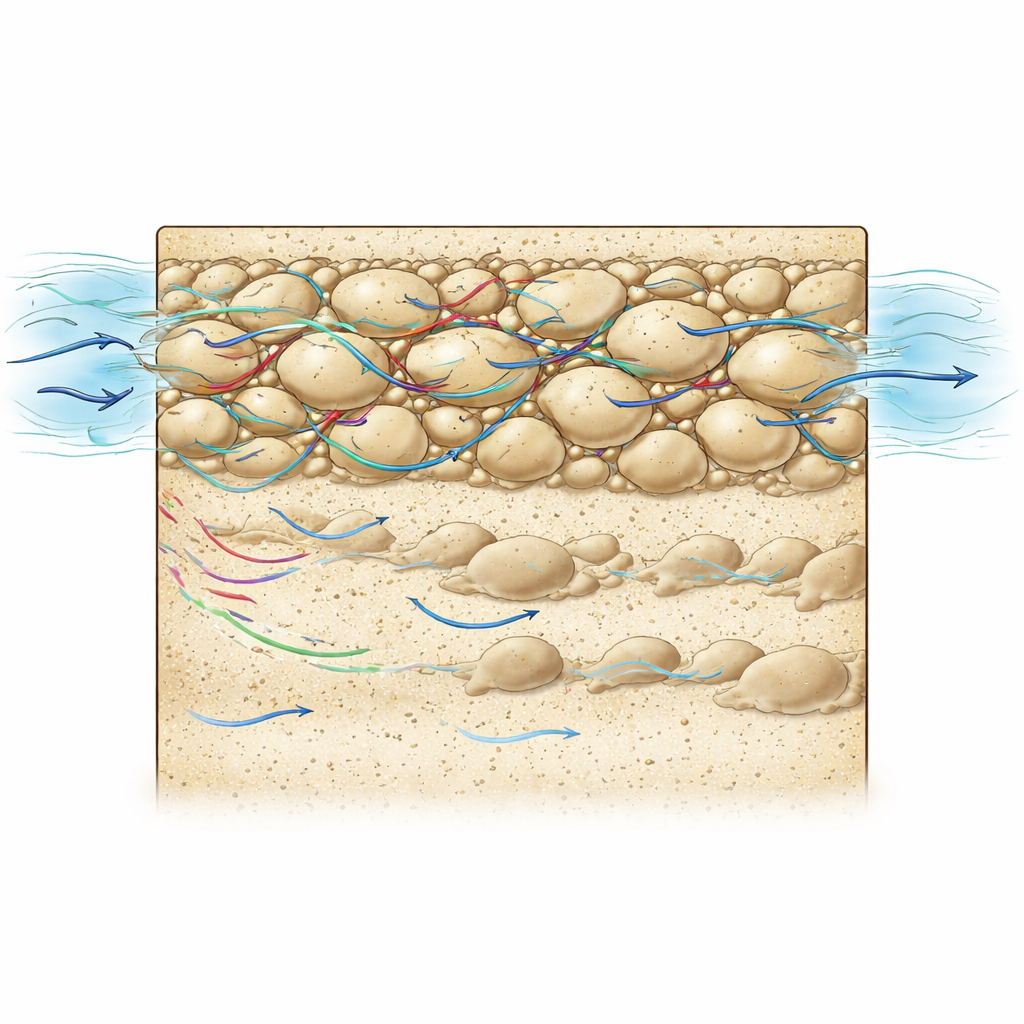
By dismantling the filters, the team found that most fibres accumulated in the upper 10 centimetres of the sand bed, regardless of sand type or flow rate. Longer fibres tended to be snagged and tangled near the top, while smaller ones penetrated deeper, especially at higher speeds. This pattern suggests that fibres are not simply blocked like marbles at a grate; instead, they weave through the pores, bend around grains, and are caught by interception and straining as they encounter tighter spaces. Over time, trapped fibres and other particles partially clog the top layer, creating an even finer natural mat that improves capture, though it also increases resistance to flow.
Water quality benefits and practical trade-offs
Beyond catching plastic fibres, the sand filters also improved basic water quality. Cloudiness dropped by around 80–90%, and dissolved organic carbon—a measure of natural and detergent-related organic matter—fell by roughly one third. The fine sand columns generally produced clearer water and slightly higher pH, reflecting longer contact between water, sand, and developing microbial communities. However, this improved performance comes with trade-offs: fine sand clogs more easily, can limit flow, and may require more frequent maintenance. Because most fibres accumulate in the top layer, scraping and washing this layer risks releasing concentrated fibres back into the environment unless the wash water is treated.
What this means for everyday pollution control
For non-specialists, the main message is that a relatively simple, low-energy technology can capture most of the plastic threads shed from laundry before they reach rivers and seas. Slow sand filters using fine sand and gentle flow can remove more than nine out of ten fibres while also polishing the water. The work also highlights that the smallest fibres are the most mobile and that the thin surface layer of the filter does most of the work. To make this approach fully sustainable, future systems will need to balance fine media with manageable flow rates and include safe handling of sand-cleaning waste. Together with better washing machine design and source-control policies, slow sand filtration could become an important part of a broader strategy to curb microplastic fibre pollution.
Citation: Gao, F., Busquets, R. & Campos, L.C. Transport and retention of laundry microplastic fibres in slow sand filtration systems. Sci Rep 16, 14445 (2026). https://doi.org/10.1038/s41598-026-41438-x
Keywords: microplastic fibres, laundry wastewater, slow sand filtration, wastewater treatment, plastic pollution