Clear Sky Science · en
Precise orbital parameters,masses, and parallax of the subgiant binary system 12 Persei: a combined spectroscopic–interferometric analysis
Measuring the Space Between the Stars
Astronomers have long wanted to know exactly how far away nearby stars are, because distance is the key that unlocks nearly every other property of a star—its true brightness, size, and life story. This paper focuses on a bright pair of stars in the constellation Perseus, known together as 12 Persei, and shows how combining several different observing techniques can pin down their distance and physical properties with remarkable precision. The result is not only a sharper picture of this particular system, but also an important independent check on the measurements made by Europe’s Gaia satellite, today’s gold standard for mapping the Milky Way.
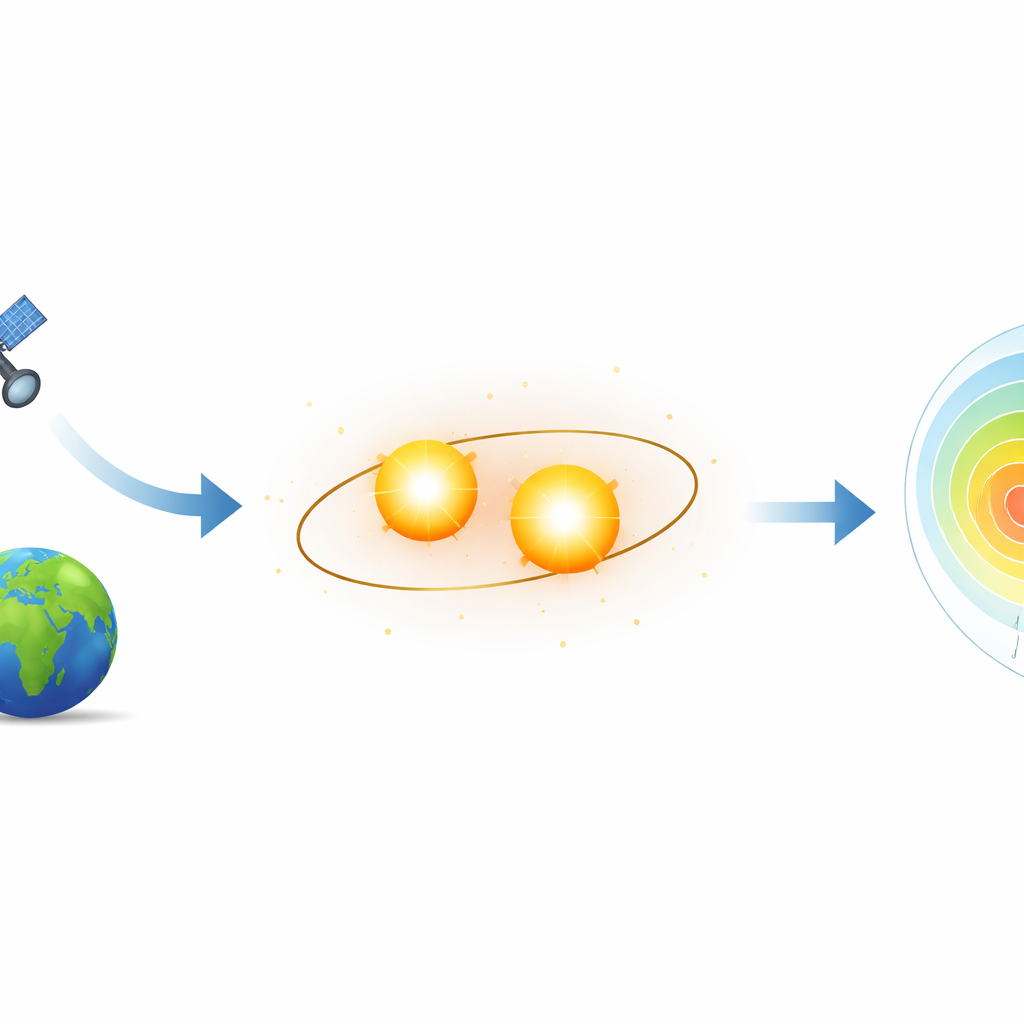
A Close Stellar Pair as a Cosmic Ruler
12 Persei is not a single star but two stars orbiting each other in less than a year. Because the pair is both bright and relatively nearby—about 24 light-years away—it offers an ideal natural laboratory. The authors treat 12 Persei as a kind of cosmic ruler: by carefully tracking how the two stars move around one another on the sky and along our line of sight, they can work out the true scale of the orbit and thus the system’s distance from Earth. This orbital distance, often called orbital parallax, can then be directly compared with the parallax that space missions such as Hipparcos and Gaia measure by watching how the stars appear to wobble as Earth circles the Sun.
Blending Different Ways of Seeing
To build this ruler, the team brings together several kinds of observations. High-resolution imaging with interferometry provides tiny shifts in position as one star moves around the other, while spectroscopy measures how their light is stretched and squeezed by motion toward or away from us. They feed all of these data into a modern statistical engine based on Markov Chain Monte Carlo methods, which explores many possible orbits and finds those most consistent with all the measurements at once. This approach delivers precise values for the orbital period, shape, tilt, and size, as well as robust confidence limits on the masses of both stars.
Turning Light into Physical Properties
Knowing the distance and masses is only part of the story. The authors also want to understand what kinds of stars make up 12 Persei and where they are in their life cycles. For this, they apply a technique developed by one of the co-authors that compares observed colors and brightnesses of the system with detailed computer models of stellar atmospheres. By constructing synthetic spectra and matching them to data from several photometric systems, they infer each star’s temperature, radius, and luminosity. They then place the stars on theoretical tracks that map how stars of different masses evolve over time, much like plotting people of different ages and weights on a growth chart.
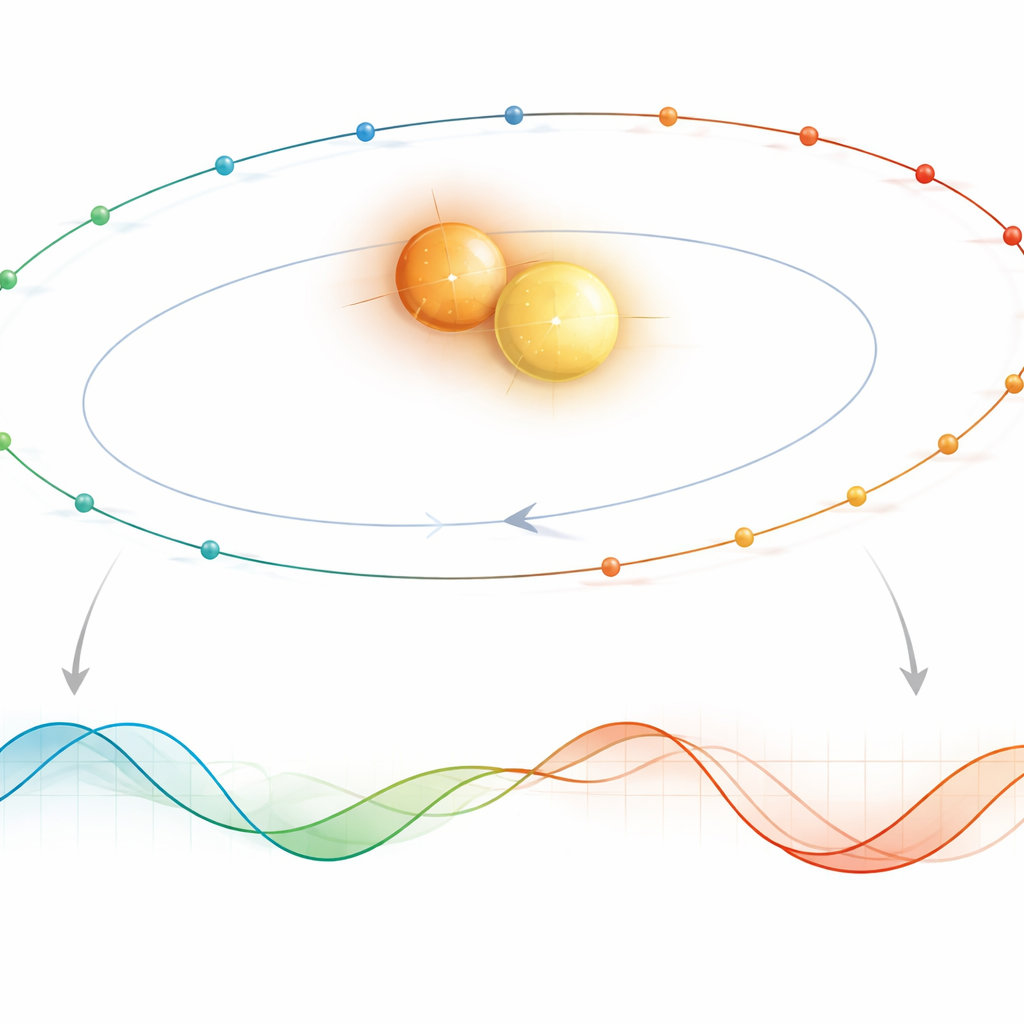
Two Stars in Midlife
The combined analysis reveals that both members of 12 Persei are slightly more massive than the Sun and are in a transitional “subgiant” phase. They are beginning to leave the long, stable middle period of stellar life and are starting to swell and brighten as their internal fuel supply changes. The primary star is classified as roughly type F6.5 subgiant and the companion as type G1 subgiant. Their similar masses and ages, together with their current properties, suggest that the pair likely formed together from the breakup, or fragmentation, of a single cloud of gas rather than through later capture.
Putting Gaia to the Test
Perhaps the most far-reaching result is that the orbital parallax derived from this intricate ground- and space-based campaign agrees extremely well with the parallaxes reported by Gaia’s latest data release and by the reprocessed Hipparcos catalog. Small numerical differences fall comfortably within the quoted uncertainties and reflect known measurement limitations rather than any real conflict. For non-specialists, this means that two completely different yardsticks—one based on watching the stars’ orbit, the other on their tiny yearly wobble—give the same answer. That agreement strengthens confidence in the distances that underpin modern astronomy, improves our understanding of how subgiant stars evolve, and sets the stage for future, even sharper studies of nearby stellar systems.
Citation: Abushattal, A.A., Widyan, H., Dirk, M. et al. Precise orbital parameters,masses, and parallax of the subgiant binary system 12 Persei: a combined spectroscopic–interferometric analysis. Sci Rep 16, 12377 (2026). https://doi.org/10.1038/s41598-026-41432-3
Keywords: binary stars, stellar distances, Gaia mission, subgiant stars, orbital parallax