Clear Sky Science · en
Assessing cranial morphology for sex determination in juvenile alpine swifts (Tachymarptis melba)
Why young swifts’ heads matter
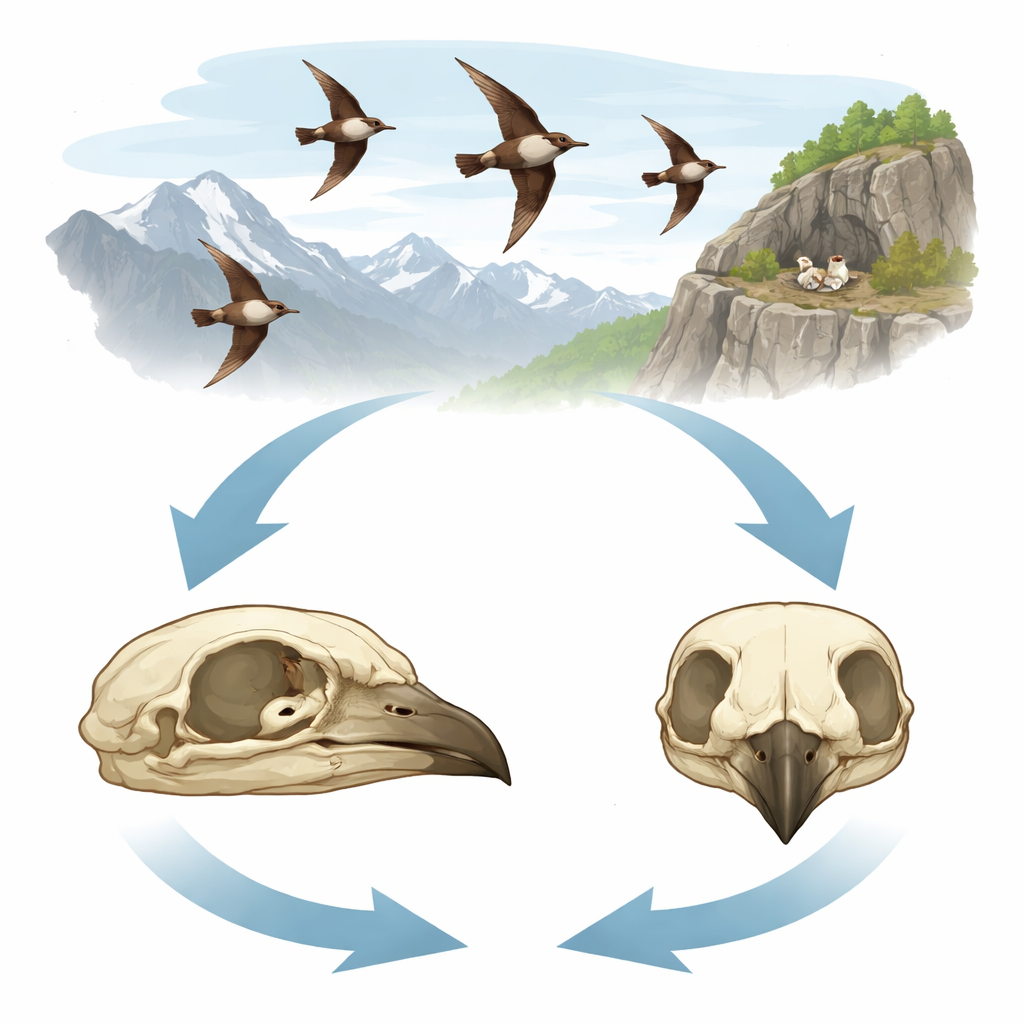
Alpine swifts are among nature’s most extreme fliers, spending months on the wing as they feed, migrate, and even sleep in the air. To support this demanding lifestyle, every part of their body must be finely tuned for flight – including the skull that houses the brain, eyes, and powerful beak. This study asks a deceptively simple question: in young alpine swifts, do male and female skulls already differ in ways that might hint at their future roles and performance in the sky?
Birds built for life in the air
Alpine swifts are specialized aerial insect hunters that nest on cliffs and spend most of their lives aloft. While adults have been well studied for their flight and behavior, much less is known about how their bodies take shape during youth. The skull is especially important: its form affects how efficiently a bird can bite, how well it can see, and how its head handles the stresses of fast, agile flight. The researchers focused on juveniles that had died of natural causes and were brought to a veterinary faculty in Istanbul. By looking at young birds, they hoped to see the earliest hints of differences between males and females before adulthood and mating reshape their bodies.
Turning tiny skulls into digital models
The team examined 100 juvenile alpine swifts, 57 females and 43 males. After carefully cleaning the heads and separating the skulls, they used a high-precision 3D scanner to create digital models. On each skull they marked 18 key points – such as the tip of the beak, the edges of the eye socket, and the highest point of the braincase – that capture its overall shape. Computer techniques then aligned all skulls into a common frame, removed differences in position and orientation, and allowed the scientists to compare shape and size with great accuracy. They also measured each bird’s body weight and the length of the skull from beak tip to the back of the head.
Subtle differences between young males and females
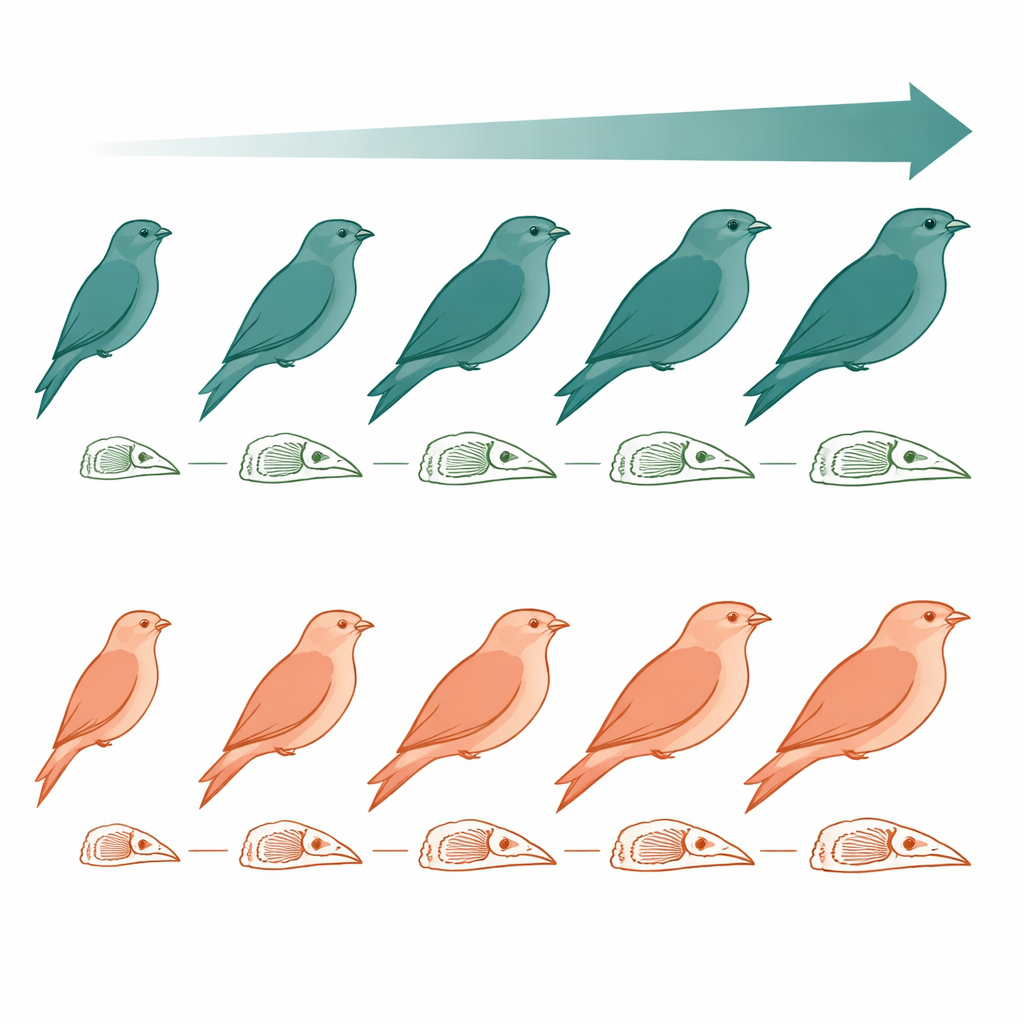
Statistical tests showed that, even at this early age, male and female swifts do not have exactly the same skull shape. The difference is small – explaining less than two percent of the total variation – but it is real. In contrast, overall skull size was virtually identical between sexes. When the researchers explored patterns of shape variation, they found that the main directions of change in their data only weakly separated males from females. This suggests that sex-linked differences are present but hidden among many other influences on skull form, such as individual growth history and environment. The skulls seem to be adjusting in shape rather than simply getting larger or smaller in one sex.
Weight matters more than length
One of the clearest signals came from body weight. Heavier juveniles, especially males, showed distinctive shifts in skull shape, including subtle front-to-back elongation related to the beak and eye region. Weight explained noticeably more of the variation in skull form than did simple linear measures like skull length. In fact, skull length itself had little to no detectable effect on shape for either sex. This pattern hints that overall body condition – how much tissue a young bird is carrying – may influence how the head grows to handle the forces of feeding and flying, whereas mere stretching of the skull from front to back is less important at this stage.
What this means for growing fliers
For a lay observer, the skulls of young alpine swifts would look almost identical, regardless of sex. Yet this study shows that beneath that apparent uniformity, males and females are already diverging slightly in how their heads are built, and that these differences are tied more to body weight than to simple size measurements. In other words, how heavy a young swift is says more about the shape of its skull than how long its head is. These findings suggest that early development emphasizes fine-tuning of form over dramatic changes in size, likely to keep young swifts aerodynamically efficient as they prepare for a lifetime on the wing. The work lays a foundation for future studies linking growth, environment, and subtle head shape differences to the impressive aerial abilities of these birds.
Citation: Szara, T., Günay, E., Çakar, B. et al. Assessing cranial morphology for sex determination in juvenile alpine swifts (Tachymarptis melba). Sci Rep 16, 10365 (2026). https://doi.org/10.1038/s41598-026-41421-6
Keywords: alpine swift, bird skull shape, sexual dimorphism, juvenile birds, 3D morphometrics