Clear Sky Science · en
Traffic pattern-adaptive channel allocation in cognitive radio networks via multi-scale windowing
Why your phone’s connection can suddenly get crowded
Anyone who has watched a video freeze or a call drop during rush hour has felt that wireless airwaves are limited. Our devices all compete for the same invisible “roads” in the sky, and traffic can swing from quiet to jammed in seconds. This paper explores a smarter way for wireless networks to share those roads, especially when many devices must wait politely behind higher-priority users, as in next‑generation cognitive radio systems.
Who gets first dibs on the airwaves
Modern wireless networks often reserve parts of the spectrum for licensed, high‑priority users such as cellular operators or broadcast services. These primary users always go first. Lower‑priority secondary users are allowed to slip into the gaps only when those licensed channels fall silent. In theory, this “use the leftovers” approach should boost overall efficiency. In practice, primary users come and go unpredictably, and the wireless channel itself fades in and out. On top of that, the data demand from secondary users can swing sharply between calm and bursty periods. Together, these effects make it hard to decide, moment by moment, which device should be granted which open channel.
Why simple traffic models fall short
Most earlier schemes treat the arrival of data from secondary users as if it were smooth and random in a very simple way, similar to raindrops hitting the ground. That makes the math easier but ignores the reality that people and apps often generate data in bursts: a sudden upload, a busy messaging period, or a software update. Past work also tended to look at only one aspect at a time—say, how many packets are waiting in line, or how often a licensed user reclaims a channel—rather than the full combination of primary‑user activity, channel quality, and secondary‑user queues. As a result, existing channel‑allocation rules can be slow to notice traffic spikes, leading to overloaded buffers and more dropped packets when the network is under stress.
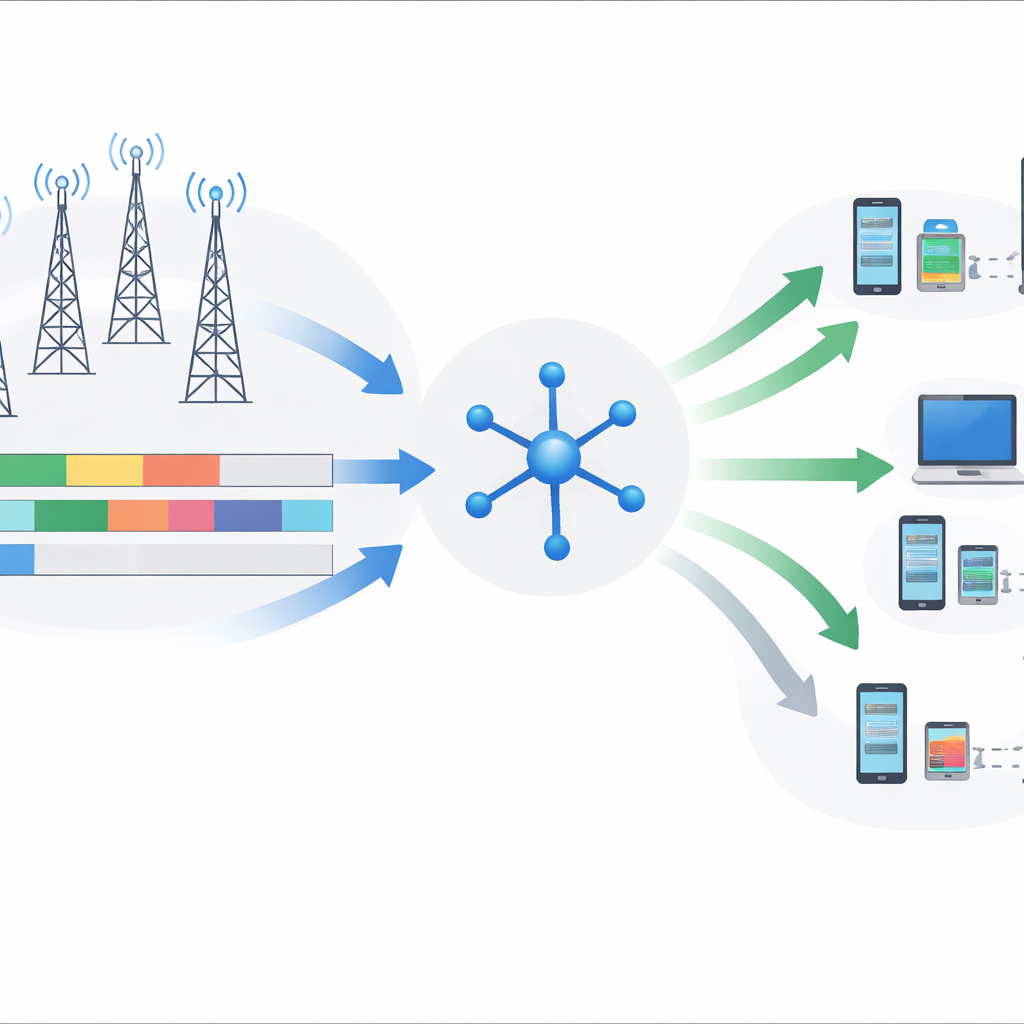
A new way to watch traffic at multiple time scales
The authors propose a new Traffic Pattern‑Adaptive Allocation (TPA) protocol that pays close attention to how secondary‑user traffic changes over time. Instead of relying on a single, fixed‑length observation window, TPA watches the flow of incoming packets through several overlapping windows of different lengths. Short windows are quick to spot sudden bursts, while long windows capture slower trends. The protocol assigns each window a weight based on how long it is and how much traffic it sees, then fuses these views into a refined estimate of the current load. Using this information, it classifies the ongoing traffic for each user into two broad modes: a normal state and a bursty state, each with its own typical arrival pattern.
From traffic patterns to smarter channel sharing
Once TPA has a good sense of whether traffic is calm or bursting, it feeds that knowledge into a unified mathematical framework that also tracks how often licensed users occupy each channel, how good the channel conditions are, and how full each secondary user’s buffer has become. All of these ingredients are woven together in a Markov and queueing‑theory model that describes how the network state evolves over discrete time steps. The key practical tool in this framework is a Probability Allocation Vector, which encodes, in one object, the chances of giving each available channel to each secondary user under different conditions. Because the vector is updated based on recent traffic patterns, the protocol can pre‑emptively shift channel assignments as bursts emerge, instead of reacting only after queues have already grown too long.
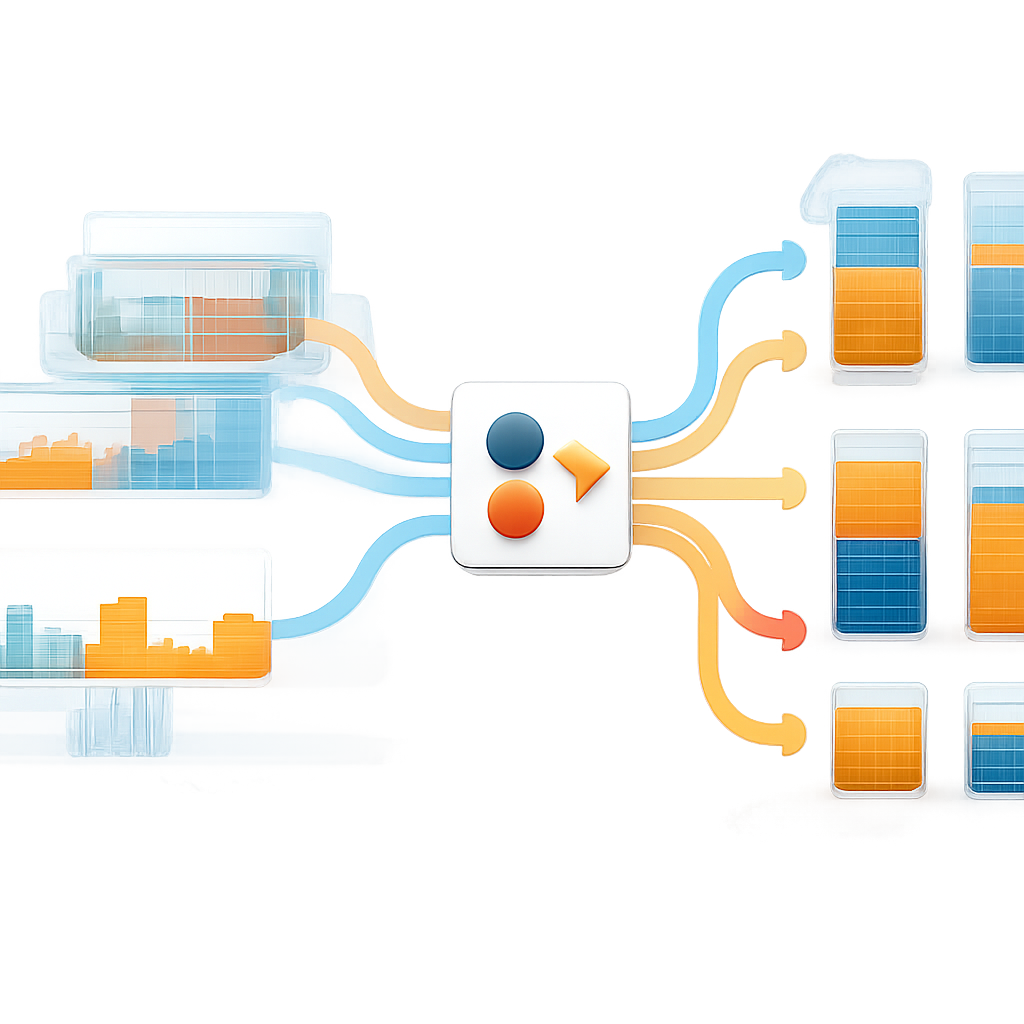
Putting the new protocol to the test
To understand how well TPA performs, the authors run detailed numerical experiments on a small but representative network with two licensed channels and two secondary users. They compare their method against a well‑known benchmark called the Maximum Throughput Allocation (MTA) protocol, which focuses on squeezing out as much data as possible in each instant but does not adapt to multi‑scale traffic patterns. Across three sets of tests—varying the size of the secondary users’ buffers, how often primary users occupy the channels, and how quickly channel quality changes—they compute two crucial measures: how many packets are successfully sent per time step (throughput) and how many packets are discarded because buffers fill up (rejection rate). In every scenario, TPA delivers higher throughput and consistently fewer discarded packets than MTA, especially when traffic is bursty or channel conditions are unstable.
What this means for everyday wireless users
In plain terms, the study shows that paying attention to traffic patterns at multiple time scales lets a network make smarter, more timely decisions about who uses which part of the spectrum. By combining this traffic awareness with a joint view of licensed‑user behavior, channel quality, and device queues, the TPA protocol keeps more data flowing and lets fewer packets fall through the cracks. While the detailed model is computationally heavy and was tested on a small setup, the underlying idea—traffic‑pattern‑aware sharing of scarce airwaves—points toward future wireless systems that can better handle busy, unpredictable demand without wasting valuable spectrum.
Citation: Min, Z., Ziru, W., Jinyuan, B. et al. Traffic pattern-adaptive channel allocation in cognitive radio networks via multi-scale windowing. Sci Rep 16, 10188 (2026). https://doi.org/10.1038/s41598-026-41417-2
Keywords: cognitive radio, dynamic spectrum access, traffic modeling, channel allocation, queueing theory