Clear Sky Science · en
Effects of selected nuts on the biology of Trogoderma granarium Everts
Why a tiny beetle in your pantry matters
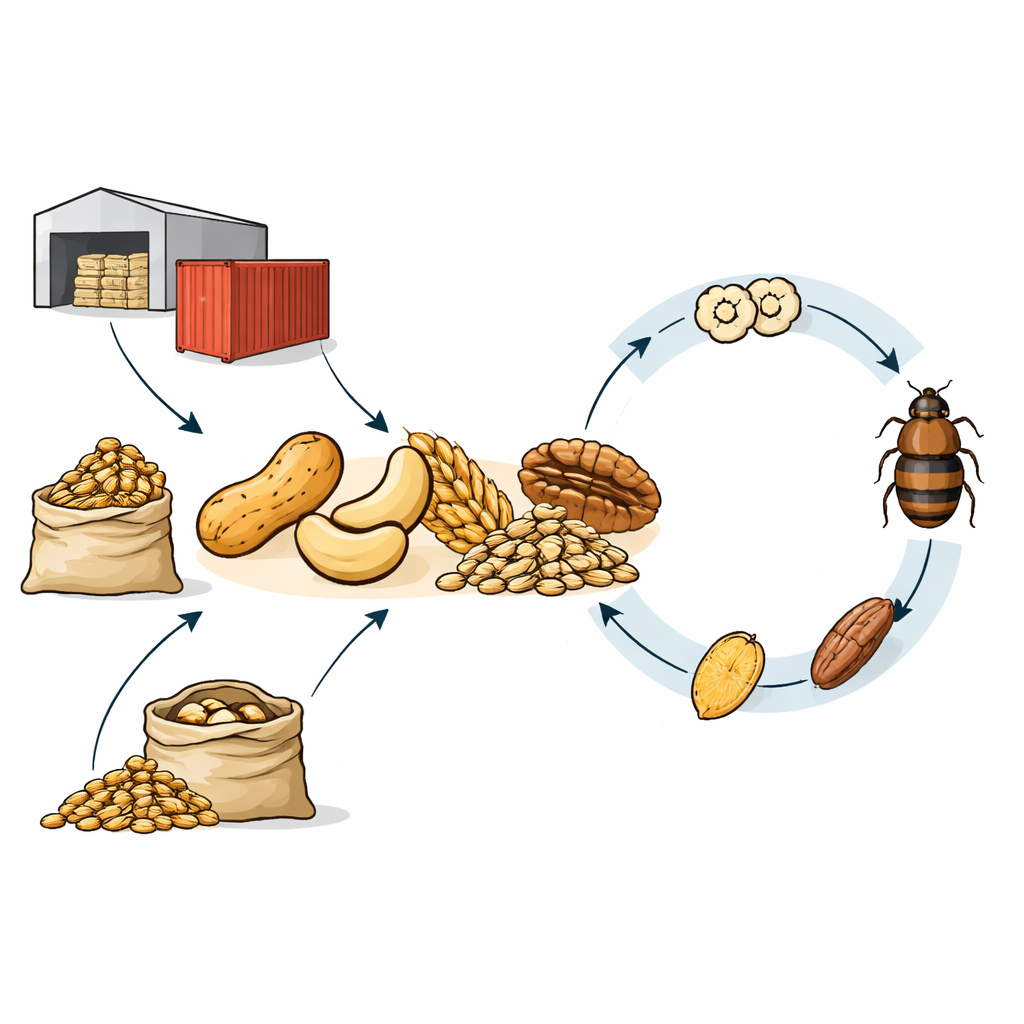
Many of the foods people store for long periods—like wheat, peanuts, and mixed nuts—can quietly harbor a small but destructive insect called the khapra beetle. This beetle can ruin up to two thirds of stored food and is so hard to control that many countries treat it as a top quarantine threat. The study summarized here asks a very practical question with global trade and kitchen cupboards in mind: when it comes to nuts, which types let this beetle thrive, and which slow it down?
A quiet hitchhiker in global food trade
The khapra beetle feeds on many dry foods, especially grains, and has spread worldwide mainly through trade. Once it reaches a warm, dry warehouse, population numbers can explode, and routine insecticides often fail because the beetle readily develops resistance. Earlier work looked mostly at grain crops, but evidence showed that the beetle can also live on nuts and other non-grain products. Because nuts are now traded and consumed globally, understanding how well the beetle survives and reproduces on different nut types is essential for designing smart inspection and storage strategies.
Putting nuts to the test
The researchers compared four common nuts—peanuts, cashews, pine nuts, and pecans—with wheat as a reference food. They reared beetle colonies on each food for several generations so that the insects could adjust to their new diet. Then they followed individual beetles from egg to adult, carefully recording how long each stage lasted, how many survived, and how many eggs females laid. Using a demographic approach known as an age–stage, two-sex life table, they converted these observations into population statistics such as how many offspring an average beetle produces and how long it takes a population to double.
Fast growth on some nuts, slow on others
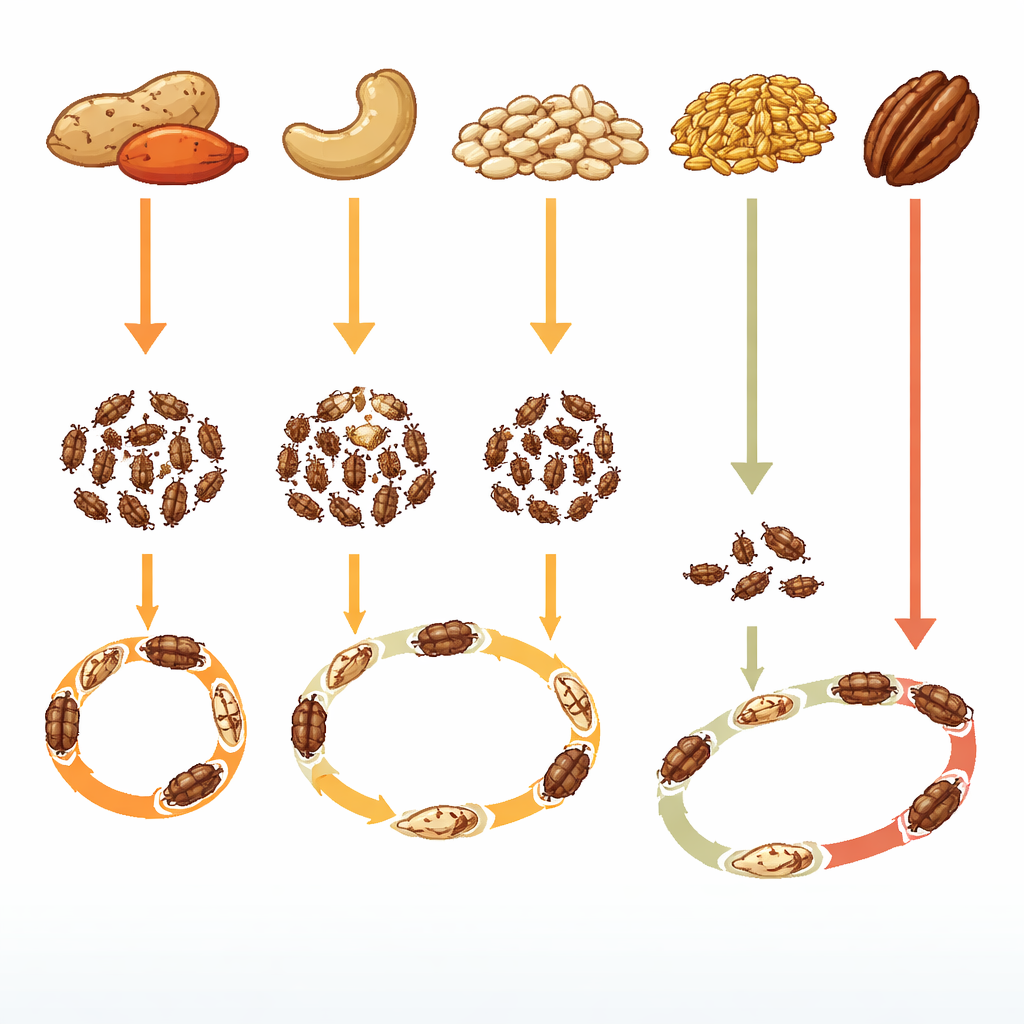
The results show a clear divide between nuts that are highly favorable and those that are less so. Peanuts and cashews, along with wheat, allowed the beetle to develop relatively quickly and produce many offspring. Females raised on peanuts and cashews laid roughly twice as many eggs as those raised on pine nuts and pecans, and more young beetles survived to adulthood. Overall, it took around two months for eggs to become adults on peanuts, slightly longer on cashews, and nearly three months on pine nuts and pecans. Population measures reflected this pattern: net reproductive rate was much higher and generation time shorter on wheat, peanuts, and cashews than on the other two nuts, meaning populations on these foods can build up faster and reach damaging levels sooner.
Slower hosts are not safe hosts
Pine nuts and pecans did not stop the beetle from completing its life cycle, but they did slow it down. Larval and pupal stages were longer and survival was lower, leading to fewer adults and slower population growth. From a biological standpoint, these foods are less suitable, likely because they do not provide the same quality or balance of nutrients as peanuts, cashews, or wheat. However, the prolonged larval stage on pine nuts and pecans could still pose a risk: the larvae are the main stage that spreads in shipments and are also relatively difficult to kill with insecticides. This means that even "less favorable" nuts can act as vehicles for the beetle to move into new regions.
What this means for food safety and trade
For a non-specialist audience, the take‑home message is straightforward: the khapra beetle can live on all four tested nuts, but it thrives on peanuts and cashews. In warm, dry storage conditions, these nuts and wheat provide ideal conditions for rapid build‑up of hidden infestations. To protect food supplies and international trade, the authors argue that pest management should be risk‑based, focusing intensive sanitation, monitoring, and treatment on wheat, peanuts, and cashews, while still watching pine nuts and pecans as potential pathways for introduction. Their findings can also guide laboratories that need to rear beetles for testing, by pointing to the most efficient diets. Overall, understanding how this beetle responds to different nuts helps regulators, industry, and even household consumers better anticipate where trouble is most likely to start and how to reduce the chances of serious losses.
Citation: Khan, H.A.A., Bukhari, M. Effects of selected nuts on the biology of Trogoderma granarium Everts. Sci Rep 16, 10190 (2026). https://doi.org/10.1038/s41598-026-41415-4
Keywords: khapra beetle, stored food pests, nuts and grains, postharvest protection, invasive insects