Clear Sky Science · en
A pilot study of a mobile application for postural analysis and training support in Shotokan Karate
Bringing Karate Coaching into Your Pocket
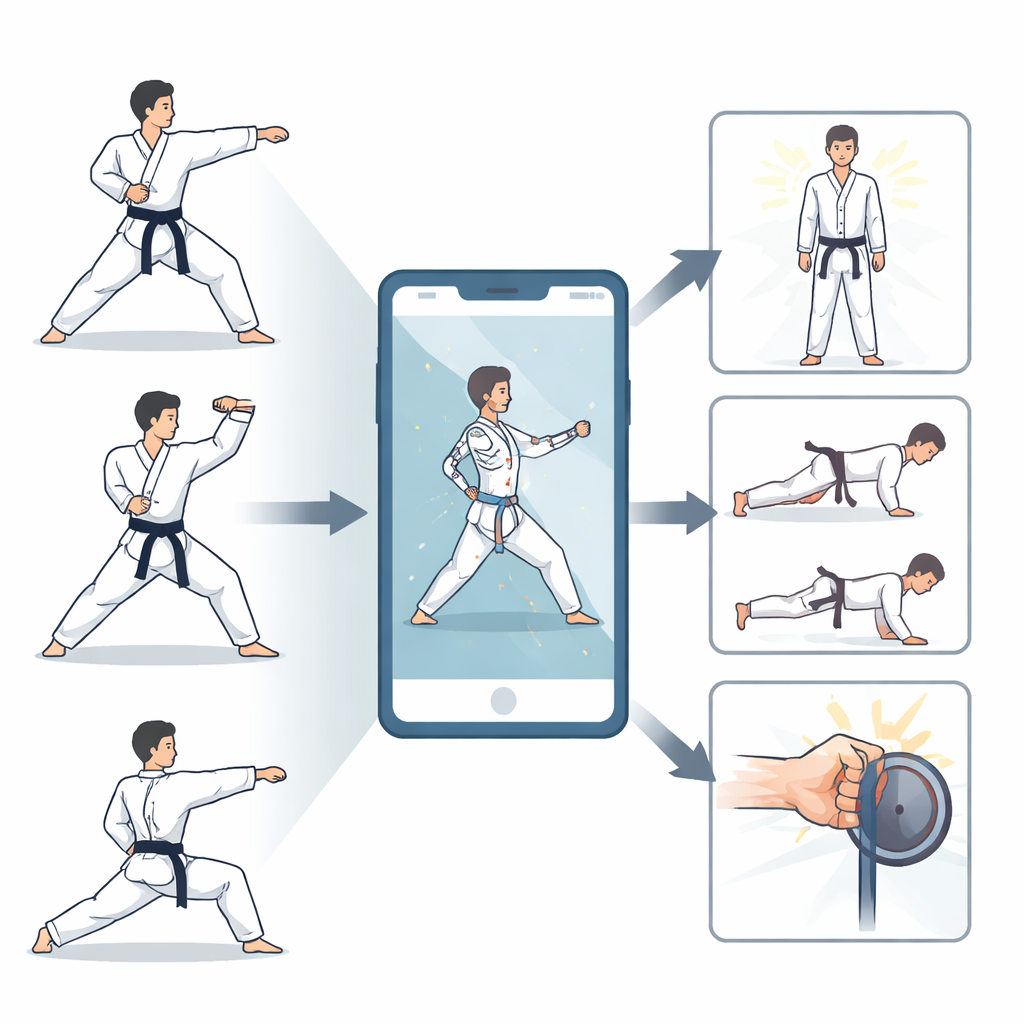
For many karate students, the hardest part of training at home is knowing whether their stance is truly correct. This study explores a simple idea with big potential: using an ordinary smartphone to watch your posture and offer instant guidance, much like a digital assistant coach. By turning the phone’s camera and built‑in artificial intelligence into a posture checker, the researchers aim to give Shotokan Karate practitioners a way to practise safely and more effectively between classes.
Why Stance Matters in Karate
Shotokan Karate places great emphasis on how you stand. Stable, well‑aligned stances are the base for powerful strikes and for avoiding injury. Traditionally, students learn by copying their instructor and receiving verbal corrections. That means feedback is often subjective and disappears once a lesson ends. When training alone at home, it can be difficult to notice small mistakes such as leaning too far, bending the knees unevenly, or placing the feet at the wrong distance. The authors argue that a low‑cost, objective tool that highlights such details could make independent practice both safer and more productive.
How the App Watches and Judges Your Moves
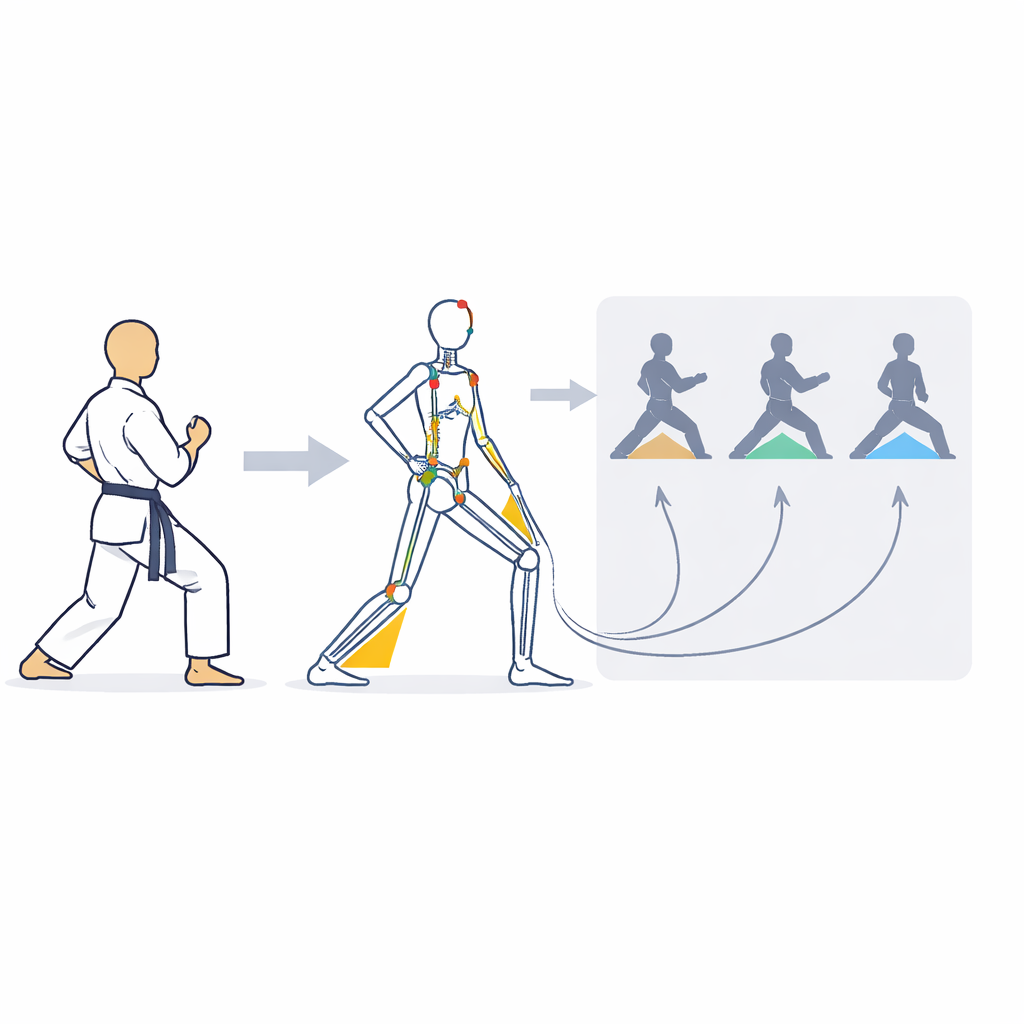
The team built a mobile application that works on common Android and iOS phones. Using Google’s ML Kit Pose Detection, the camera identifies 33 points on the body—such as shoulders, hips, knees and ankles—without any markers or special suits. From a sideways view, the app calculates angles at the hips, knees and ankles and checks how the torso lines up over the feet. These measurements are turned into simple rules that mirror traditional teaching for three core stances: Zenkutsu Dachi (forward stance), Kokutsu Dachi (back stance) and Kiba Dachi (horse stance). If the front knee bends more than the back knee and the body stays upright over a wide base, for example, the app recognises a forward stance; if both knees bend similarly with a wide side‑on base, it signals the horse stance.
More Than Stances: Exercises and a Reflex Game
Beyond static posture, the app also supports basic conditioning and reaction training. For squats, it watches how the knee angle changes as the user lowers and rises, ticking off a repetition when the movement passes clearly through “top” and “bottom” positions. For push‑ups, it looks at elbow bend and the straightness of the body. A simple game asks the user to throw a punch toward an on‑screen target; the phone measures how quickly the hand moves after the cue appears. All these activities feed into a statistics screen that shows how many correct stances or repetitions the user has achieved over time, helping them track their progress without storing any identifying video.
What the Pilot Test Actually Showed
To see whether the idea worked at all, the researchers ran a tightly controlled pilot with just one adult participant. The person performed the three target stances plus squats and push‑ups in a well‑lit indoor setting while the camera stood 1.5 metres away at a right angle. An experienced Shotokan instructor reviewed selected video frames and estimated key joint angles, which were then compared with the app’s own estimates. On average, the app’s knee and shin angles differed from the expert’s values by only a few degrees under these ideal conditions, and the stance labels usually matched the instructor’s judgement. However, the study also exposed weaknesses: the system struggled when joints were partially hidden, when the torso was not centred, or when users paused awkwardly during exercises, sometimes missing or inventing repetitions.
Limits, Lessons, and the Road Ahead
Because this was a single‑person feasibility test, the authors stress that their results are only an early demonstration, not proof that the app is reliable for all karateka. The system assumes a fixed side‑on camera angle, good lighting, and a clear view of the whole body—conditions that may not hold in a busy dojo or a cramped living room. It also uses fixed cut‑off values for angles that may not suit every body type or style variation. The next step, the authors argue, is a larger study with at least 30 practitioners across beginner, intermediate and advanced levels, multiple instructors providing independent ratings, and more rigorous statistical checks of accuracy and consistency. Even so, this pilot suggests that everyday phones can one day offer meaningful, real‑time feedback on karate posture and basic conditioning, acting as a helpful companion rather than a replacement for a human sensei.
Citation: Silva, C.M., Pataca, A.O., Branco, F. et al. A pilot study of a mobile application for postural analysis and training support in Shotokan Karate. Sci Rep 16, 11129 (2026). https://doi.org/10.1038/s41598-026-41414-5
Keywords: Shotokan Karate, mobile training app, pose estimation, posture analysis, markerless motion capture