Clear Sky Science · en
Dramatic changes induced on porous silicon birefringence by shape-dependent properties
Light through a sponge like crystal
Many technologies from smartphone cameras to fiber networks rely on controlling how light waves vibrate as they travel. This study looks at a special "sponge" form of silicon, called porous silicon, and shows how tiny changes in the shape and density of its nano sized holes can dramatically change the way it bends and twists light. Understanding and tuning this effect could help build compact optical parts for sensors and communication devices that rely on the polarization of light.
What makes porous silicon special
Porous silicon is ordinary silicon that has been etched until it is full of nanometer scale pores, a bit like a rigid sponge. Because it has a huge internal surface area and its structure can be finely tuned, it is already used or explored for biosensors, drug delivery, and optical components. In bulk form, silicon treats light the same in every direction. Once it becomes porous, however, the ordered forest of pores can make light behave differently depending on how it is polarized, an effect known as birefringence. In this work, the authors focus on porous layers made on silicon wafers cut in a specific way, called the (100) orientation, to see how pore shape and porosity control this directional optical response.
How tiny holes steer light
Even though silicon itself is optically uniform, arranging it as an array of aligned pores creates a pattern that light “feels” as it travels. When light passes along the main direction of the pores, it experiences one effective refractive index; when its electric field points across the pores, it experiences another. This structural origin of birefringence is called form birefringence. By combining basic rules for reflection and refraction with measurements of colored light reflected from thin porous films at several angles, the team extracted both the thickness of the films and an effective refractive index that encodes how differently the material responds to the two polarization states.
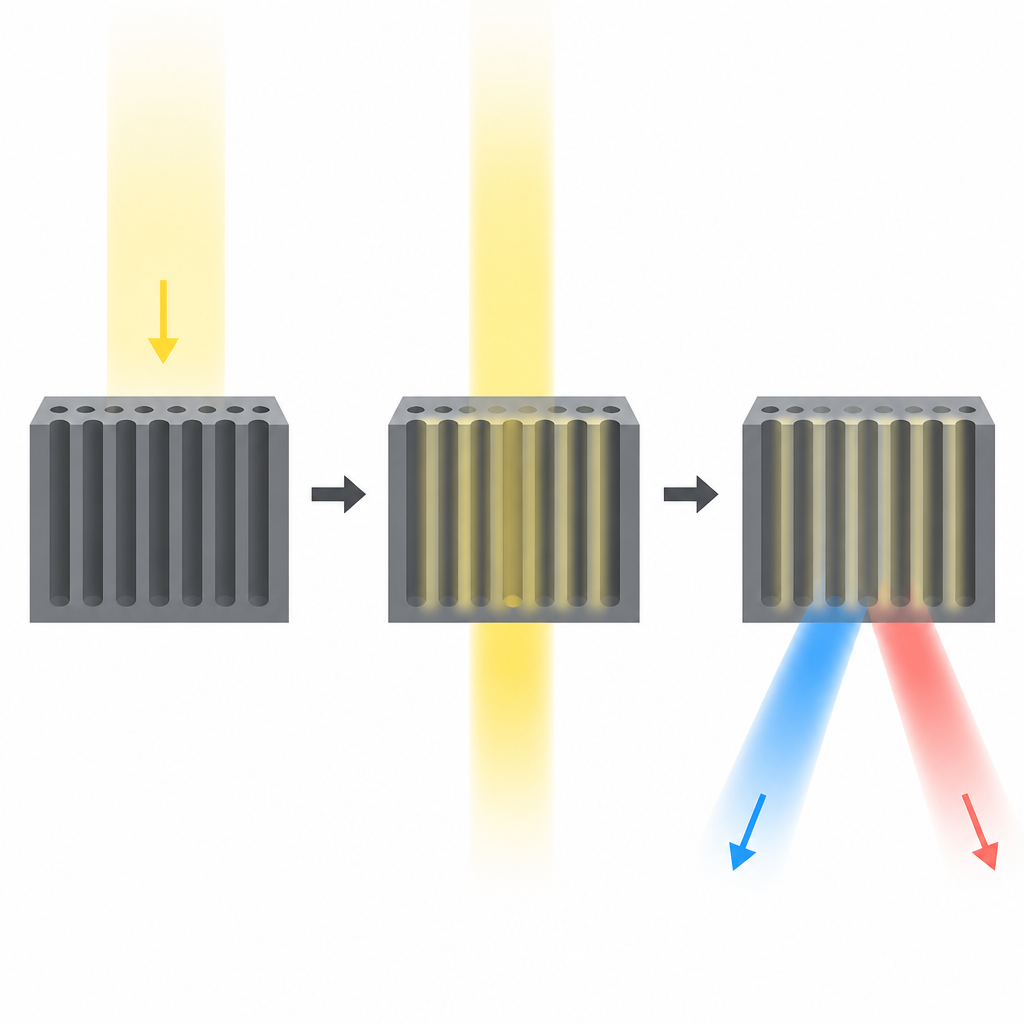
Measuring the role of pore shape and porosity
The researchers fabricated many porous silicon layers on highly doped (100) wafers using electrochemical etching in hydrofluoric acid under different conditions. Electron microscope images reveal that they could vary pore diameter, branching and overall void fraction (porosity) almost independently. They then measured how the effective refractive index changed with wavelength and with the angle at which light hit the samples. All the studied samples showed what is called negative birefringence, meaning the polarization state that “sees” the pores along one direction experiences a lower refractive index than the one across them. The strength of this effect increased markedly with porosity, indicating that more extreme structural anisotropy leads to stronger polarization dependent behavior.
Tuning the response with chemistry and membranes
To test how surface chemistry influences light control, some samples were partially oxidized, turning part of the silicon skeleton into silicon dioxide. This treatment lowered the overall refractive index, as expected, but slightly increased the difference between the two polarization responses. The group also fabricated free standing porous silicon membranes about 15 micrometers thick, transparent in the red part of the spectrum. When a red laser beam passed through a membrane at different tilt angles, its polarization changed from linear to elliptical and finally to nearly circular. At a specific angle, the membrane behaved like a quarter waveplate, a standard optical element that converts linear into circular polarization, with a very high degree of control.
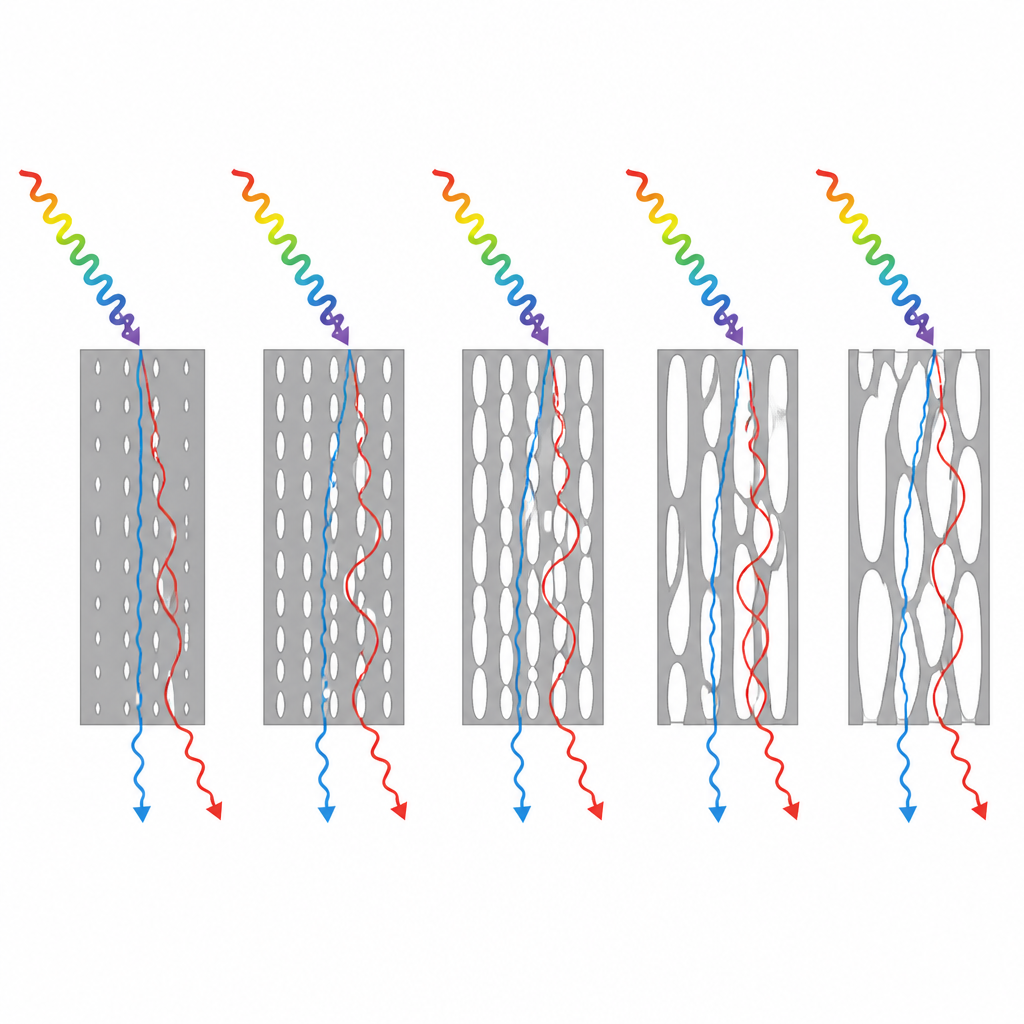
Why this matters for future devices
The study shows that even when starting from similar materials and orientations, small differences in pore geometry, porosity, doping and oxidation can flip or greatly alter the sign and strength of birefringence in porous silicon. Existing theoretical models, which treat the complex structure as a simple average medium, cannot yet fully explain why a given sample becomes positively or negatively birefringent. Nonetheless, this sensitivity is a feature for applications: by engineering the internal architecture, designers can build porous silicon components that finely tune light polarization. Such control opens paths to compact optical sensors and polarization based devices where subtle structural or chemical changes inside the pores are translated into easily measured changes in how the material handles polarized light.
Citation: Mula, G., Akhtar, M.N., Pisu, F.A. et al. Dramatic changes induced on porous silicon birefringence by shape-dependent properties. Sci Rep 16, 15198 (2026). https://doi.org/10.1038/s41598-026-41405-6
Keywords: porous silicon, birefringence, light polarization, nanostructured materials, optical sensors