Clear Sky Science · en
Research on innovative furniture design methods combining Huizhou window grilles with digital technology
Bringing Old Windows into Everyday Life
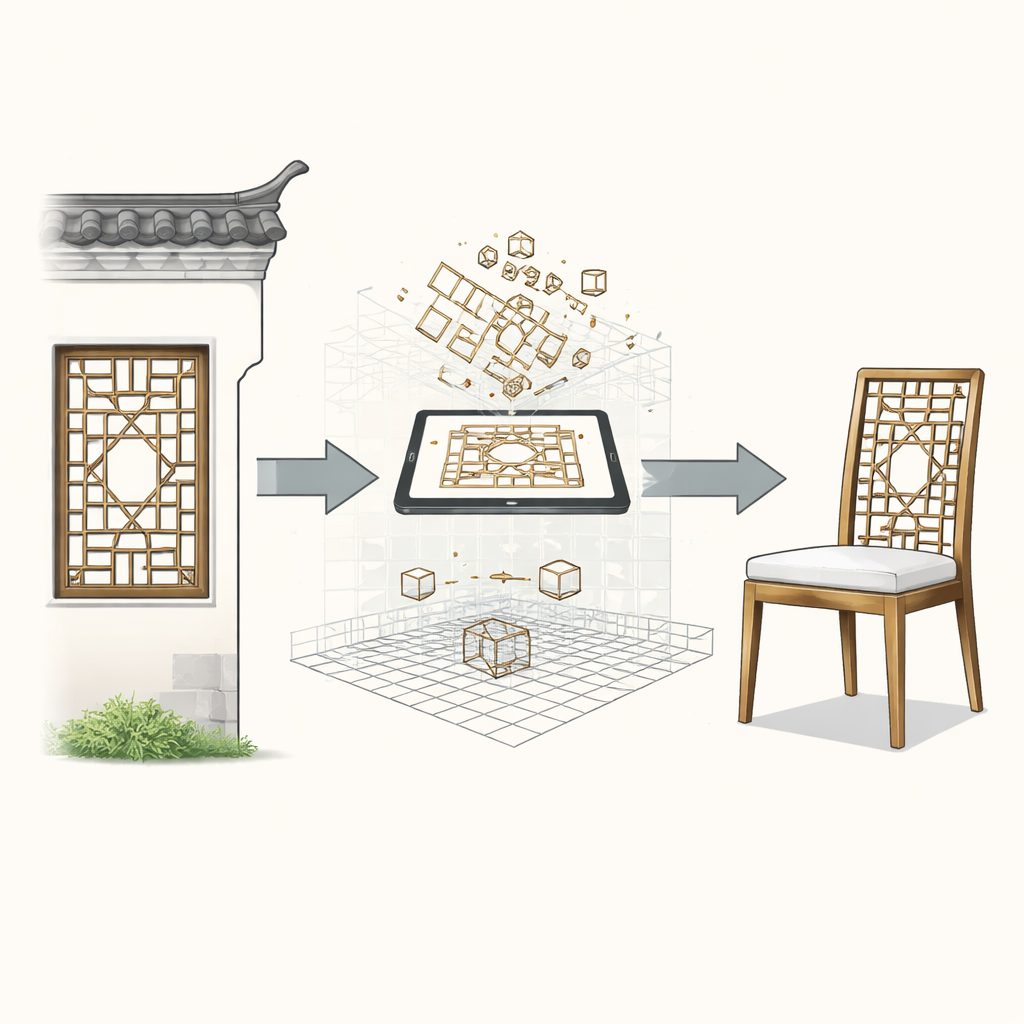
Imagine sitting on a dining chair that quietly carries the story of an ancient Chinese house. This study shows how the delicate lattice patterns from Huizhou’s traditional window grilles can be reborn as modern furniture that is not only beautiful but also comfortable, durable, and easy to manufacture. By combining careful cultural research with advanced digital tools, the authors chart a path for turning architectural heritage into practical objects for today’s homes.
Why Traditional Patterns Still Matter
For centuries, Chinese furniture and architecture have shared a common “family resemblance” in their curves, joints, and patterns. Today, as people look for more meaning in their surroundings, they want furniture that does more than offer a place to sit—it should also reflect local culture and values. Designers have tried using computers to copy traditional patterns onto tables and cabinets, but these efforts often stay at the level of surface decoration. Many digital designs cannot be built, do not feel comfortable, or lose the deeper cultural spirit behind the original motifs. The paper argues that what is missing is a complete, reliable method that connects cultural understanding, human comfort, and factory production.
A Three-Step Path from Wall to Chair
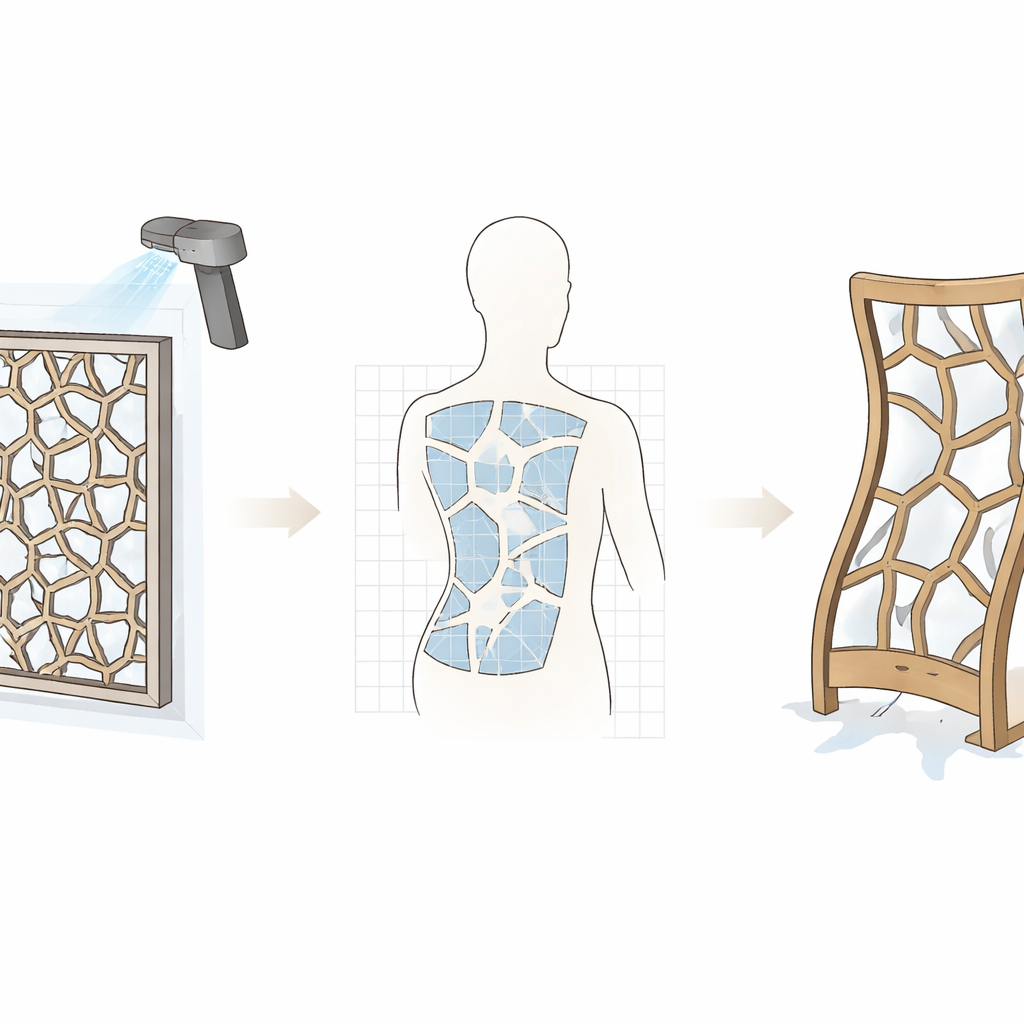
The researchers propose a three-stage method they call “Element Deconstruction – Parametric Mapping – Process Adaptation.” First, they break down a traditional element into precise digital information. Using high-accuracy 3D laser scanning, they capture the exact shapes, angles, and fine details of Huizhou’s “crackle glaze” window lattice, turning the wooden grille into a detailed digital model. This step preserves not only the overall pattern but also the subtle chamfers and intersections that give the original window its character. The result is a library of measurable features that can be reused in different designs instead of a one-off copy.
Translating Meaning into Comfort and Function
Next, the team “maps” this digital pattern to human needs and cultural meaning. They study how the geometry of the window can be scaled and adjusted to fit the size and shape of a dining chair back, while also supporting the spine and allowing air to flow. User tests show which feelings the pattern evokes—such as resilience, lightness, and a sense of openness—and these impressions guide choices of color and material, like a blue-grey frame and translucent inserts that echo traditional Huizhou walls and daylight. Ergonomic experiments with volunteers, combined with computer simulations, identify an ideal spacing of the lattice so that back pressure is spread evenly and people feel more comfortable during everyday tasks such as reading or working at a desk.
Making Heritage Fit the Factory
The final stage focuses on the workshop floor. Here, the authors check whether the adapted pattern can actually be carved, assembled, and used for years without failing. They build databases of traditional patterns, structural joints, and past case studies, and link them to rules that describe machine limits, costs, assembly times, and material behavior. For example, they adjust line widths so that laser cutters can follow the curves cleanly, fine‑tune classic mortise‑and‑tenon joints to reach higher strength, and compare solid wood with a glass‑and‑wood composite that bends less under heavy loads. These changes are tested through mechanical analysis, repeated loading, and trial runs in real guesthouses, where users rate comfort and the sense of cultural atmosphere.
What This Means for Future Homes
By the end of the study, the reimagined dining chair backrest inspired by Huizhou window grilles scores higher on cultural recognition, feels cooler and more comfortable, wastes less material, and lasts longer than a straightforward copy of the old pattern. Instead of treating tradition as a fixed ornament, the method treats it as a flexible set of rules that can be measured, adjusted, and verified from sketch to final product. For everyday users, this means that future furniture could carry visible traces of historic buildings while still fitting modern bodies, budgets, and manufacturing lines—allowing cultural heritage to live on not just in museums and tourist sites, but in the chairs we sit on at home.
Citation: Wang, W., Zhao, J., Wang, X. et al. Research on innovative furniture design methods combining Huizhou window grilles with digital technology. Sci Rep 16, 11207 (2026). https://doi.org/10.1038/s41598-026-41397-3
Keywords: Huizhou window lattice, digital furniture design, cultural heritage, parametric modeling, ergonomic chair design