Clear Sky Science · en
Mechanistic investigation of ammonium nitrogen adsorption on low-temperature pyrolysis cotton stalk biochar based on DFT calculations
Turning Farm Waste into Clean Water and Fertilizer
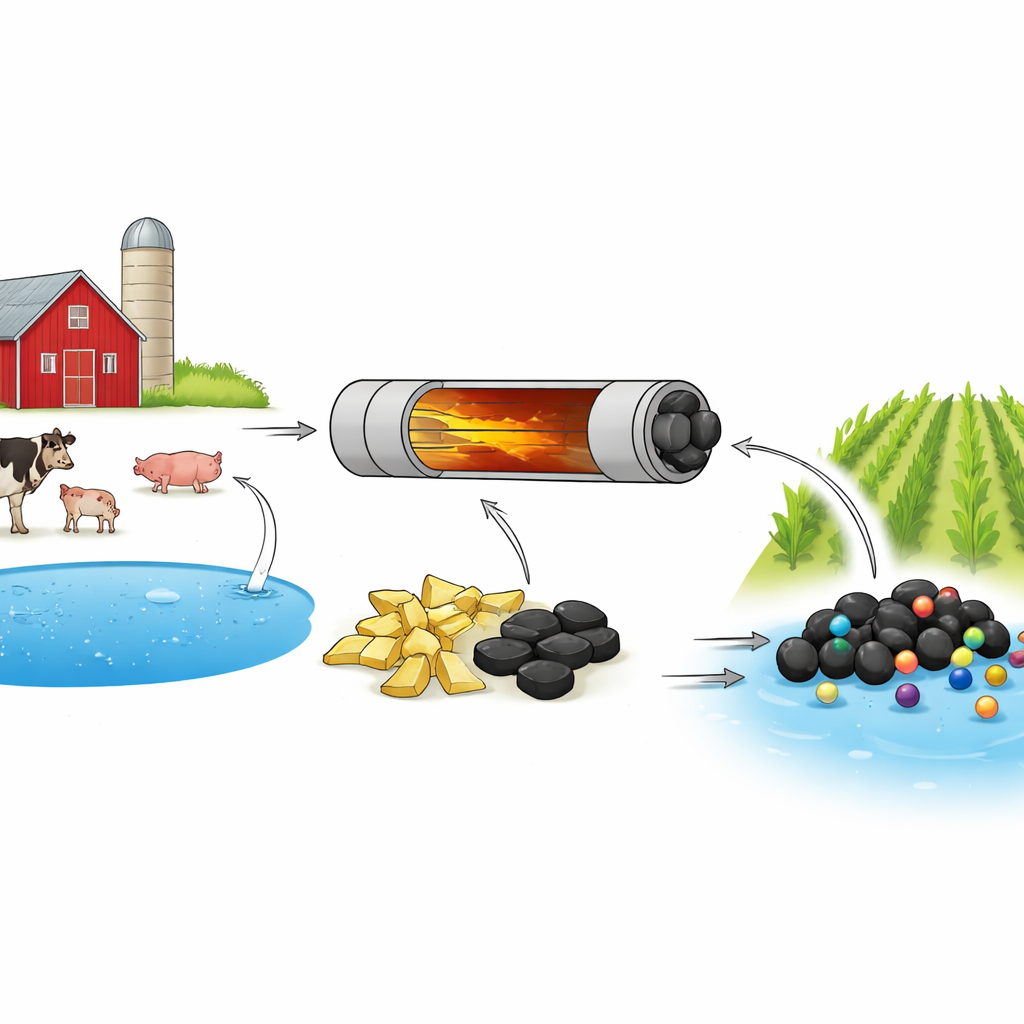
Across the world, huge livestock operations generate wastewater rich in nitrogen. If this nitrogen is not captured, it can leak into rivers and groundwater, fueling algal blooms and contaminating drinking water. At the same time, farmers burn or discard mountains of crop residues such as cotton stalks. This study explores a way to tackle both problems at once: transforming cotton stalks into a simple charcoal-like material that can pull ammonium, a key form of nitrogen, out of animal wastewater and then return it to the soil as a slow-release fertilizer.
From Cotton Fields to Charcoal Pellets
The researchers collected leftover cotton stalks from Xinjiang, China, and heated them in a low-oxygen furnace at relatively mild temperatures between 250 and 350 degrees Celsius. This process, known as pyrolysis, converts plant matter into biochar, a carbon-rich solid. The team produced several versions, including a standout sample made near 300 degrees Celsius, labeled CS300II. They then tested how well each biochar could soak up ammonium from water, and carefully measured properties such as surface area, pore size, ash content, and the types of chemical groups on the surface.
How the Char Works in Real and Test Waters
In simple laboratory solutions containing only ammonium, the CS300II biochar performed best, capturing about 4.3 milligrams of ammonium nitrogen per gram of char and following well-known adsorption models that describe a uniform layer of ammonium on the surface. Although this capacity is modest compared with high-tech engineered materials, the biochar is cheap, made from waste, and requires little energy to produce. When the same material was exposed to real cow manure wastewater, its performance dropped to roughly 40–60 percent of the laboratory value. The reason is that the real wastewater also contains large amounts of other positively charged ions such as potassium, calcium, sodium, and magnesium, which compete with ammonium for the limited binding spots on the char surface.
Why a “Just Right” Temperature Matters
Microscope images and basic measurements showed that all of the low-temperature biochars had extremely small surface areas compared with typical activated carbons. This means that the char does not work mainly by trapping ammonium in tiny pores, but by chemical interactions on its surface. As the pyrolysis temperature increased, the biochar became more carbon-rich and more negatively charged, and its ash content—containing minerals like potassium and calcium—grew. At the same time, some helpful oxygen-containing groups, such as carboxyl and hydroxyl groups, were gradually burned away. The CS300II sample hit a sweet spot: enough mineral content and negative charge to attract and swap ions, while still retaining plenty of reactive surface groups for binding ammonium.
What Happens at the Atomic Scale
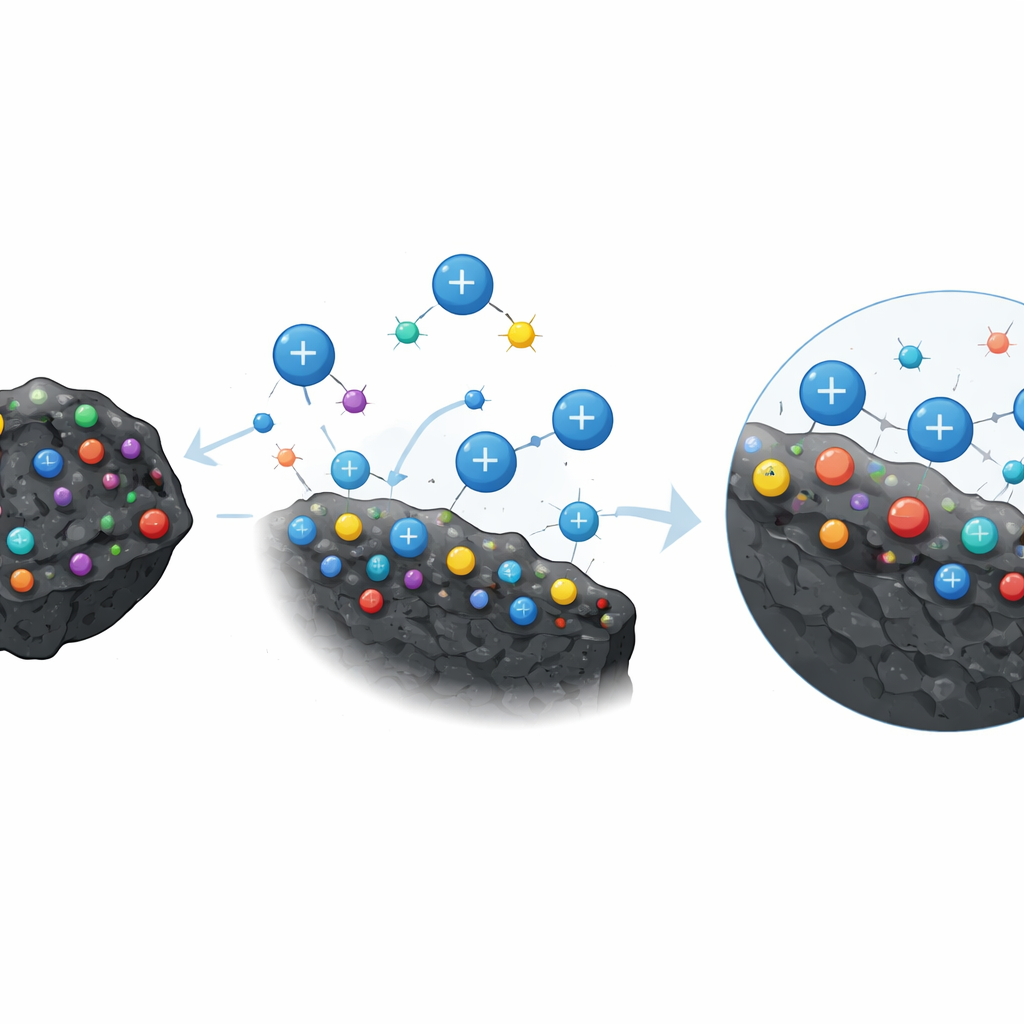
To peek beneath the bulk measurements, the team combined several spectroscopic techniques with quantum chemical calculations. X-ray and infrared measurements before and after ammonium exposure revealed that mineral salts on the biochar dissolve and trade places with ammonium in the water, and that key oxygen-containing groups on the surface weaken as they bind nitrogen. The calculations, carried out on simplified model surfaces, ranked different chemical groups by how strongly they could hold ammonium. Two stood out: pyridine-like nitrogen atoms built into the carbon framework, and carboxyl groups. These sites form strong hydrogen bonds and electrostatic attractions with ammonium, giving them a larger share of the work than other groups such as simple hydroxyls.
Closing the Loop from Wastewater to Crops
Taken together, the experiments and calculations point to a multi-step picture of how ammonium sticks to low-temperature cotton stalk biochar. First, mineral ions in the char’s ash trade places with ammonium in the water. Then, negatively charged sites and specific chemical groups on the surface draw ammonium close and hold it through electrostatic attraction and hydrogen bonding, with weaker forces playing a supporting role. The resulting ammonium-loaded char can be spread directly on fields, where it slowly releases nitrogen to crops and may help cut greenhouse gas emissions from fertilizer use. While more work is needed on long-term stability and large-scale performance, this study lays out clear design rules—especially the importance of pyridine-like nitrogen and carboxyl groups—for turning simple crop residues into efficient tools for cleaning water and recycling nutrients.
Citation: Li, S., Li, P., Jia, L. et al. Mechanistic investigation of ammonium nitrogen adsorption on low-temperature pyrolysis cotton stalk biochar based on DFT calculations. Sci Rep 16, 11965 (2026). https://doi.org/10.1038/s41598-026-41396-4
Keywords: biochar, ammonium removal, livestock wastewater, nutrient recovery, cotton stalks