Clear Sky Science · en
Design of a microwave sensor for non-invasive monitoring of blood glucose level with high sensitivity using electromagnetic properties
Why a gentler glucose test matters
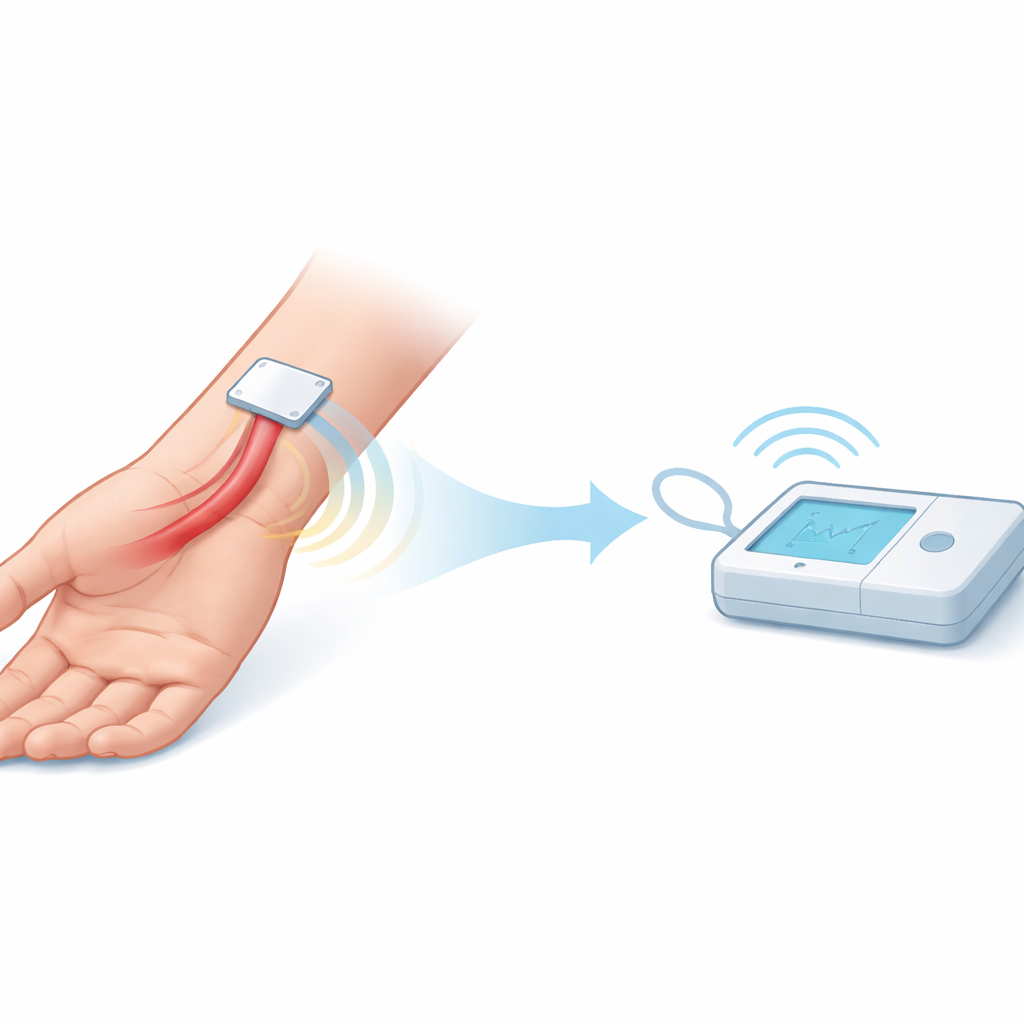
For people living with diabetes, checking blood sugar often means needles, finger sticks, and discomfort—sometimes many times a day. This paper explores a very different approach: using harmless radio waves, similar to those in Wi‑Fi routers, to sense blood sugar from outside the body. The authors present a new palm‑sized microwave sensor that could one day sit on the wrist like a watch and read glucose levels quickly, without pricking the skin.
A new way to listen to the body
Instead of drawing blood, the sensor "listens" to how blood interacts with microwaves. When these waves pass through blood, their behavior changes slightly depending on how much sugar is present. The key is to build a tiny structure that is extremely sensitive to these changes. The team designed a special pattern of metal shapes on a circuit board that acts a bit like a tiny radio tuned to a particular station. As glucose in the nearby blood changes, the station it is tuned to slides slightly up or down in frequency. By tracking this shift, the device can infer the glucose level.
Shaping waves for greater sensitivity
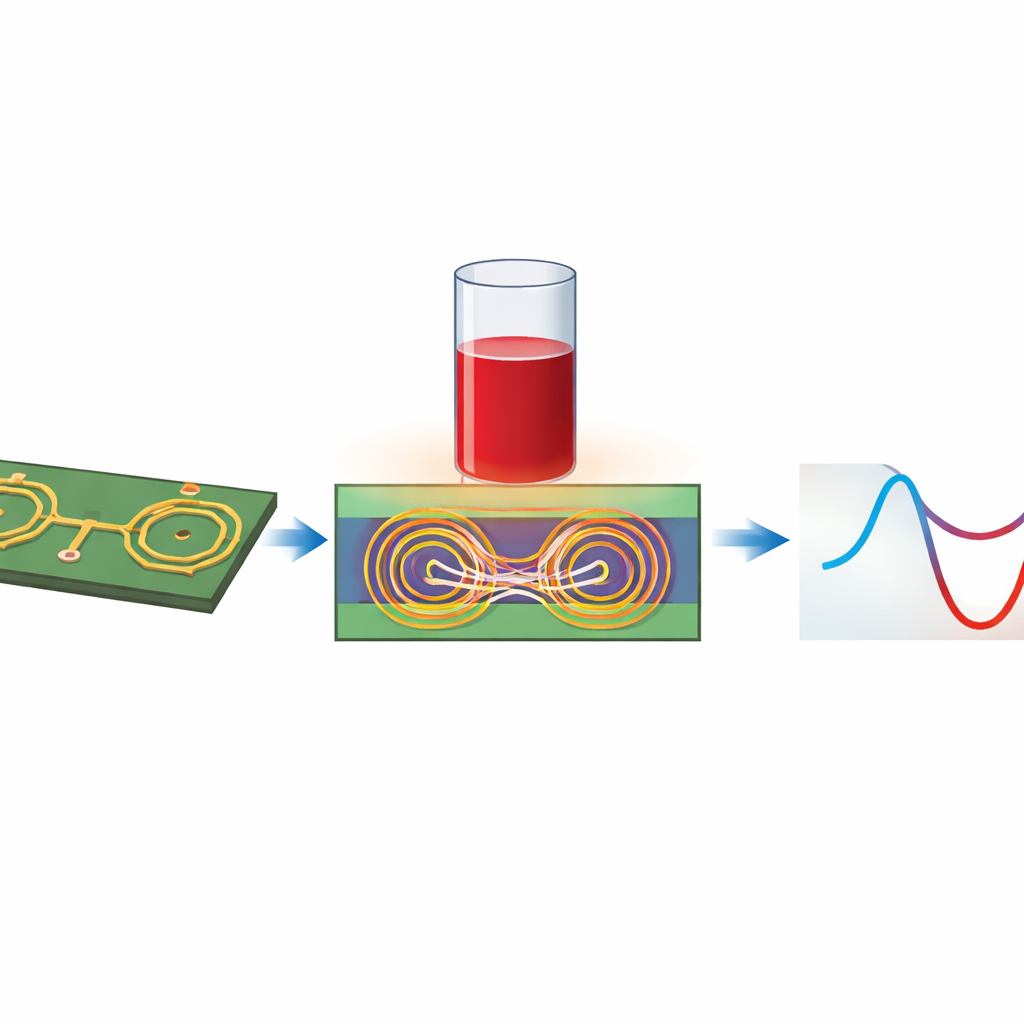
The heart of the device is a pair of eight‑sided ring structures etched into a copper layer. They are arranged side by side and excited so that the microwave signal reaching one ring is exactly half a turn out of step with the signal reaching the other. This deliberate opposition forces the electric waves between the rings to squeeze tightly into the small gap where the blood sample sits. In that region, the waves are especially strong and concentrated, making them far more responsive to even tiny changes in the electrical properties of blood caused by differing sugar levels.
From computer model to real blood
To make sure the design would work in practice, the researchers first ran detailed computer simulations. They tested how the sensor would respond to blood with glucose levels spanning from well below to well above typical medical ranges, and how the response changed when more or less sample was present. They also built a digital model of a human wrist with layers representing skin, fat, and a blood vessel, to see whether the focusing effect of their design would still hold when the waves had to pass through tissue rather than just air or glass. In all these virtual trials, one particular operating frequency around 5.5 gigahertz proved especially sensitive and stable.
Putting the sensor to the test
Next, the team fabricated physical prototypes and tested them using real human blood placed in tiny glass vials above the sensing region. With a laboratory instrument that precisely measures microwave signals, they watched how the sensor’s preferred frequency shifted as they adjusted glucose levels between 80 and 340 milligrams per deciliter—a range that covers normal, low, and high blood sugar. The shifts were clear and nearly perfectly straight‑line: each one‑unit change in glucose produced a reliably measurable change in frequency. Repeating the tests with samples from three different volunteers showed nearly identical results, suggesting the sensor is both accurate and reproducible.
Steps toward a wearable device
The authors also examined how realistic factors, such as skin thickness and the presence of surrounding tissue, would affect performance. As expected, having to look through skin and fat reduced sensitivity somewhat but did not erase the signal. Even in these tougher conditions, the sensor outperformed many earlier microwave‑based designs reported in the scientific literature. The device is compact, inexpensive to make, and uses very low power, making it a promising candidate for integration into wristbands, smartwatches, or flexible skin patches in the future.
What this means for everyday life
In simple terms, this work shows that carefully shaped radio waves can "feel" small changes in blood sugar without piercing the skin. By using a clever twin‑ring layout that concentrates energy exactly where blood flows, the sensor can detect shifts across the full medically important range with unusually high precision. While more work is needed to turn this laboratory setup into a comfortable wearable and to test it during real‑world daily use, the study points toward a future in which people with diabetes could monitor their glucose as easily as checking the time—no lancets, no strips, and far less pain.
Citation: Jamili, A., Tayarani, M. Design of a microwave sensor for non-invasive monitoring of blood glucose level with high sensitivity using electromagnetic properties. Sci Rep 16, 11863 (2026). https://doi.org/10.1038/s41598-026-41378-6
Keywords: non-invasive glucose monitoring, microwave biosensor, diabetes technology, wearable health devices, electromagnetic sensing