Clear Sky Science · en
Defining synergy for three-phase polymer nanocomposites: a volume-weighted quantitative framework
Why mixing tiny ingredients can make plastics smarter
Modern products, from phones to cars, rely on plastics that are tougher, safer, or more conductive than ordinary materials. One popular way to boost these properties is to sprinkle in tiny solid particles, known as fillers. This paper asks a simple but important question: when two different kinds of nano-sized fillers are mixed into one plastic, how can we tell if they are truly helping each other, or just adding their effects — or even getting in each other’s way? The authors propose a clear, numbers-based way to answer that question.
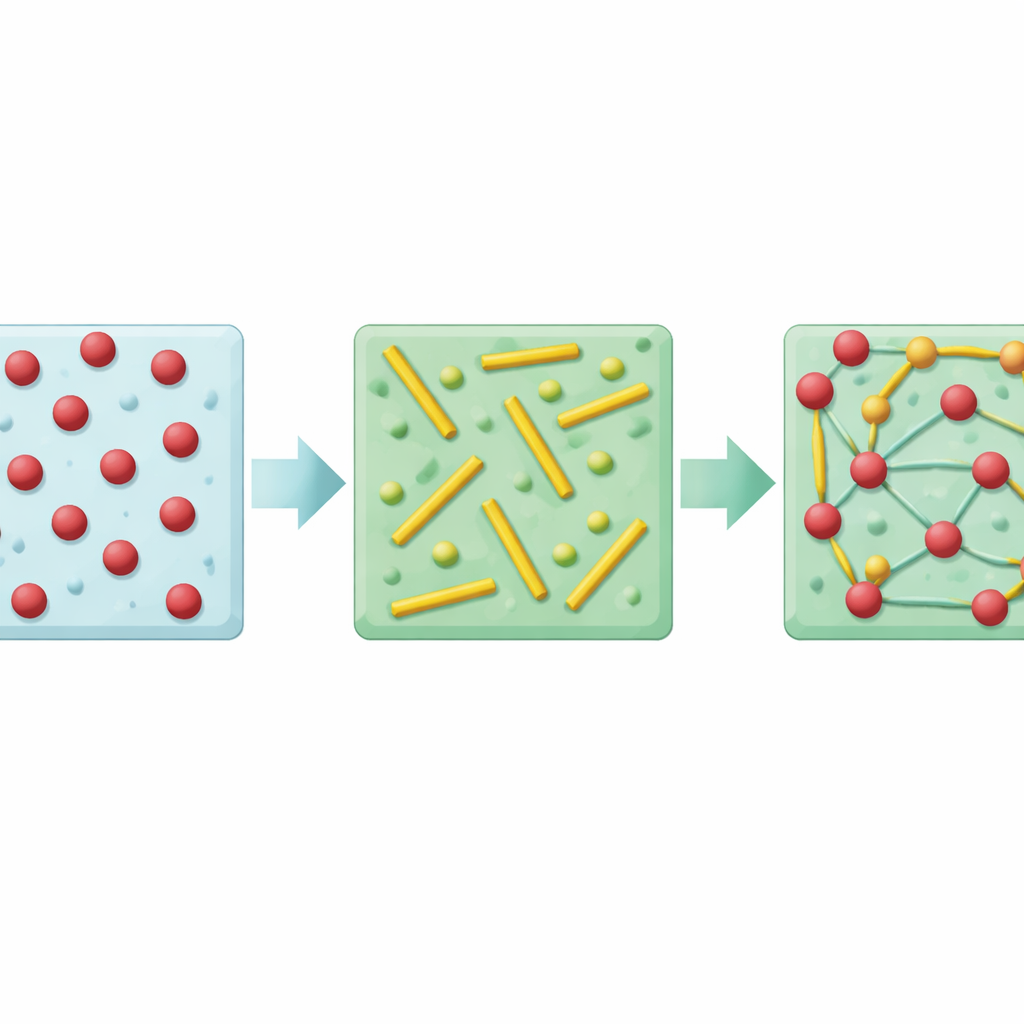
How mixed plastics get their extra powers
Composite materials combine a soft or flexible base, called a matrix, with harder particles or fibers that reinforce it. In recent years, ultra-small fillers like carbon nanotubes, graphene sheets, and other nanomaterials have been used to give plastics extra strength, better heat flow, flame resistance, or electrical conductivity. When two different fillers are added together, researchers often hope for “synergy” — a situation where the plastic with both fillers performs better than you would expect from simply adding the effects of each filler alone. For example, one filler might make the material strong, while another helps heat escape, and together they could create a tough, heat-managing plastic.
Why the usual way of judging teamwork falls short
Until now, most scientists judged synergy with simple formulas that compare a property (like strength or conductivity) of the mixed-filler plastic to the sum of two simpler plastics, each containing only one filler. The new study shows that these formulas often give misleading answers. They ignore how much space each filler actually occupies, how well the nanometer-sized particles are spread out, and whether the second filler is meant to improve the same property or a different one. As a result, many mixed systems have been wrongly labeled as “antagonistic,” meaning harmful or non-cooperative, even when experiments and microscopic images clearly show that the two fillers are working together.
A better yardstick that weighs what really matters
The authors propose new equations that weight each filler by its volume share in the mixture, rather than just counting total content. This volume-based approach better reflects how particles touch each other and the surrounding plastic, which is crucial for carrying stress, electricity, or heat. For cases where both fillers target the same property, the new formulas compare the mixed material to a fair reference that assumes each filler contributes in proportion to its presence. For cases where each filler controls a different function — say, one for mechanical strength and another for flame resistance — the authors provide separate equations to measure how much each filler helps or hinders the other’s main job. These tools let engineers distinguish cooperative, one-sided (asymmetric), and inhibiting interactions in a quantitative way.
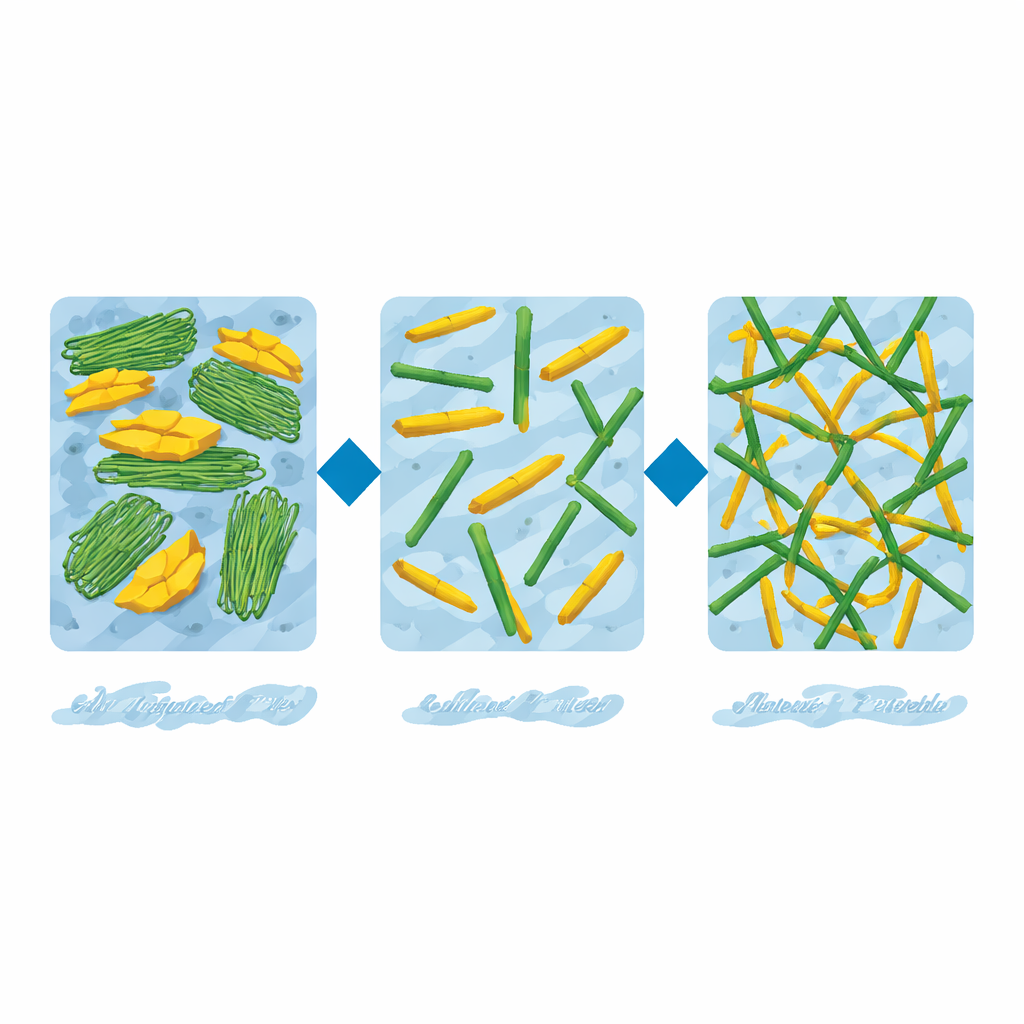
What the new test reveals about real materials
To show how their framework works, the researchers re-analyzed many published examples of plastics loaded with two or more types of nanofillers, covering mechanical, thermal, electrical, and fire-safety behavior. In system after system, the classic formulas had classified the combination as antagonistic, even though the mixed material clearly outperformed either filler alone. When the new, volume-weighted equations were applied, those same systems were consistently identified as synergistic. The method also uncovered how synergy depends on the mixing ratio: changing the relative amounts of two fillers can flip a material from poor cooperation to strong teamwork. In more complex cases, such as three different fillers providing strength, barrier protection, and flame retardancy, the new approach still worked, teasing apart which ingredients were helping and which were quietly undermining performance.
What this means for designing better everyday materials
In plain terms, this paper replaces guesswork with a fair scorecard for judging whether tiny additives in plastics are truly cooperating. By taking into account how much space each filler occupies and which property it is supposed to improve, the new framework helps researchers avoid discarding promising combinations just because older equations mislabeled them as failures. This clearer view of synergy can guide the design of next-generation plastics that are lighter, tougher, safer, and more multifunctional — all by choosing the right mix and ratio of nano-sized ingredients and measuring their teamwork correctly.
Citation: Araby, S., Bakhbergen, U., Han, S. et al. Defining synergy for three-phase polymer nanocomposites: a volume-weighted quantitative framework. Sci Rep 16, 14582 (2026). https://doi.org/10.1038/s41598-026-41377-7
Keywords: polymer nanocomposites, hybrid fillers, material synergy, multifunctional plastics, nanomaterials