Clear Sky Science · en
High-precision non-destructive blade surface inspection via self learning transformer networks
Keeping jet engines safe in the sky
Every commercial flight depends on turbine blades spinning deep inside jet engines at blistering temperatures and enormous speeds. If the protective coating on these blades starts to crack, pit, or peel, efficiency drops and the risk of failure rises. This study explores how an artificial intelligence system can automatically spot tiny flaws on blade surfaces from images, promising faster, more reliable inspections and safer, cheaper air travel.
Why tiny surface flaws matter
The blades inside a jet engine face scorching heat, rapid pressure changes, and a corrosive mix of gases and particles. To survive, they are covered with special coatings that act like thermal armor and rust-proof paint. Over time, however, these coatings can develop hairline cracks, pits, peeling regions, and small trapped inclusions inside the surface. Left unnoticed, these flaws can grow, weaken the blade, increase fuel burn, and in extreme cases contribute to engine failure. Today’s standard checks rely heavily on human inspectors using cameras, ultrasound, or heat imaging. These methods work, but they are slow, labor-intensive, and can miss the smallest defects on curved, shiny blade surfaces.
From manual checks to learning machines
In recent years, computer vision systems based on deep learning have begun to help with industrial inspection tasks. Traditional deep networks called convolutional neural networks are good at recognizing local patterns, like a crack in a small flat region. But they struggle when the surface is curved, the lighting is uneven, or defects are scattered in different parts of the same image. Earlier research had mostly focused on flat materials such as circuit boards or steel sheets, which do not capture the visual complications of real jet engine blades. Newer models known as vision transformers, originally developed for image recognition, can look at an entire picture at once, learning how distant parts of an image relate to each other. This broader view makes them promising for hard inspection problems where both fine detail and overall structure matter.
A new way to see blades inside engines
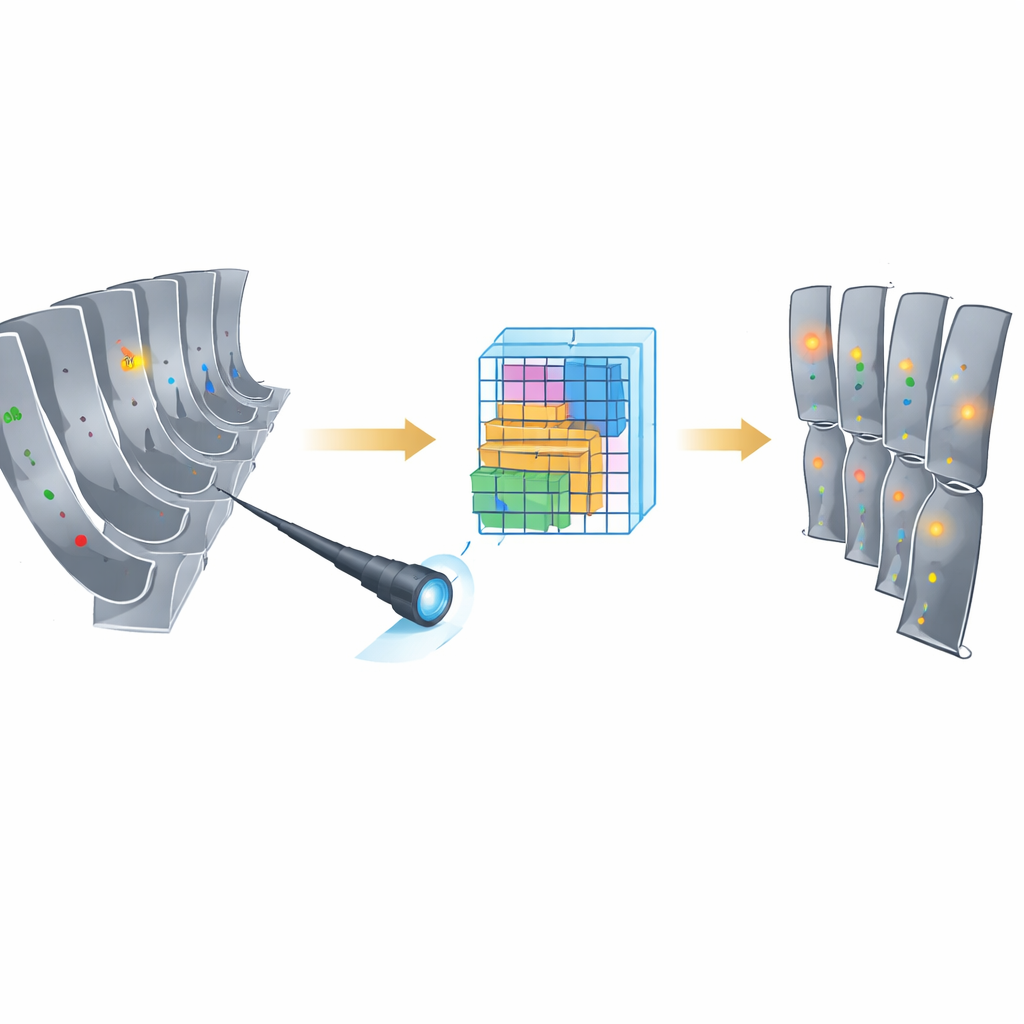
The authors propose an inspection system built around a model called a Swin Transformer, adapted specifically for turbine and compressor blades. First, high-resolution images of real blades are gathered from lab setups, borescopes inside engines, and public datasets. Each defect—such as a crack, dent, pit, or inclusion—is carefully outlined by experts so the model can learn from clear examples. Before training, the images go through a tailored cleaning process: lighting is evened out, noise is reduced without blurring defect edges, and colors are converted into a form that makes subtle surface changes stand out. The images are then artificially varied by rotating, flipping, changing brightness, and overlaying synthetic defects, so the system learns to cope with many real-world conditions.
How the smart inspector works
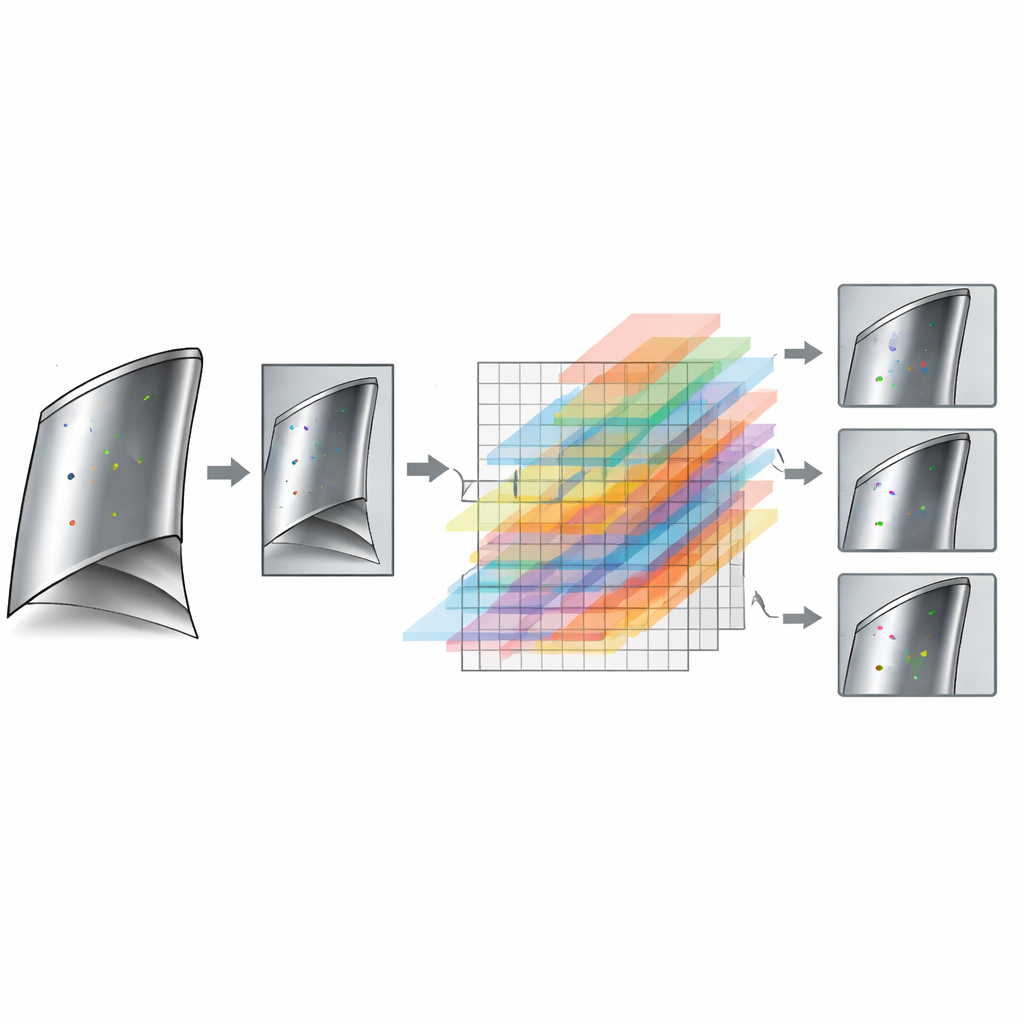
Once prepared, each blade image is chopped into small square patches that feed into the Swin Transformer. Inside the model, groups of neighboring patches are examined through sliding “windows” that shift between layers, allowing the system to capture both tiny details and their larger surroundings. This layered attention structure lets the model connect a faint line across the blade with broader patterns of coating damage. On top of this backbone, an additional module combines information from different scales so that very small pits and larger peeled areas can be detected in a single pass. The trained system can then, in a fraction of a second, mark where each flaw is on a blade and decide which category it falls into.
What the tests revealed
To judge performance, the researchers compared their approach against well-known deep networks that are widely used in image analysis. Their Swin Transformer reached about 98% accuracy in telling damaged from undamaged regions and in labeling four main defect types: dent, crack, porosity, and inclusion. It caught nearly all true defects while keeping false alarms low, and it pinpointed defect locations precisely, even when flaws were only tenths of a millimeter across. Experiments also showed that each part of the pipeline mattered: simply adding better image pre-processing and data expansion improved results, but the biggest leap came from switching to the Swin Transformer architecture itself. The system delivered this performance with fast processing times suitable for use during routine maintenance.
What this means for future flights
In plain terms, this work shows that an AI “inspector” can watch over jet engine blades with an accuracy and consistency that surpass many current methods, especially for the hardest-to-see flaws. By automatically flagging tiny cracks and pits before they become serious, such systems could shorten inspection times, reduce dependence on scarce experts, and help prevent costly or dangerous failures. The authors envision their model being built into automated maintenance lines, working alongside robotic cameras and, eventually, digital twins that track engine health over its entire life. For passengers, the end result is not just smarter algorithms—it is quieter, cleaner, and safer flights.
Citation: Kannusamy, P., Gayathri, D., Mirdula, S. et al. High-precision non-destructive blade surface inspection via self learning transformer networks. Sci Rep 16, 10288 (2026). https://doi.org/10.1038/s41598-026-41373-x
Keywords: jet engine blade inspection, surface defect detection, deep learning vision, transformer-based models, aerospace maintenance