Clear Sky Science · en
Reliable ECG classification using parallel hybrid models with limited resources
Why smarter heart checks matter
Heart rhythm problems can strike without warning, leading to strokes, heart failure, or sudden cardiac arrest. Doctors rely on electrocardiograms (ECGs) to spot these dangers early, but reading thousands of heartbeats by eye or with traditional computer tools is slow and prone to error. Powerful artificial intelligence systems can help, yet they usually need expensive hardware and often behave like black boxes. This study presents a new way to read ECGs that is both lightweight enough for wearable devices and transparent enough to show how confident it is in each decision.
Big heart risks, limited tools
Cardiovascular diseases kill nearly 20 million people worldwide each year, and irregular heart rhythms, or arrhythmias, are a major cause. An ECG is a simple, low-cost test that records the heart’s electrical activity and can reveal these rhythm problems long before symptoms appear. Historically, clinicians or rule-based programs analyzed ECG traces by hand, marking characteristic bumps and dips and feeding hand-picked numbers into classical algorithms. These steps were time‑consuming, demanded expert attention, and tended to break down when signals were noisy or unusual, leaving dangerous room for missed or wrong diagnoses.
When deep learning is too heavy
Deep learning changed ECG analysis by allowing neural networks to learn patterns directly from raw signals and, in some cases, rival cardiologists at spotting arrhythmias. However, top‑performing models such as large convolutional networks and transformer-based systems are computationally hungry. They work well in big hospitals with powerful servers, but are hard to deploy in battery-powered wearables, basic clinic computers, or rural settings. Worse, these complex systems can still make confident mistakes, and they rarely tell doctors how trustworthy any given prediction is. The field has lacked methods that are both efficient and explicitly focused on reliability.
A team of small models working in parallel
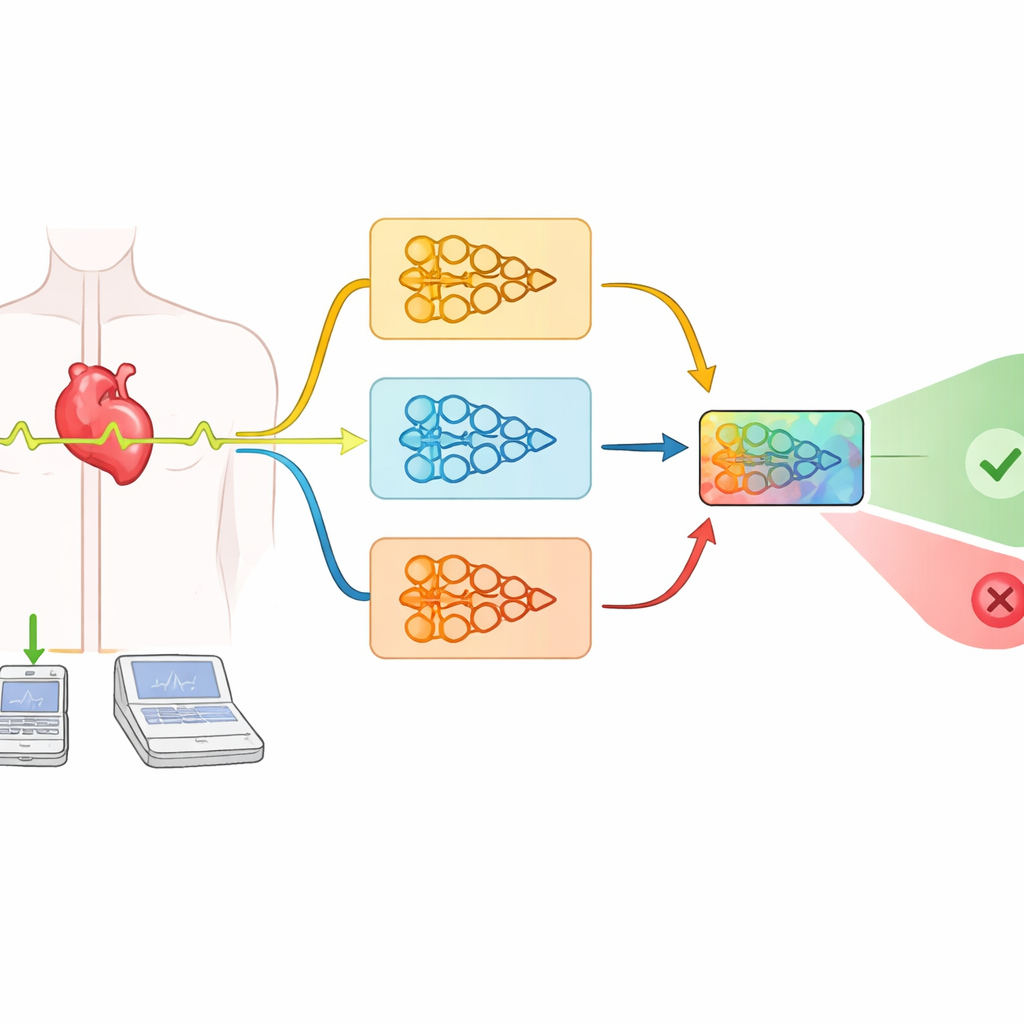
The authors propose a Parallel Hybrid Model (PHM) that tackles these trade‑offs by combining three small, fast neural networks instead of relying on one giant model. Each of the three components—variants of EfficientNet, SequentialNet, and the classic LeNet‑5—analyzes the same short ECG snippet in parallel. These snippets, drawn from the widely used MIT‑BIH Arrhythmia Database, capture a single heartbeat plus surrounding context. After preprocessing to align and normalize the beats, each network outputs its own set of probabilities for five heartbeat types: normal and four categories of abnormal rhythms.
How the model weighs its own judgment
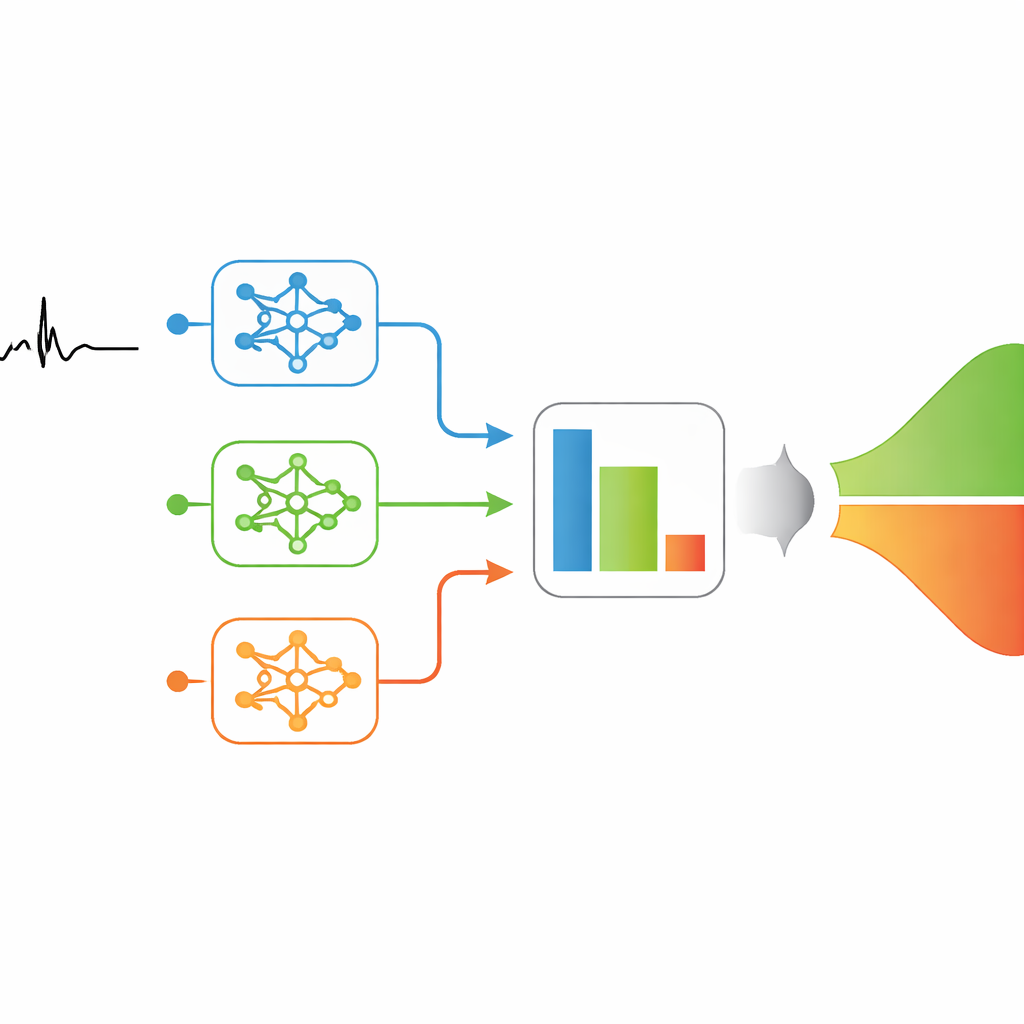
Rather than simply voting by majority, the PHM uses a weighted soft voting scheme. Networks that proved slightly more accurate during training are given proportionally more influence when their opinions differ. The system also introduces an unusual idea for medical AI: reliability zones. When all three networks agree with the true label, the decision falls in the Correct Decision Zone. When they all agree but are wrong, it lands in the Misclassification Zone. When they disagree with one another, the case enters a False Decision Zone, where the weighted voting mechanism resolves the conflict. By tracking how often cases fall in each zone, clinicians gain a clear, numerical sense of how often the system is unanimous, hesitant, or collectively mistaken.
Performance that fits in your pocket
On more than 100,000 heartbeats from the MIT‑BIH database, the PHM achieved an overall accuracy of 98.46 percent—slightly better than any of its individual members and competitive with much larger models. It performed especially well on rare but clinically important arrhythmias, a common weakness of automated systems trained on imbalanced data. At the same time, the entire ensemble uses only around 200,000 adjustable parameters and can classify a heartbeat in about hundredths of a second on modest hardware. Tests on a small single‑board computer similar to those used in wearables confirmed that such real‑time operation is feasible, with low energy use.
What this means for patients and clinicians
For non‑specialists, the key message is that this work moves automated heart‑rhythm analysis closer to devices you could wear on your wrist or chest, even in settings far from major hospitals. By carefully blending three simple models and explicitly measuring how often they agree, the PHM offers both strong accuracy and a built‑in sense of confidence. Doctors not only receive fast alerts about dangerous rhythms but can also see when the system is on firm ground or entering a more doubtful zone. That combination of speed, efficiency, and transparency could make AI‑assisted ECG screening safer and more widely available, potentially catching life‑threatening arrhythmias earlier and improving outcomes for patients around the world.
Citation: Alyahya, S., Malik, A.N., Amir, M. et al. Reliable ECG classification using parallel hybrid models with limited resources. Sci Rep 16, 11762 (2026). https://doi.org/10.1038/s41598-026-41370-0
Keywords: ECG arrhythmia detection, wearable heart monitoring, lightweight deep learning, ensemble neural networks, medical AI reliability