Clear Sky Science · en
Transportation-oriented isolated type energy interaction converter for vehicle-to-vehicle
Sharing Power on the Road
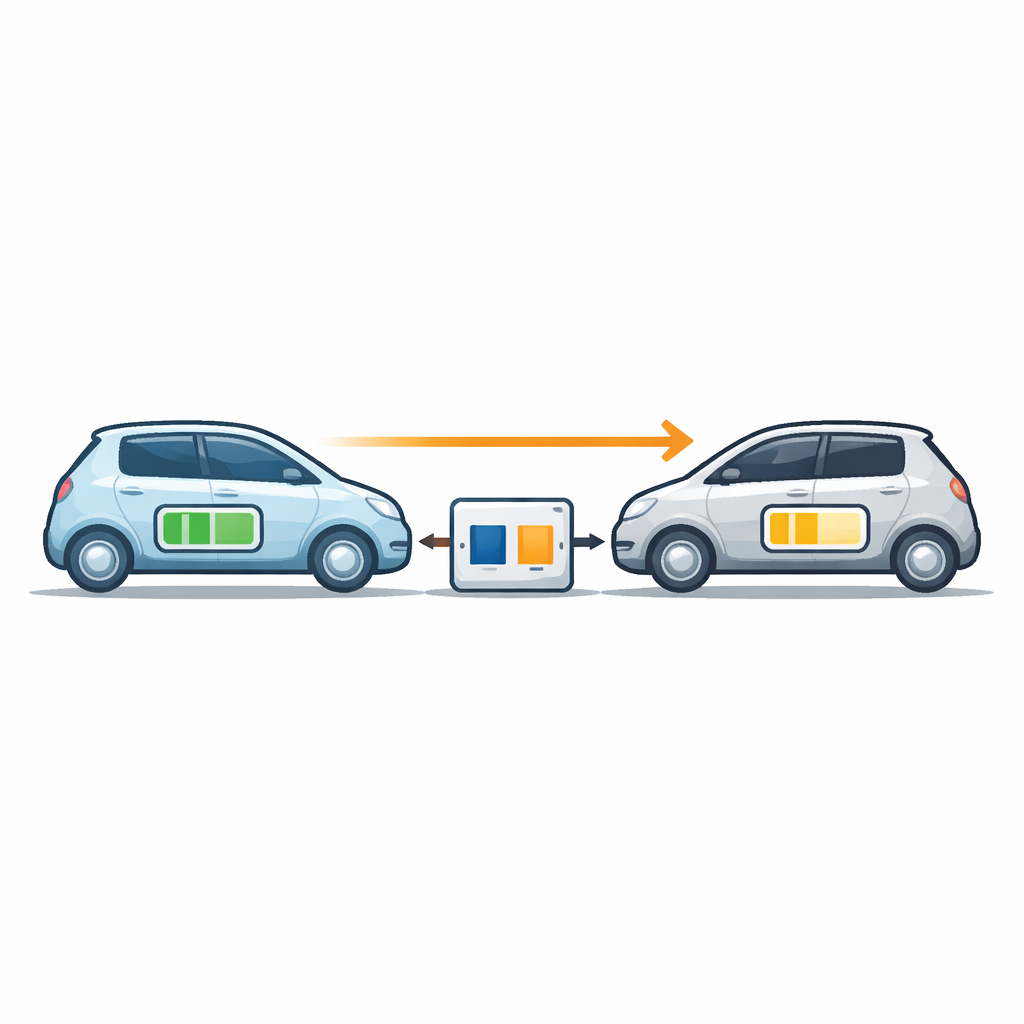
Imagine your electric car running low on battery on a lonely highway, with no charging station in sight. Instead of waiting for a tow truck, what if another nearby electric car could safely lend you some of its energy, much like jump-starting a gasoline car—but faster, cleaner, and fully controlled? This paper explores exactly that idea: a portable box that lets one electric vehicle quickly charge another, overcoming range anxiety and reducing dependence on fixed charging stations.
A Portable Bridge Between Two Cars
The authors propose a compact "energy interaction converter" that sits between two parked electric cars. One car acts as the energy supplier, the other as the receiver. Because real vehicles use different battery voltages and must be kept electrically safe from each other, the converter has to boost voltage, handle power flowing in either direction, and provide strong isolation so that faults in one car do not harm the other. To meet these demands, the researchers build the converter around a dual-active-bridge (DAB) circuit, a design that uses a high-frequency transformer and electronic switches to move power efficiently and safely between two separate DC sides.
Making a Complex Circuit Behave Predictably
Although the DAB design is powerful and flexible, it is also tricky to control in real life. Small timing gaps added to protect the switches, manufacturing tolerances in inductors and capacitors, temperature changes, and sudden shifts in load can all push the output voltage away from its target. Traditional control methods must be re-tuned whenever the switching strategy changes and often assume near-perfect components, which drives up cost. The authors tackle this by rethinking how they model the converter. Instead of directly controlling the timing shift between the two sides of the transformer—which makes the math highly nonlinear—they first design a simpler current-based model and then translate the desired current into the proper timing. This separation makes the system easier to tune and more flexible across different operating modes.
A Control Strategy That Learns from Disturbances
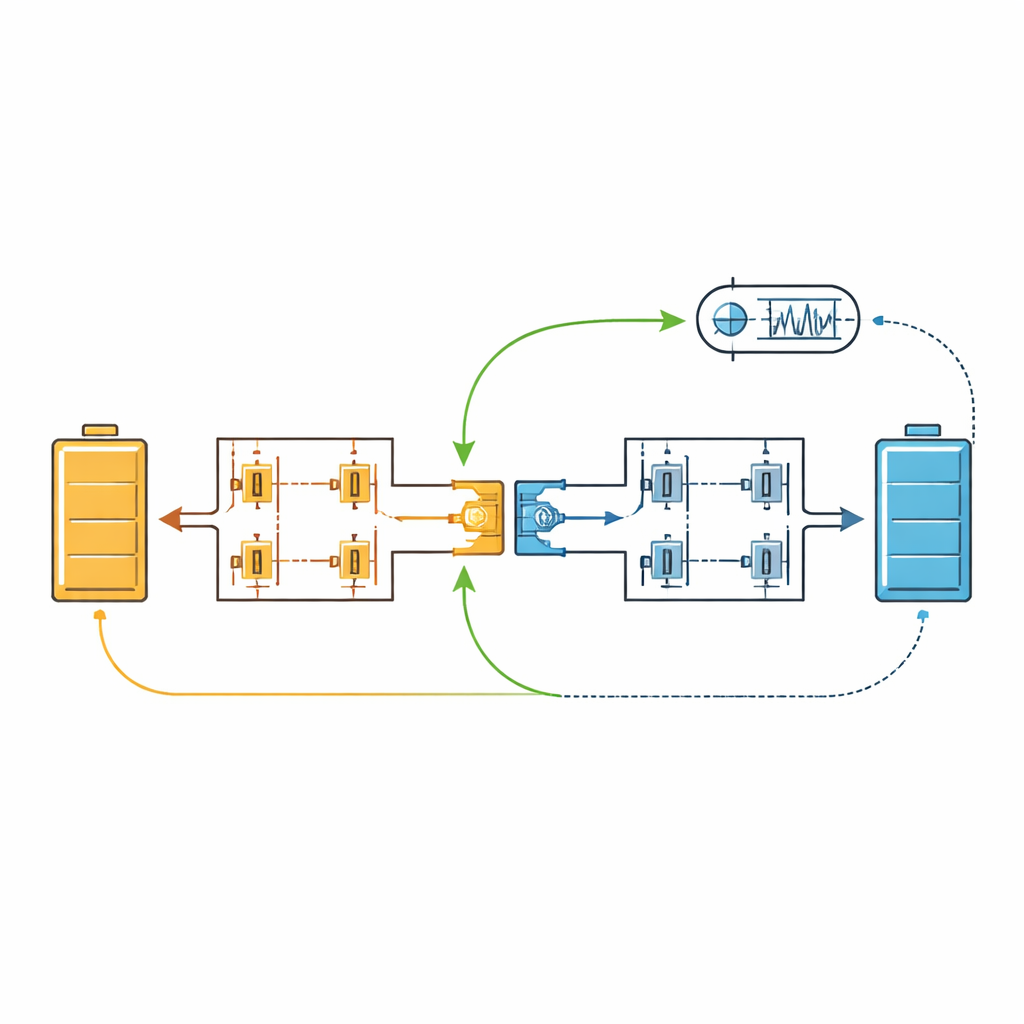
To keep the output voltage steady even when components are imperfect or conditions change, the team adopts an approach called an uncertainty and disturbance estimator (UDE). In simple terms, the controller assumes that everything it does not know exactly—component errors, calculation delays in the digital controller, external electrical noise, and sudden load changes—can be grouped into a single "disturbance" term. The UDE continuously estimates this lumped disturbance from measured currents and voltages, then actively cancels it out. On top of that, the researchers add an integral action, a mathematical way of accumulating small errors over time, so that any lingering mismatch between desired and actual voltage is slowly driven to zero under steady conditions.
Testing with Realistic Vehicles and Harsh Conditions
Using computer simulations, the authors test their design with battery voltages matching popular small electric cars in China, such as the HongGuang MINIEV, BaoJun E-series, Chery QQ IceCream, and BYD QinEV. They explore demanding scenarios: large errors in component values, changes in input and output voltage, abrupt shifts in load, different states of charge, and even reversing who is charging whom. In all cases, the converter’s output voltage returns to its target within a few hundredths of a second, and remains stable. The team also builds a physical prototype about the size of a small toolbox, capable of transferring up to 5 kilowatts, and compares their UDE-based controller to a standard proportional–integral (PI) controller and another advanced method. The new approach recovers faster from disturbances and shows smaller overshoots, all while tolerating lower-cost components.
What This Means for Everyday Drivers
For non-specialists, the key takeaway is that this work brings the idea of car-to-car fast charging closer to everyday reality. By combining a safe, isolated converter design with a control method that automatically compensates for imperfections and changing conditions, the authors demonstrate that one electric vehicle can reliably and quickly recharge another without relying on a dense network of fast-charging stations. If devices like this reach the market, drivers could worry less about being stranded with a low battery, fleets could share energy more flexibly, and portable V2V chargers could even sell stored electricity during peak-price hours—all while using hardware that is compact, efficient, and affordable.
Citation: Jia, W., Wang, R., Wei, Z. et al. Transportation-oriented isolated type energy interaction converter for vehicle-to-vehicle. Sci Rep 16, 11419 (2026). https://doi.org/10.1038/s41598-026-41368-8
Keywords: vehicle-to-vehicle charging, electric vehicles, DC DC converter, power electronics control, range anxiety