Clear Sky Science · en
Damping factor estimation of damped complex sinusoidal signals using a maximum likelihood approach
Why fading vibrations matter
Whenever a bridge trembles in the wind, an engine housing rings after a knock, or a radar pulse echoes off a distant object, the motion does not last forever—it fades away. That fade, or damping, carries valuable information about the health of a structure, the properties of a material, or the quality of a communication link. This paper introduces a fast and mathematically grounded way to measure how quickly such oscillations die out, even when the signal is weak and buried in noise.
Listening to dying waves
Many modern technologies rely on signals that look like a wave whose amplitude shrinks over time. Engineers use this simple pattern to model radar and sonar echoes, vibrations in buildings, musical notes, and even certain medical scans. In these settings, a few key numbers describe each signal: how strong it is, how fast it oscillates, and how quickly it decays. The last of these, the damping factor, is often the hardest to estimate accurately because the signal fades into the background noise just as we are trying to measure it. Traditional tools, such as Fourier transforms or classic curve-fitting methods, are easy to compute but can become unreliable when the data are short, noisy, or contain strong damping.
A smarter way to read noisy decay
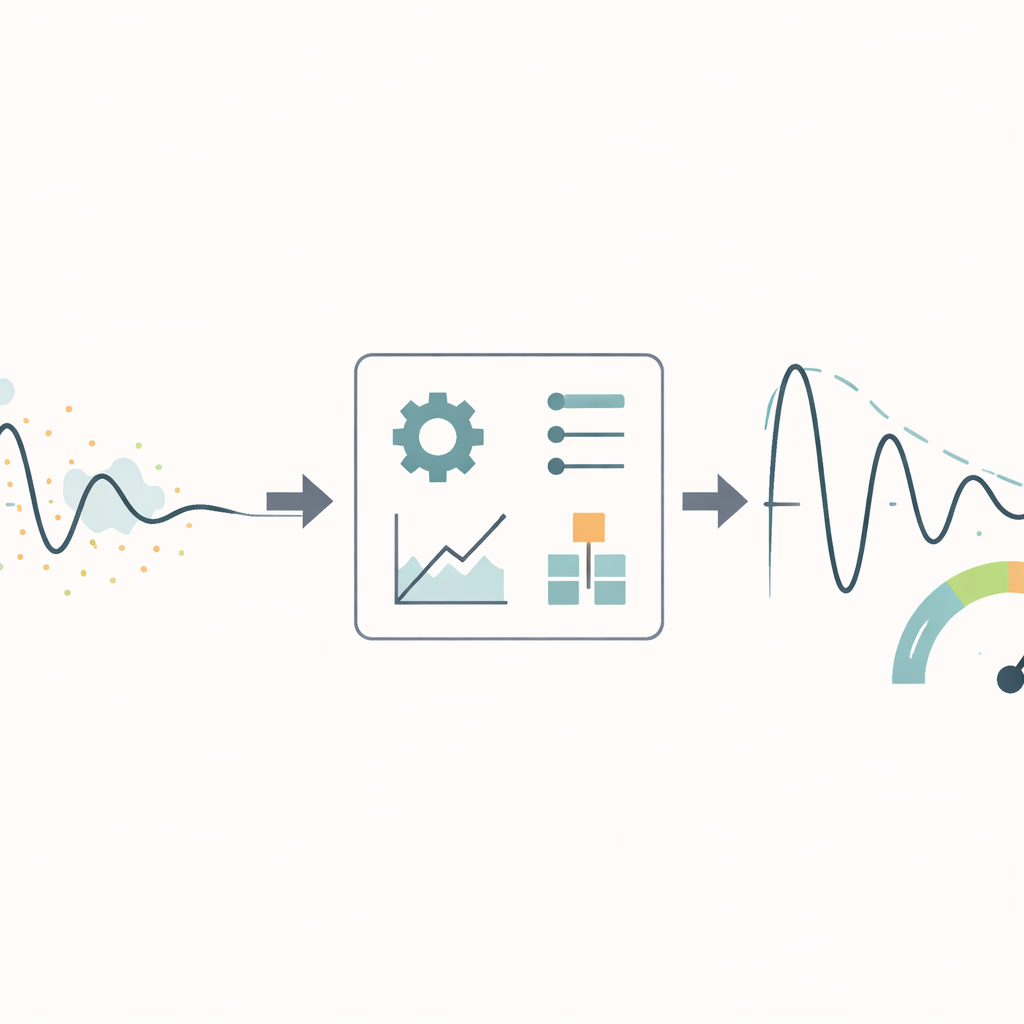
The authors build on a powerful statistical idea known as maximum likelihood estimation. Instead of simply looking at peaks in a spectrum, they ask: given our mathematical model of a fading wave plus random noise, which value of the damping factor makes the observed data most probable? Working through this framework leads to an expression that, in general, would require heavy numerical optimization. The key advance of the paper is to show that when the decay is not too strong—a common situation in practice—the model can be simplified in a controlled way, turning a complicated problem into a closed-form formula for the damping factor. This approximate solution needs only simple sums over the data, making it attractive for real-time or embedded systems.
When simple beats complex
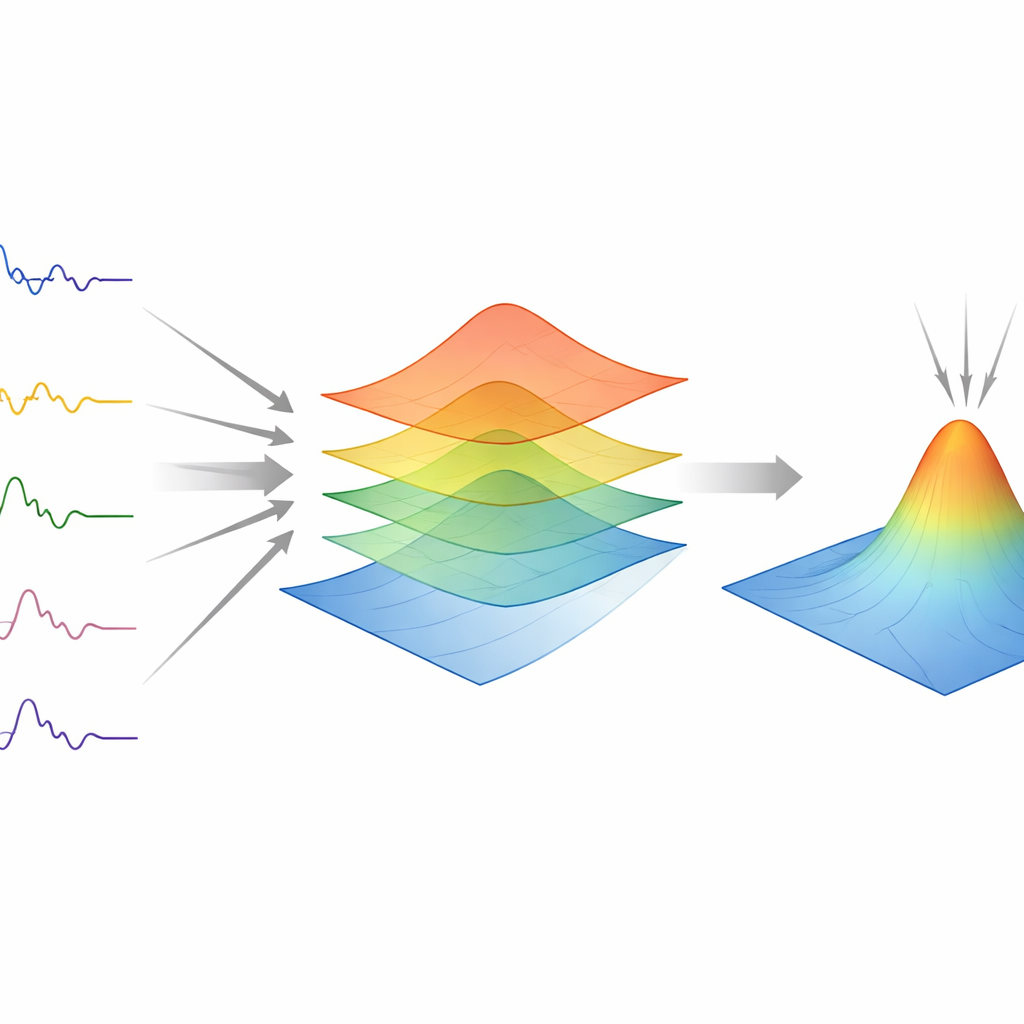
The study does more than propose a shortcut; it rigorously checks when that shortcut can be trusted. By comparing the new estimator to a fundamental statistical benchmark called the Cramér–Rao Lower Bound, the authors show that, for gently damped signals, their formula is essentially as accurate as any theoretically possible unbiased method. They also analyze how small mathematical approximations introduce bias as damping grows stronger, and they quantify when that bias remains negligible. In challenging cases with heavier damping, the same closed-form estimate can still be used as a high-quality starting point for an iterative refinement method, which then homes in on the exact maximum-likelihood answer.
Design rules for engineers
Through extensive simulations, the paper turns abstract statistics into concrete design guidelines. It shows how estimation accuracy improves with cleaner signals (higher signal-to-noise ratio), longer recordings (more samples), and stronger amplitudes, and how it degrades when damping is large. For weakly damped vibrations, only modest data lengths and moderate signal quality are required to achieve reliable results. Strongly damped cases, where the wave dies out quickly, demand either better sensors, longer observations, or more advanced processing to reach similar precision. The analysis is framed in terms that apply directly to fields like structural health monitoring, radar, sonar, and vibration diagnostics.
What the findings mean in practice
In plain terms, this work offers a way to read the "rate of fading" from noisy oscillatory signals both quickly and accurately, as long as the decay is not extreme. The proposed estimator is simple enough for small devices yet comes with strong statistical guarantees: under its intended conditions it is as good, in a variance sense, as any method can possibly be. When conditions are tougher, it still serves as a smart initial guess that speeds up more exact algorithms. For practitioners, the paper provides a recipe for choosing sampling rate, measurement length, and required signal quality to reliably quantify damping, helping turn raw vibrations and echoes into actionable information about structures, machines, and communication channels.
Citation: Karthikeyan, A., Rahul, A.K. & Tiwari, R. Damping factor estimation of damped complex sinusoidal signals using a maximum likelihood approach. Sci Rep 16, 13105 (2026). https://doi.org/10.1038/s41598-026-41361-1
Keywords: damped sinusoidal signals, damping factor estimation, maximum likelihood, signal-to-noise ratio, structural health monitoring