Clear Sky Science · en
Molecular simulation of pore size effect on CH4 adsorption characteristics in anthracite
Why tiny spaces in coal matter
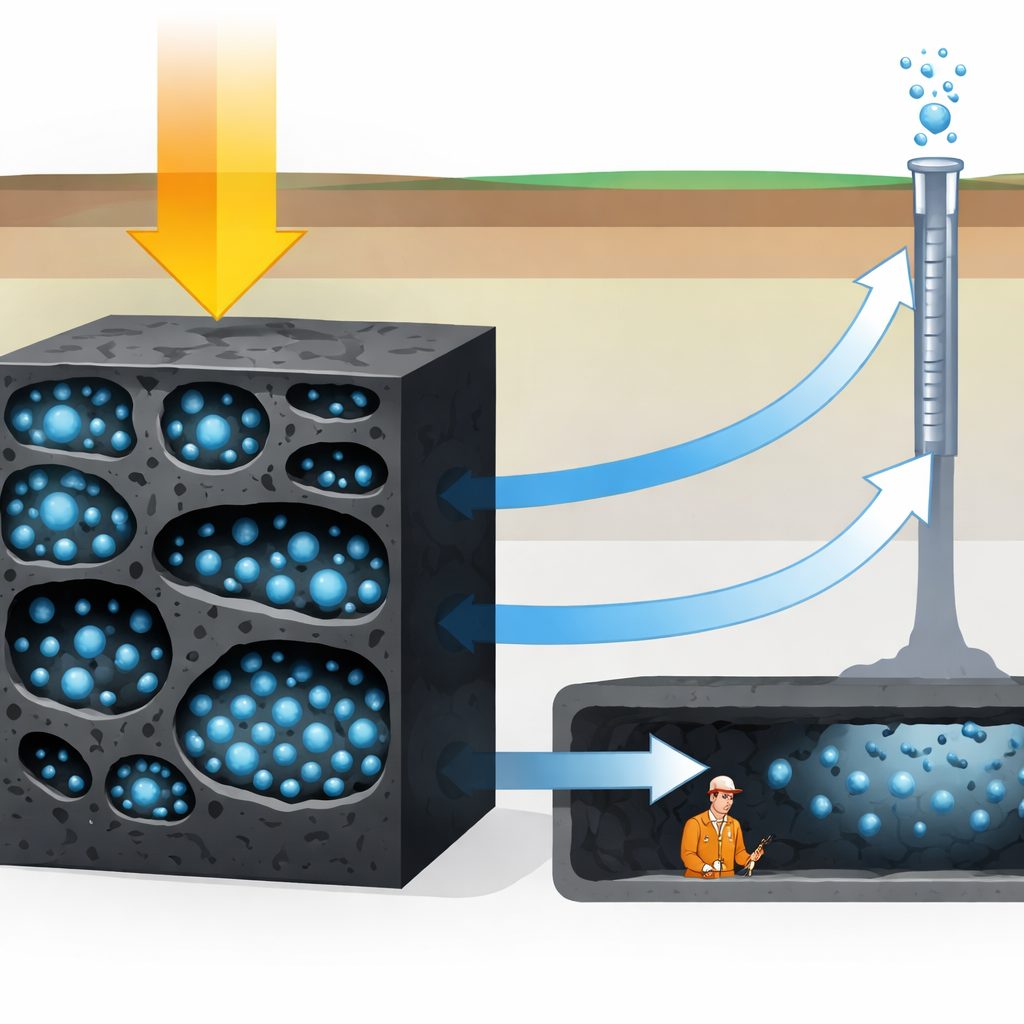
Deep underground, coal is laced with an invisible maze of pores that trap methane gas. This gas is both a valuable fuel and a major safety risk in mines. The study behind this article uses computer-based molecular "experiments" to see how methane behaves inside coal pores that range from extremely small to relatively large. Understanding this hidden world helps engineers better estimate how much coalbed methane can be produced for energy while reducing the risk of sudden gas outbursts and supporting climate goals by using methane more safely and efficiently.
Looking inside coal at the molecular scale
The researchers focused on anthracite, a hard, high-rank coal with many very small pores. They built a detailed digital model of this coal, checking that its density and pore structure matched real lab measurements. Then they created a series of idealized slit-like pores whose widths spanned almost the entire realistic range in coal, from about one methane molecule across (0.4 nanometers) up to wide channels 200 nanometers across. Using a statistical simulation method called grand canonical Monte Carlo, they allowed methane molecules to move in and out of these pore models at different pressures, mimicking conditions from shallow to deep coal seams.
How pore size changes methane storage
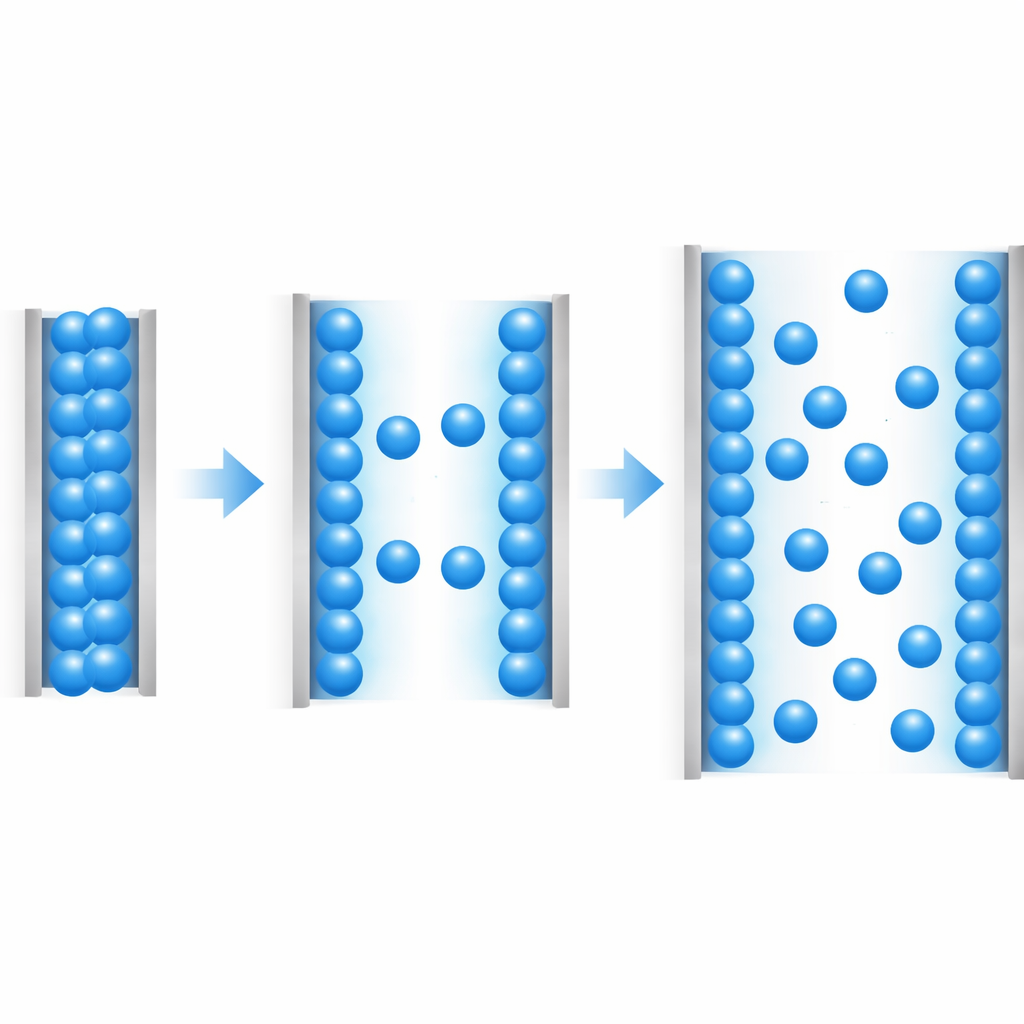
The simulations showed that methane does not fill all pores in the same way. In the tiniest pores, the walls are so close that their attraction to methane overlaps, pulling the molecules into a very dense, liquid-like layer that practically fills the cavity. As the pores widen into a mid-size range, methane first forms a single, fairly ordered layer along the walls, then adds more layers as pressure rises, leaving some low-density gas in the center. In the largest pores, the walls have only a weak effect: a couple of loose layers form near the surface, while most of the gas in the middle behaves almost like free, unconfined gas. Across all pore sizes, increasing pressure boosts the amount of methane, but with three clear stages: rapid growth at low pressure, steadier increase at moderate pressure, and a gradual leveling off at high pressure as storage approaches saturation.
Blending classic models into one picture
To translate these complex patterns into practical equations, the team tested three well-known adsorption models. They found that the Dubinin–Astakhov model best describes the filling of the very smallest pores; the Langmuir model captures the behavior of mid-size pores dominated by a single wall layer; and the BET multilayer model is most suitable for the large pores where surface layers and free gas coexist. By relating the parameters of each model directly to pore size, they stitched these pieces together into a single "full pore" model that can predict how much methane a given pore width will hold at a chosen pressure. When they compared the predictions of this unified model with the detailed simulations, the differences were generally below six percent, indicating that the simplified description still captures the main physics.
What the density of trapped gas reveals
Rather than just counting how many molecules fit into each pore, the authors also asked how tightly packed the methane becomes, expressed as an average density inside the pore. They found that this density falls strongly as pores get larger. In the smallest pores, methane reaches densities close to that of liquid methane, showing how strongly the walls confine it. As pores grow into the mid-size range, the density drops sharply because more of the space is occupied by loosely bound or free gas. In the largest pores, the density changes only slowly with size, settling into values much lower than in the tiny cavities. This pattern confirms that small pores are energy-controlled storage sites, while large pores act more like volume-controlled containers for compressed gas.
From hidden pores to safer, cleaner energy
In plain terms, this work shows that not all pores in coal contribute equally to holding methane: the smallest ones pack gas very efficiently, mid-size pores add more storage but at lower density, and the largest pores mainly host free gas that depends strongly on pressure. By weaving these behaviors into a single predictive model, the study provides a tool for better estimating methane reserves in coal seams and for planning safer extraction. Knowing how methane is stored at different scales can help reduce explosive risks in mines while improving the design of coalbed methane production aimed at supporting a lower-carbon energy mix.
Citation: Bai, Y., Yang, L., Hu, B. et al. Molecular simulation of pore size effect on CH4 adsorption characteristics in anthracite. Sci Rep 16, 11975 (2026). https://doi.org/10.1038/s41598-026-41355-z
Keywords: coalbed methane, gas adsorption, pore structure, molecular simulation, anthracite