Clear Sky Science · en
A VR-based experimental system for studying mirror visual feedback effects on cross-education
Training One Hand to Help the Other
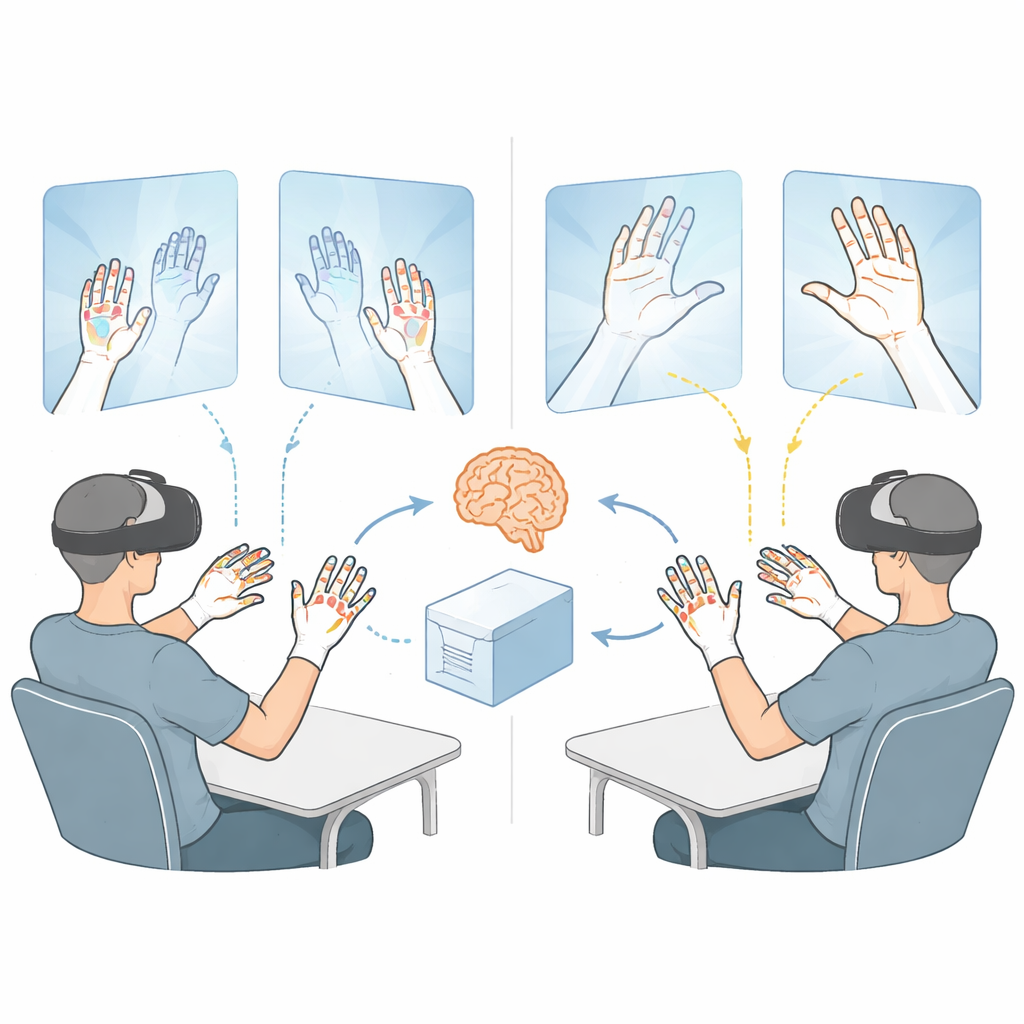
Imagine recovering from a stroke that has left one hand weak. What if simply practicing with your healthy hand—while seeing a convincing illusion that the weak hand is moving—could help both sides get better? This study introduces a sophisticated virtual reality (VR) system designed to explore exactly that idea: how “mirror” images of movement might train the brain to share skills across hands, even for very delicate finger tasks like typing on an invisible keyboard.
A Brain Trick with Real Clinical Promise
When we practice a skill with one hand, the untrained hand often improves too—a phenomenon called cross-education. Therapists hope to harness this for people who can move only one side of their body well, such as many stroke survivors. Previous experiments showed that cross-education can be boosted by mirror visual feedback: seeing a moving reflection or virtual copy of the hand creates a powerful illusion that both hands are active. However, nearly all earlier studies used simple actions such as wrist flexes, ball rotations, or basic finger taps. The present work tackles a much tougher challenge: can this mirror-based boost also apply to complex, precisely sequenced finger movements, the kind we rely on for typing, playing instruments, or button-heavy gaming?
Turning the Hand into a Wearable Keyboard
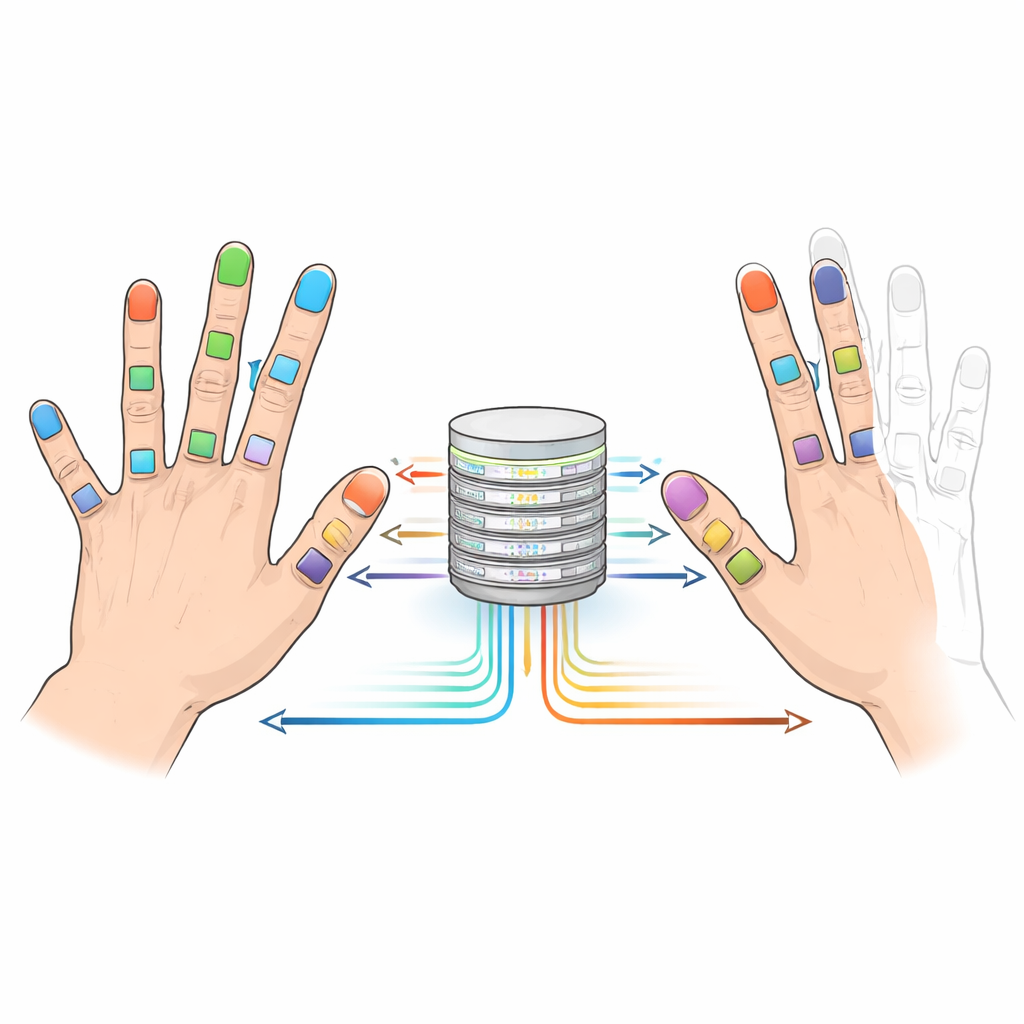
To investigate this, the researchers built a novel “typing” task in which the hand itself becomes the keyboard. Thin copper pads are attached to the palm side of each finger segment, and another pad on the thumb acts as the striker. By tapping different pads in sequence with the thumb, participants type words, each thumb–finger contact acting like a key press. Inside the VR headset, they see lifelike virtual hands with characters drawn on the finger segments and three-dimensional words floating above the active hand. Correct taps advance the word; mistakes force an immediate retry, encouraging fast, accurate sequences of small, well-aimed movements across many joints.
High-Speed Sensing Behind the Illusion
Under the surface, the system is a tightly synchronized blend of electronics, motion capture, and graphics. On the back of each finger and the hand, miniature motion sensors track orientations at 100 times per second. A custom circuit board collects this motion data along with detailed timing of every key press and release from the copper pads. A carefully designed “stable period” algorithm filters out tiny electrical and mechanical glitches that would otherwise look like phantom keystrokes, using brief windows of steady voltage rather than crude fixed delays. At the same time, special mathematical tools (quaternions) convert the raw sensor readings into precise joint rotations in the game engine, including a clever transformation that produces perfect mirror movements across the body’s midline.
Virtual Hands Tailored to Each Person
For the illusion to feel convincing—and for the data to be useful—the virtual hands must move and “land” exactly where the real fingers do. Generic hand models were not accurate enough, so the team measured each participant’s finger lengths, joint positions, and finger spacing using a 3D tracking system. They then built person-specific 3D hand models whose proportions match the real hand, and further fine-tuned them inside VR by adjusting finger positions until thumb-to-fingertip touches in the real world lined up perfectly with the same contacts in the virtual world. A companion “mirror” version of each hand was also created, so that the virtual left hand can be an exact mirrored copy of the right (and vice versa), preserving touch accuracy even when movements are flipped across the body.
Putting the System to the Test
The researchers ran a pilot study with two right-handed volunteers over four days. In every session, participants used the right hand to practice the typing task, then were tested with the untrained left hand. One person viewed normal feedback, where each virtual hand matched its real counterpart; the other saw mirror feedback, where the left virtual hand mirrored the right hand’s movements and the right virtual hand stayed frozen. Both participants showed steady improvement in left-hand performance over days—typing more correct letters faster and with shorter pauses between key presses. The mirror-feedback participant improved more, though with only two people and some confounding factors, the authors rightly treat this as a demonstration of feasibility, not proof of superiority.
A Ready-Made Testbed for Future Therapies
In everyday terms, this study does not yet prove that VR mirror training will transform rehabilitation. Instead, it delivers a highly polished “testbed”: a working, validated system that can present vivid hand illusions, capture every nuance of fine finger motion to the millisecond, and support demanding, game-like tasks. Early tests show it runs smoothly, stores data reliably, and can compute meaningful performance measures such as speed, dwell time on keys, and movement intervals. With this infrastructure now in place, larger studies can rigorously ask whether training one hand—while the brain sees its mirror-image twin at work—can truly help restore nimble, coordinated finger movements in the other.
Citation: Gupta, A., SKM, V. A VR-based experimental system for studying mirror visual feedback effects on cross-education. Sci Rep 16, 12048 (2026). https://doi.org/10.1038/s41598-026-41353-1
Keywords: virtual reality, motor learning, hand rehabilitation, mirror feedback, fine finger movements