Clear Sky Science · en
Diversity of culturable gut bacteria associated with brown planthopper, Nilaparvata lugens (Stål) and their role in imidacloprid degradation
Rice pests and hidden helpers
The brown planthopper is a tiny insect that causes enormous damage to rice crops across Asia, threatening food security and farmers’ livelihoods. For years, growers have relied on the insecticide imidacloprid to keep this pest in check, but many planthopper populations are now becoming harder to kill. This study looks inside the insect’s gut to ask a surprising question: are its resident bacteria helping it survive these chemicals—and could those same microbes be turned into tools for safer pest control?
Why tiny insects beat powerful sprays
Brown planthoppers feed on the sap of rice plants, weakening them and sometimes killing entire fields. Imidacloprid, a widely used pesticide, targets the insect’s nervous system and has been an important line of defense. Yet the planthopper has developed resistance in many places, meaning doses that once worked now fail. Scientists already knew that insects can evolve their own detoxifying enzymes. More recently, attention has turned to the insect gut, where communities of bacteria may help break down pesticides before they can do harm. Understanding which microbes are present in resistant insects, and what they can do, may reveal missing pieces of the resistance puzzle.
Gut residents in resistant and susceptible insects
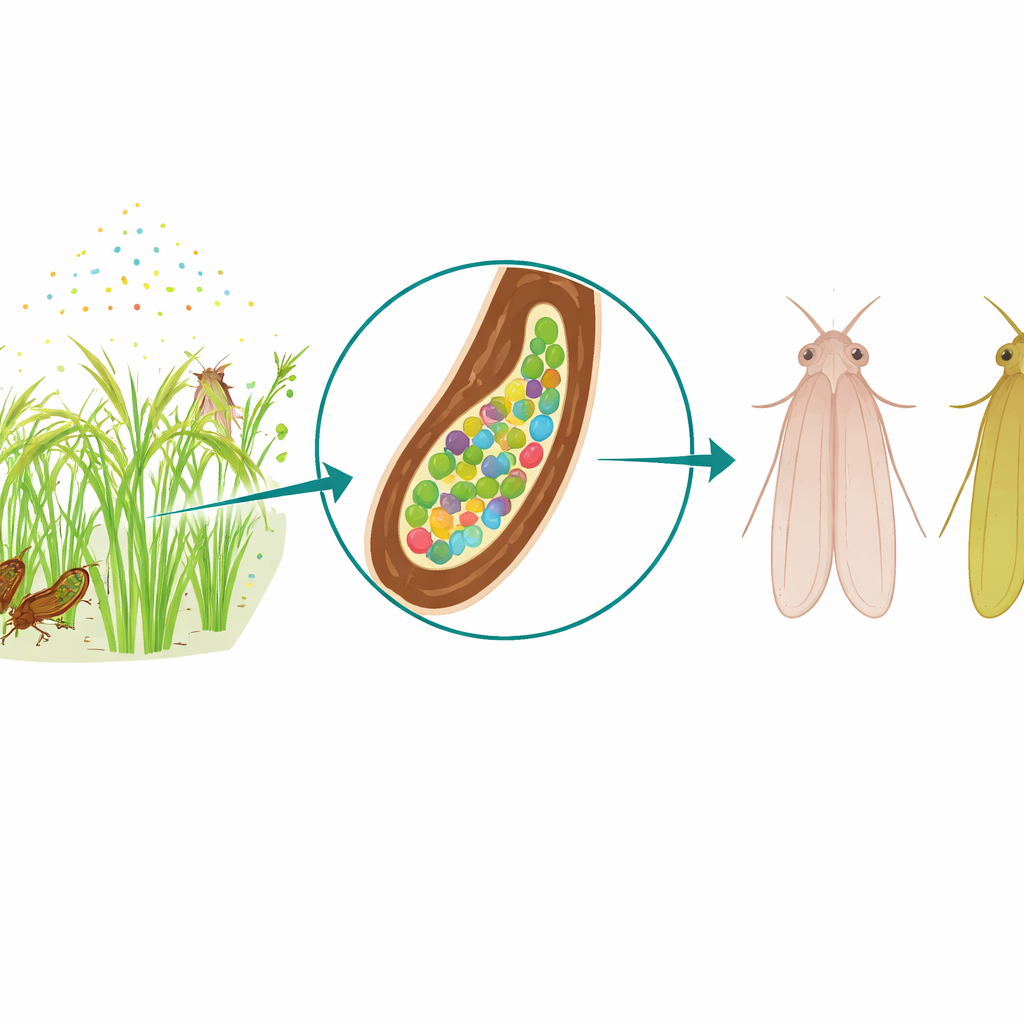
The researchers compared two lab populations of brown planthoppers: one kept free from insecticides (susceptible) and another gradually exposed to imidacloprid over many generations (resistant). They carefully dissected the insects, isolated bacteria that could be grown in culture, and identified them using DNA-based methods. In total, they found 13 distinct bacterial types belonging to three major groups. The resistant insects carried nine of these, spanning all three groups, while the susceptible insects carried only four and lacked one entire group. This means that resistant planthoppers not only survive imidacloprid better, but also host a richer and more varied community of gut bacteria.
Which bacteria can eat the insecticide?
Next, the team tested whether any of the bacteria from resistant insects could actually use imidacloprid as food. They grew the microbes on a simple salt medium spiked with different amounts of the insecticide. Four species from resistant insects—Paenibacillus amylolyticus, Serratia marcescens, Acinetobacter soli and a Brucella strain—managed to grow even at relatively high imidacloprid levels. Two of them stood out: Serratia marcescens could use the insecticide as its only source of carbon, and Paenibacillus amylolyticus could use it as its only source of nitrogen. In liquid culture, these two bacteria actually grew better at higher imidacloprid concentrations, hinting that they are well adapted to living with, and feeding on, this chemical.
Measuring how much pesticide disappears
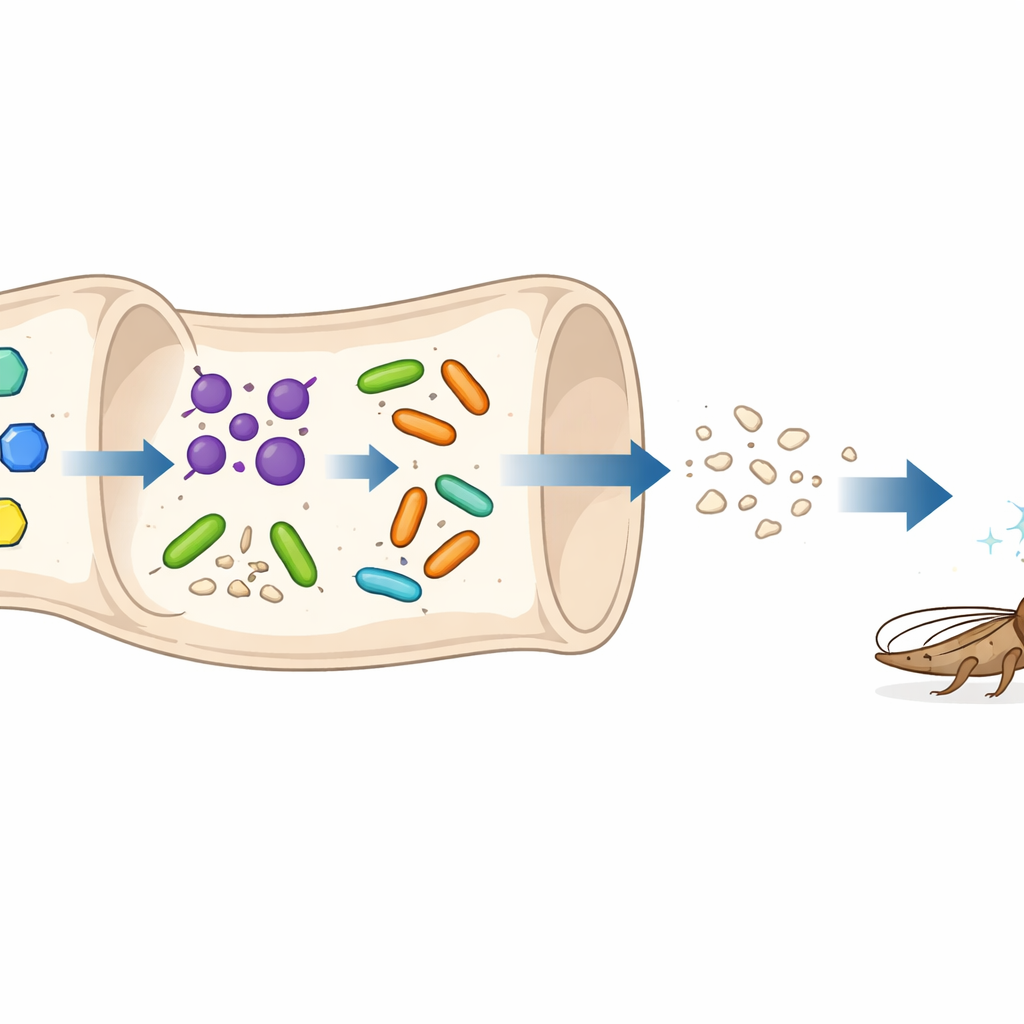
To find out how effective this breakdown really was, the scientists used a sensitive instrument (LC–MS/MS) to measure how much imidacloprid remained after the bacteria had two weeks to work. In flasks without bacteria, some of the insecticide disappeared on its own, but most remained. In contrast, flasks containing Paenibacillus amylolyticus had lost about 73 percent of the original imidacloprid, and those with Serratia marcescens had lost about 67 percent. This showed that the bacteria were actively degrading the chemical, not just tolerating it. Although the study did not identify the exact breakdown products or pathways, it strongly suggests that these gut microbes can lighten the toxic load that the insect experiences.
From hidden partners to new control ideas
By showing that specific gut bacteria in brown planthoppers can rapidly dismantle a major insecticide, this work helps explain how such a small insect can withstand powerful chemical attacks. Resistant insects are not just tougher on their own; they are supported by microbial partners that share the work of detoxification. In the long run, understanding and perhaps disrupting these partnerships—by targeting key bacteria or altering the insect gut environment—could lead to new, more sustainable ways to protect rice crops. Instead of simply increasing pesticide doses, future strategies might aim to manage the pest’s microbiome, turning its hidden allies into potential weak points.
Citation: Chowdary, D.D., Sridhar, Y., Rao, G.R. et al. Diversity of culturable gut bacteria associated with brown planthopper, Nilaparvata lugens (Stål) and their role in imidacloprid degradation. Sci Rep 16, 12652 (2026). https://doi.org/10.1038/s41598-026-41348-y
Keywords: brown planthopper, gut bacteria, imidacloprid resistance, pesticide degradation, rice pests