Clear Sky Science · en
Aeroponic and NFT system optimization for lettuce: effects of flow rate and nutrient source on water use efficiency, growth, and profitability
Growing More Food with Less Water
As cities expand and climates grow hotter and drier, farmers are under pressure to produce more food using far less water. This study looks at how to grow lettuce without soil, using carefully controlled water systems inside a greenhouse. By comparing two popular soilless setups and two different nutrient sources, the researchers show how to save water, boost yields, and even earn more money per plant—insights that matter to anyone concerned about future food security.
Farming Without Soil
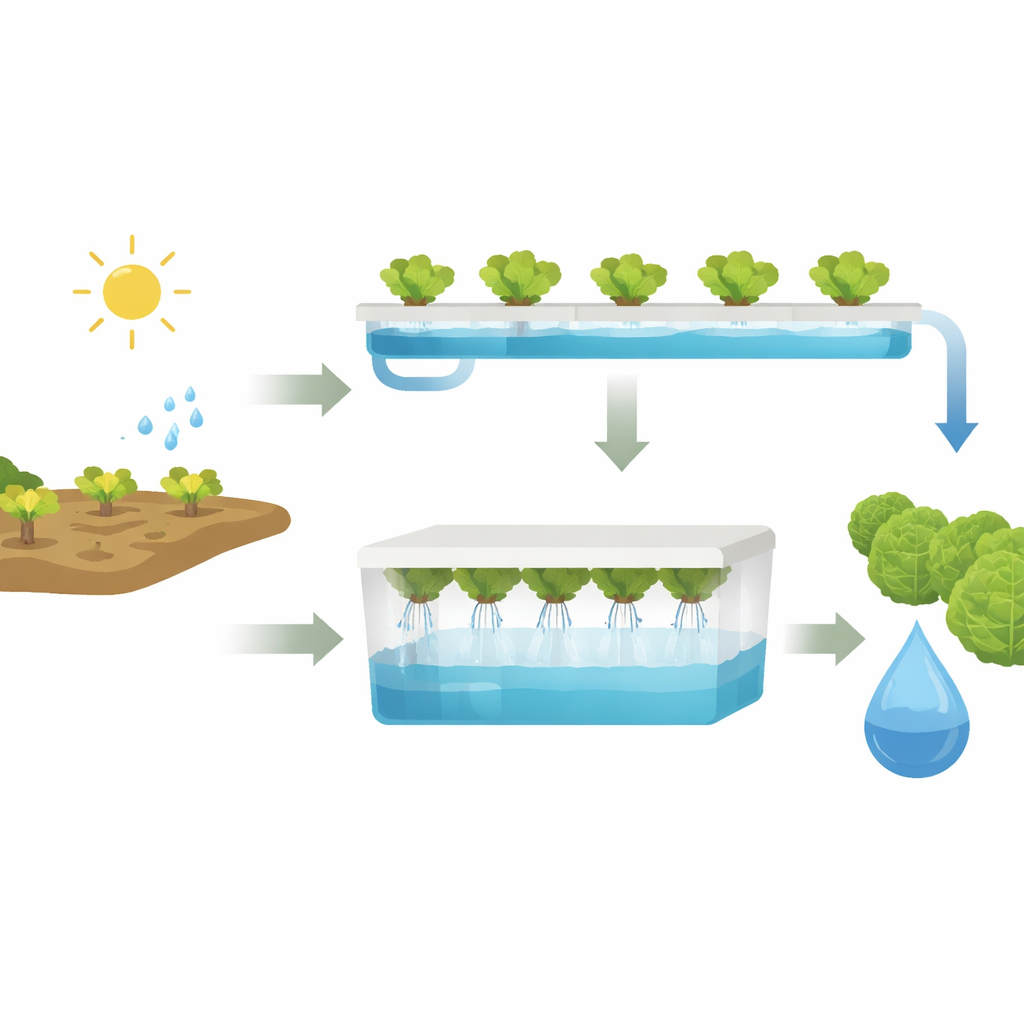
Instead of fields of earth, the team worked with two water-based systems: the nutrient film technique (NFT) and an aeroponic setup. In NFT, lettuce sits in long pipes while a thin sheet of nutrient-rich water flows past the roots. In aeroponics, the plants stand above a closed tank and their roots dangle in the air, where they are regularly sprayed with a fine nutrient mist. Both systems recirculate water, cutting waste dramatically compared with traditional irrigation. The experiments took place in an unheated plastic greenhouse in Egypt, using iceberg lettuce grown over about 55 days from seed to harvest.
Turning Wells and Fish into Plant Food
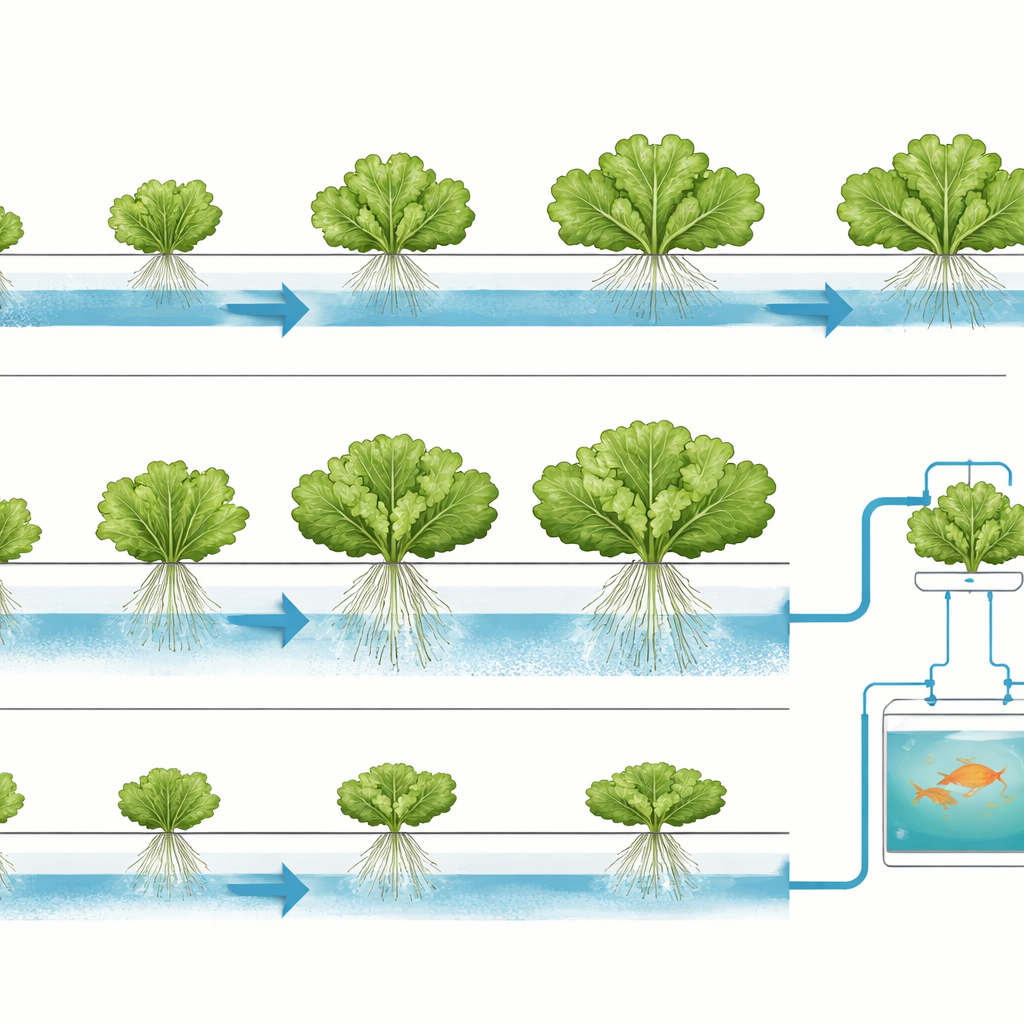
The study also compared two sources of plant nutrition. One was a classic chemical mix dissolved in well water, based on a well-known recipe used in many hydroponic farms. The other was drainage water from a closed tank of Nile tilapia, where fish waste naturally supplies nitrogen and other key nutrients. This “fish water” was filtered and pumped to the plants, creating a simple aquaponic loop in which fish and lettuce benefit from the same water. The researchers ran both nutrient sources through NFT and aeroponic systems at four different water flow rates, then tracked nutrient uptake, plant growth, and overall water use.
Finding the Sweet Spot for Water Flow
The results show that more water is not always better. In the NFT system, lettuce took up the most nutrients and reached its highest fresh weight at a mid-range flow rate of 1.6 liters per hour; pushing the flow faster to 2 liters per hour actually reduced nutrient uptake and growth, likely because nutrients rushed past the roots too quickly. In contrast, the aeroponic system performed best at the lowest tested flow rate of 0.8 liters per hour, where roots had enough time in the mist to absorb both water and dissolved minerals while staying well supplied with oxygen. Across almost all nutrients measured—nitrogen, phosphorus, potassium, calcium, and magnesium—aeroponics at low flow beat NFT at its best flow.
More Lettuce per Drop and Better Returns
These patterns translated directly into crop performance and water use efficiency, a measure of how many kilograms of lettuce are produced per cubic meter of water. Aeroponics at 0.8 liters per hour delivered the heaviest shoots and the highest water use efficiency, improving this metric by about two-thirds compared with NFT under both nutrient sources. NFT at 1.6 liters per hour did offer a modest water-use advantage over aeroponics at higher flows, but it never matched the best aeroponic setting. Economically, aeroponics also came out ahead: even though its equipment and operation were slightly more expensive, the higher yields meant 34% more net profit than NFT with the standard nutrient mix and about 5% more when fish water was used. Incorporating fish culture raised costs but added a valuable second product—marketable fish—so total income and profit were higher than using chemical nutrients alone.
What This Means for Future Food
For growers and planners looking beyond conventional fields, this work offers a clear message in simple terms: carefully tuned aeroponic systems can grow more lettuce with less water and more profit than a widely used hydroponic alternative. Running aeroponics at a gentle flow and feeding it with nutrient-rich fish water not only boosts plant growth and nutrient uptake, it also turns waste from aquaculture into useful fertilizer. In regions facing water scarcity and limited farmland, such closed-loop, soilless systems could play an important role in producing fresh vegetables and fish side by side, helping stretch every drop of water further while keeping production financially viable.
Citation: El-Demerdash, D.I., Morad, M.M., Wasfy, K.I. et al. Aeroponic and NFT system optimization for lettuce: effects of flow rate and nutrient source on water use efficiency, growth, and profitability. Sci Rep 16, 14292 (2026). https://doi.org/10.1038/s41598-026-41347-z
Keywords: hydroponic lettuce, aeroponics, aquaponics, water use efficiency, soilless agriculture