Clear Sky Science · en
Optimized environmental prediction in smart buildings using Dynamic Greylag Goose algorithm and deep learning
Smarter Buildings for Everyday Comfort
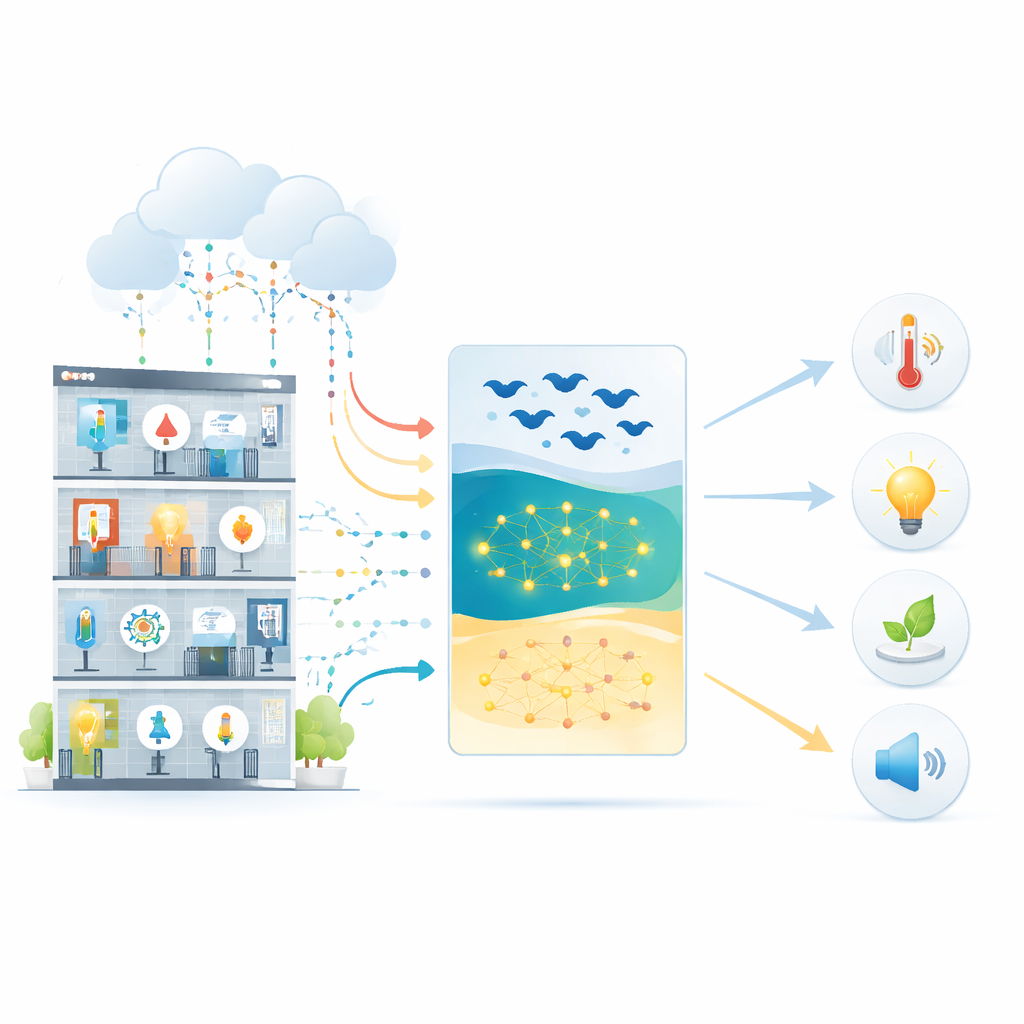
Imagine living or working in a building that quietly adjusts itself—keeping the air fresh, the temperature pleasant, and the lights just right—without wasting energy. As more buildings fill up with Internet-connected sensors, they collect huge amounts of data about indoor conditions. This paper explores how to turn that flood of information into accurate predictions of what the indoor environment will be like in the next minutes or hours, so that heating, cooling, lighting, and ventilation systems can act ahead of time instead of reacting too late.
Why Indoor Conditions Are Hard to Predict
Modern smart buildings use many sensors to track temperature, humidity, light, air quality, and noise around the clock. These signals change over time in complicated ways: mornings differ from evenings, weekdays from weekends, and sudden events—like opening a window or a crowd entering a room—can cause sharp jumps. Because there are so many sensors, the data are high-dimensional and often noisy. Simple models struggle to capture these patterns, leading to inaccurate forecasts and inefficient control of heating, ventilation, and air conditioning systems. The challenge is to sift through this complex data, keep only the most informative signals, and learn how they evolve over time.
A Learning System Inspired by Bird Flocks
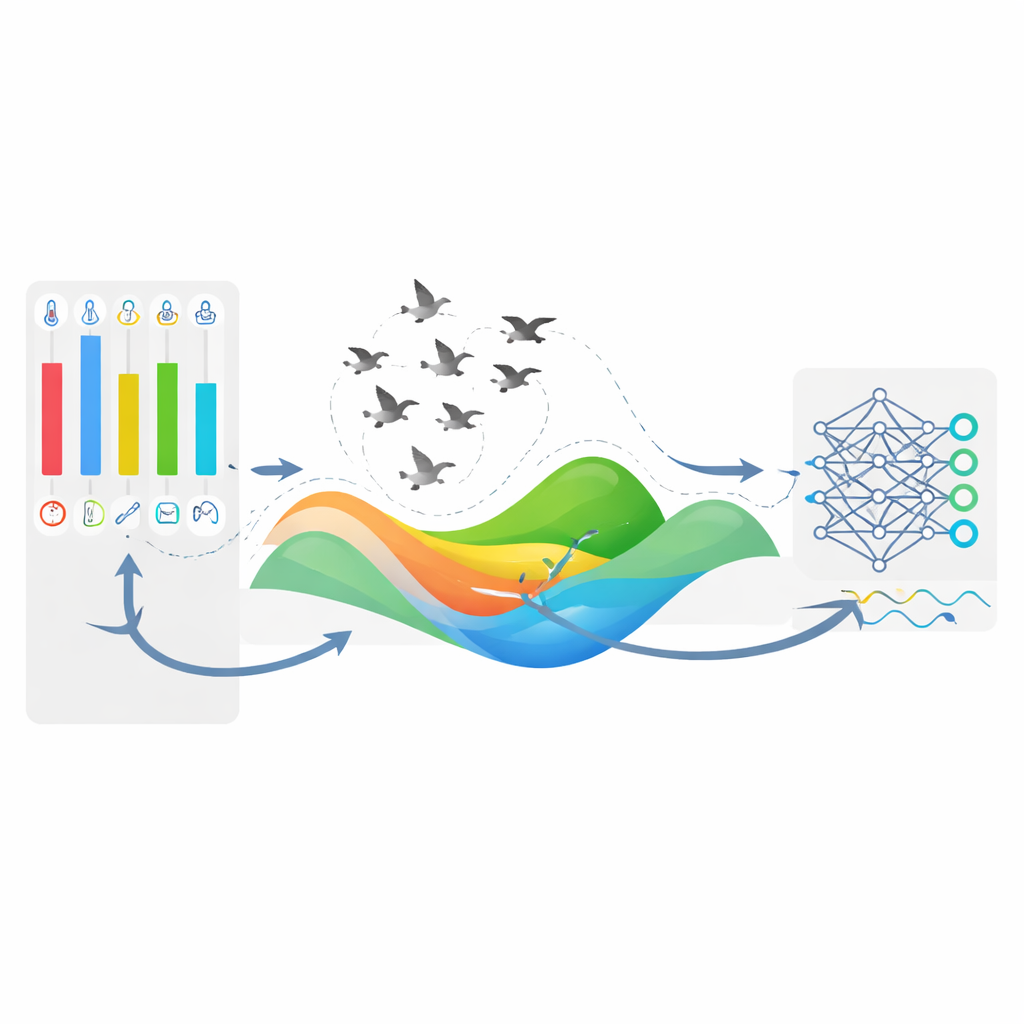
The authors propose an intelligent prediction framework that combines two ideas: a deep learning model called Long Short-Term Memory (LSTM), and a nature-inspired optimizer modeled on the behavior of greylag geese. LSTM networks are especially good at learning from sequences, making them well suited to time-stamped sensor data. The Dynamic Greylag Goose Optimization (DGGO) algorithm mimics how flocks explore large areas and gradually home in on favorable routes. In the framework, virtual “geese” explore different choices for which sensor features to keep and how to set the LSTM’s internal settings. Over time, their search pattern shifts from broad exploration to fine-tuned adjustment, helping the system avoid getting stuck in poor solutions.
Picking the Right Signals and Tuning the Brain
A key step is feature selection—deciding which pieces of sensor information actually help prediction. The researchers convert each possible subset of features into a simple on–off pattern and let a binary version of DGGO search through those patterns. It tends to select combinations that summarize both the level and the recent trend of indoor variables, as well as how they relate to one another—such as the ratio of temperature to humidity or rolling averages that smooth out momentary spikes. After this trimming step, DGGO is used again to tune the LSTM’s structure and training settings, such as how many units to use in each layer and how fast the model should learn. This two-stage optimization aims to produce a compact, fast, and accurate model tailored to the building’s data.
How Well the System Performs
The team tested their approach on a public dataset collected from a smart building equipped with sensors for temperature, humidity, light, air quality, and sound. They compared their DGGO-tuned LSTM model with several alternatives, including other optimization methods that imitate wolves, whales, or a simpler goose strategy. The DGGO-LSTM combination achieved the lowest prediction error and the highest efficiency score among all tested setups. It reduced the main error measure by roughly 17–37 percent compared with the next best methods and ran about 42 percent faster than one of the competing optimizers. Cross-checks such as repeated train–test splits, analysis of differences between training and validation performance, and tests on a completely different industrial IoT dataset all suggest that the gains are genuine and not just overfitting to one particular case.
What This Means for Everyday Life
For non-specialists, the takeaway is straightforward: by carefully choosing which sensor readings matter and using an optimization strategy inspired by bird flocks to fine-tune a deep learning model, buildings can learn to “see into the near future” of their indoor environment. That allows control systems to adjust heating, cooling, and ventilation before conditions drift out of comfort range, while avoiding unnecessary energy use. The result is a pathway toward smarter, greener buildings that quietly keep occupants comfortable and healthy, backed by a predictive engine that remains accurate, efficient, and adaptable as sensor networks and data volumes continue to grow.
Citation: Kenawy, S., Alhussan, A.A., Khafaga, D.S. et al. Optimized environmental prediction in smart buildings using Dynamic Greylag Goose algorithm and deep learning. Sci Rep 16, 10769 (2026). https://doi.org/10.1038/s41598-026-41343-3
Keywords: smart buildings, environmental forecasting, IoT sensor data, deep learning, optimization algorithms