Clear Sky Science · en
Theoretical analysis of prestressed unequal-walled rectangular concrete-filled steel beams
Why stronger, lighter beams matter
Modern bridges and long-span structures must carry ever-heavier traffic over wider valleys and rivers, all while keeping construction costs and material use under control. Yet long beams tend to sag under their own weight and under traffic, which can lead engineers to overbuild with extra steel and concrete. This paper explores a new kind of beam that combines steel, concrete, and built-in tensioning so that the materials work together more efficiently, allowing structures to stay stiff and safe without becoming excessively heavy.
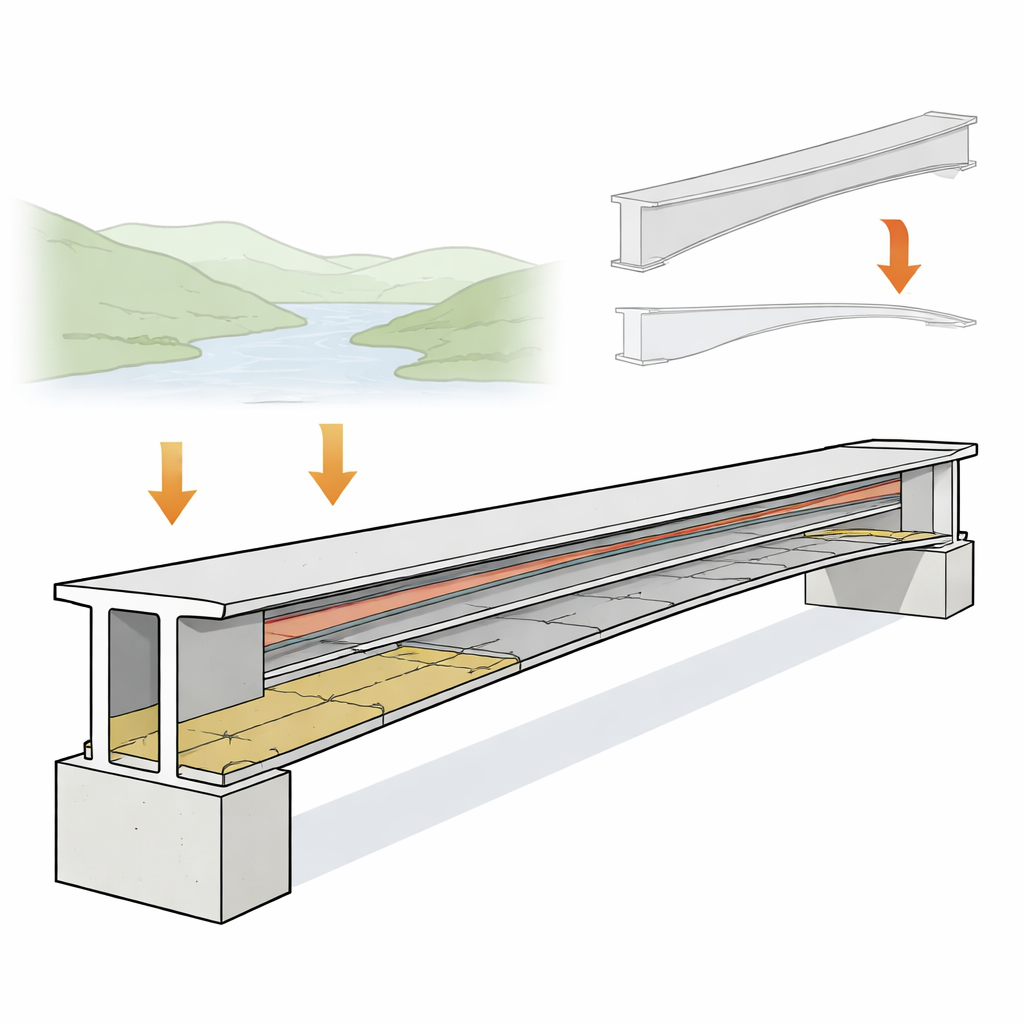
A new mix of steel, concrete, and built-in tension
The researchers focus on a beam made from a hollow rectangular steel box whose walls do not all have the same thickness. The bottom plate is thicker, the top plate thinner, and the vertical sides are relatively light. The hollow space in the lower part of the box can be partially or fully filled with concrete. Inside the box, steel bars are pulled tight before the beam is put into service; this built-in pull, called prestressing, makes the beam curve upward slightly and puts much of the section into gentle compression. The goal is to reduce cracking in the concrete and delay permanent bending when the beam is later loaded by traffic or other forces.
Putting the new beam to the test
To understand how this hybrid beam behaves, the team built and tested ten real beams three meters long. All had the same outer steel shape but differed in two key ways: how much of the box was filled with concrete (from empty, to one-third, one-half, two-thirds, and completely full) and how much prestress was applied (low and high levels). The beams were bent using a standard four-point loading setup that creates a pure bending zone in the middle, letting the researchers focus on how the beams resist bending rather than shear. They carefully measured how much the beams deflected, when the concrete began to crack, when the steel started to yield, and how strains were distributed across the depth of the section.
What the experiments revealed
The measurements showed that prestressing is highly effective at keeping cracks at bay: under the tested conditions, the load needed to start cracking in the concrete more than doubled for some beams. Increasing the concrete filling generally raised the maximum bending resistance, with the best performance around a two-thirds fill in the experiments, giving roughly 50% more ultimate capacity than an empty steel box. However, filling beyond that did not keep improving strength under extreme loads; extra concrete adds weight and can crack, so it does not always contribute to carrying more bending. The tests also confirmed that the beam deforms in a simple, nearly linear way across its depth even as parts of the steel and concrete begin to yield, which supports the use of classical beam theory for design.
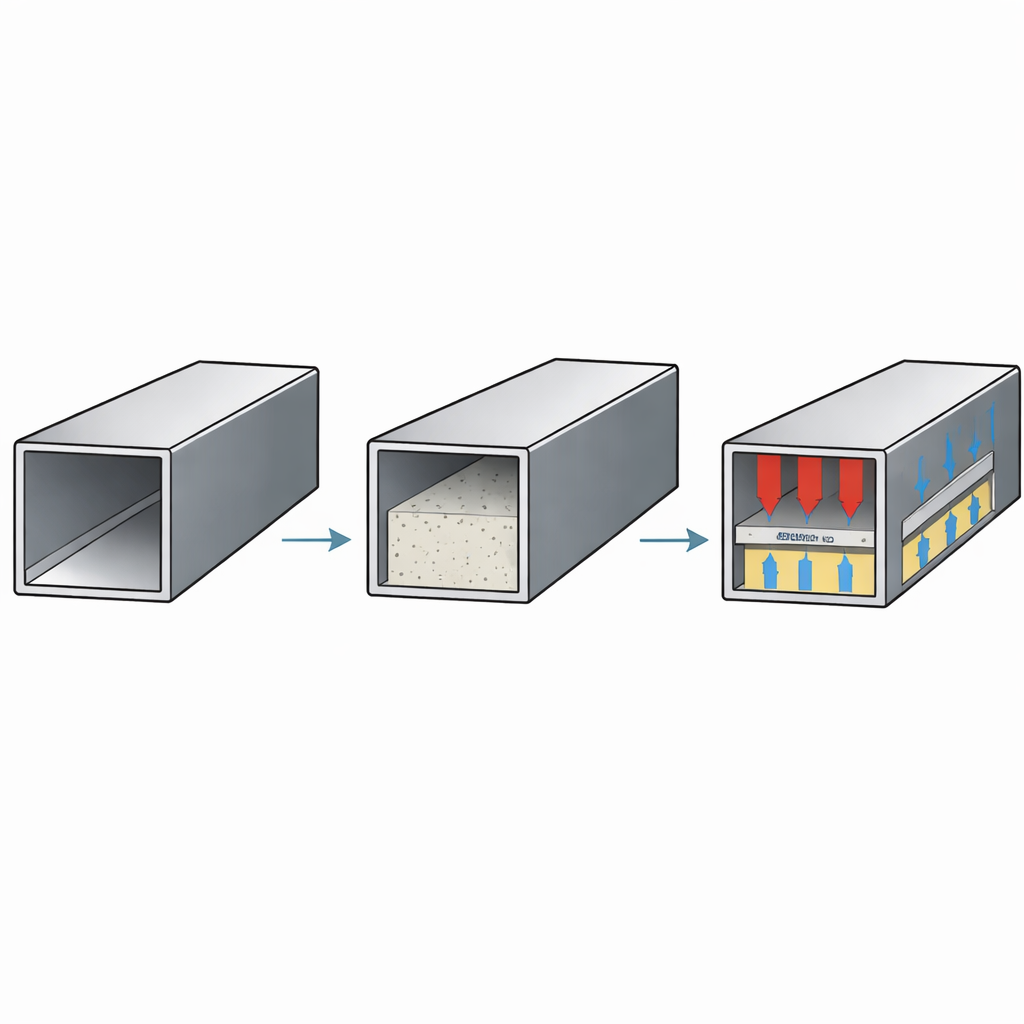
From test data to design formulas
Building on the experiments, the authors developed mathematical expressions that predict two quantities of great interest to designers: the cracking moment (the bending level at which concrete first cracks) and the ultimate moment (the highest bending the beam can sustain). These formulas take into account the geometry of the cross-section, the strength of the steel and concrete, the level of prestress, and how much of the box is filled. They were checked against both the physical tests and detailed computer simulations and were found to match very closely on average. With these tools, engineers can vary the concrete filling and prestress continuously on paper, rather than relying only on discrete tested cases, to search for combinations that maximize performance or minimize material use.
Finding the sweet spot in concrete filling and prestress
The analysis reveals some clear guiding trends. As long as the concrete filling stays below about 60% of the inner depth, the concrete should remain uncracked during normal service for beams similar to those studied. Beyond that, further filling can actually lower the cracking resistance, even though it still adds weight. When the contribution of internal plates is ignored to simplify the picture, the theory predicts that the ultimate bending strength peaks at a filling ratio of about 41%, highlighting that there is an optimal intermediate amount of concrete rather than a simple "more is better" rule. Prestressing continues to raise the cracking moment, but under the specific test conditions it does not significantly change the ultimate strength because the prestressing bars reach their own limits first. Using stronger tendons in future designs could extend the benefit of prestress into the extreme load range as well.
What this means for future bridges
For readers, the key takeaway is that by carefully balancing how much concrete is placed inside a shaped steel box and how strongly the internal steel bars are pulled tight, engineers can create beams that resist sagging and cracking far better without simply adding bulk. The study provides design-ready formulas that point to safe ranges of concrete filling and show how much prestress is worthwhile. In practical terms, this means that long-span bridges and similar structures could become lighter, more material-efficient, and more durable, while still meeting demanding safety and serviceability requirements.
Citation: Su, Q., Zhang, Z. & Li, S. Theoretical analysis of prestressed unequal-walled rectangular concrete-filled steel beams. Sci Rep 16, 8712 (2026). https://doi.org/10.1038/s41598-026-41341-5
Keywords: concrete-filled steel beams, prestressed structures, bridge engineering, structural optimization, composite beams