Clear Sky Science · en
Comparing hemodynamic and cardiorespiratory responses during six-minute walk and step tests in mild acute COVID-19
Why simple walking tests still matter after COVID
Many people who recover from even a mild case of COVID-19 notice that climbing stairs or walking quickly feels harder than it used to. Doctors need safe, low‑tech ways to measure how well a person’s heart and lungs cope with everyday effort, without sending everyone to a high‑tech exercise lab. This study compares two very simple six‑minute tests—one based on walking and one based on stepping up and down—to see how they stress the body in adults who recently had mild COVID-19.
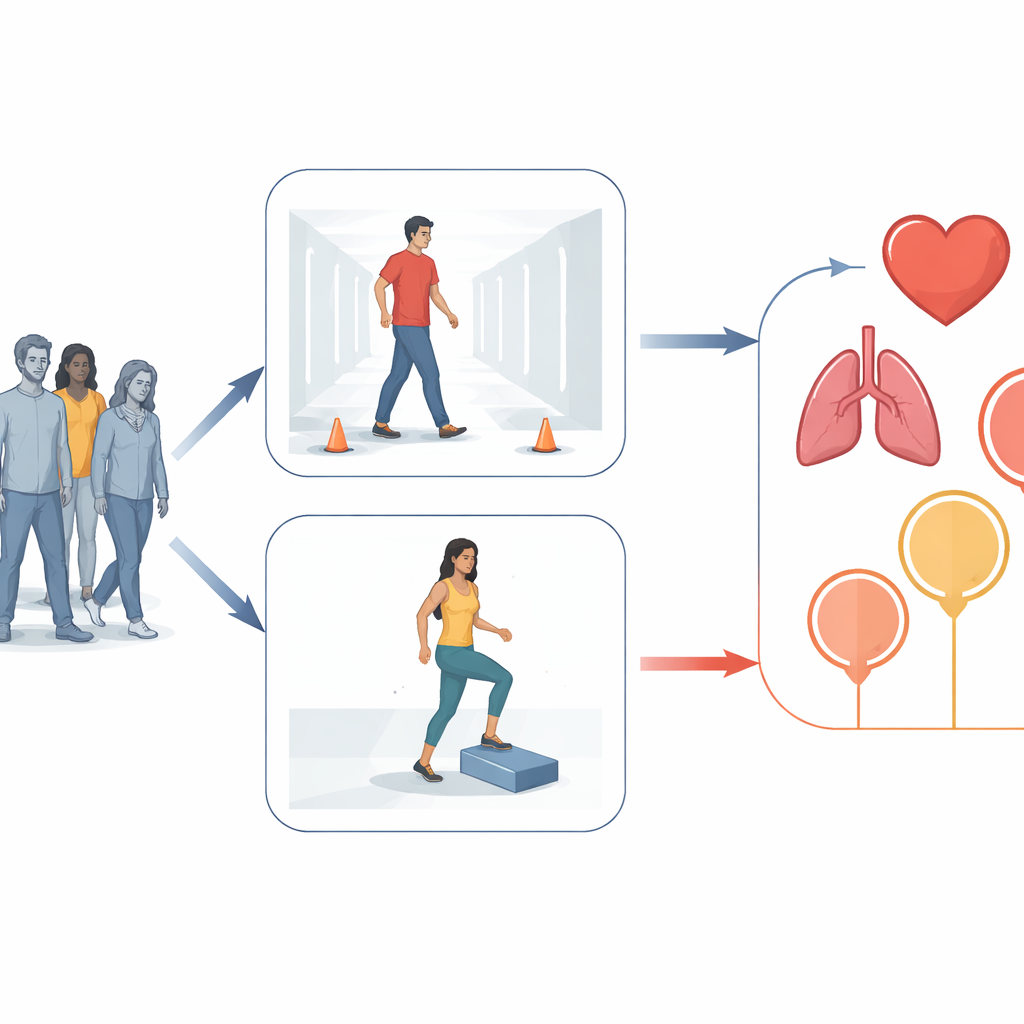
Two easy tests of everyday effort
The researchers focused on the six‑minute walk test, where a person walks back and forth along a corridor, and the six‑minute step test, where they repeatedly go up and down a single 20‑centimeter step. Both tests are widely used because they are cheap, quick, and mimic common daily activities. In this project, 40 adults about five weeks after testing positive for COVID-19 took part. Most were in their mid‑30s, slightly overweight on average, and had not been hospitalized. Before the tests, the team measured lung function, body composition, handgrip strength, and usual physical activity, then monitored breathing gases, heart rate, blood pressure, and perceived breathlessness during each six‑minute effort.
How the body reacts to walking versus stepping
On paper, the two tests looked similar: participants reached just over 80% of the distance or step count expected for healthy people of the same age and sex in both tests. But inside the body, the story was different. The step test drove heart rate much higher than the walk, pushing participants to about 85% of their age‑predicted maximum heart rate, compared with about 69% during walking. Systolic blood pressure rose more during stepping, and people reported more breathlessness and leg fatigue. Measurements of oxygen use and ventilation showed that the step test demanded more from the heart, lungs, and working muscles from the very first minute and kept those demands higher through most of the recovery period.
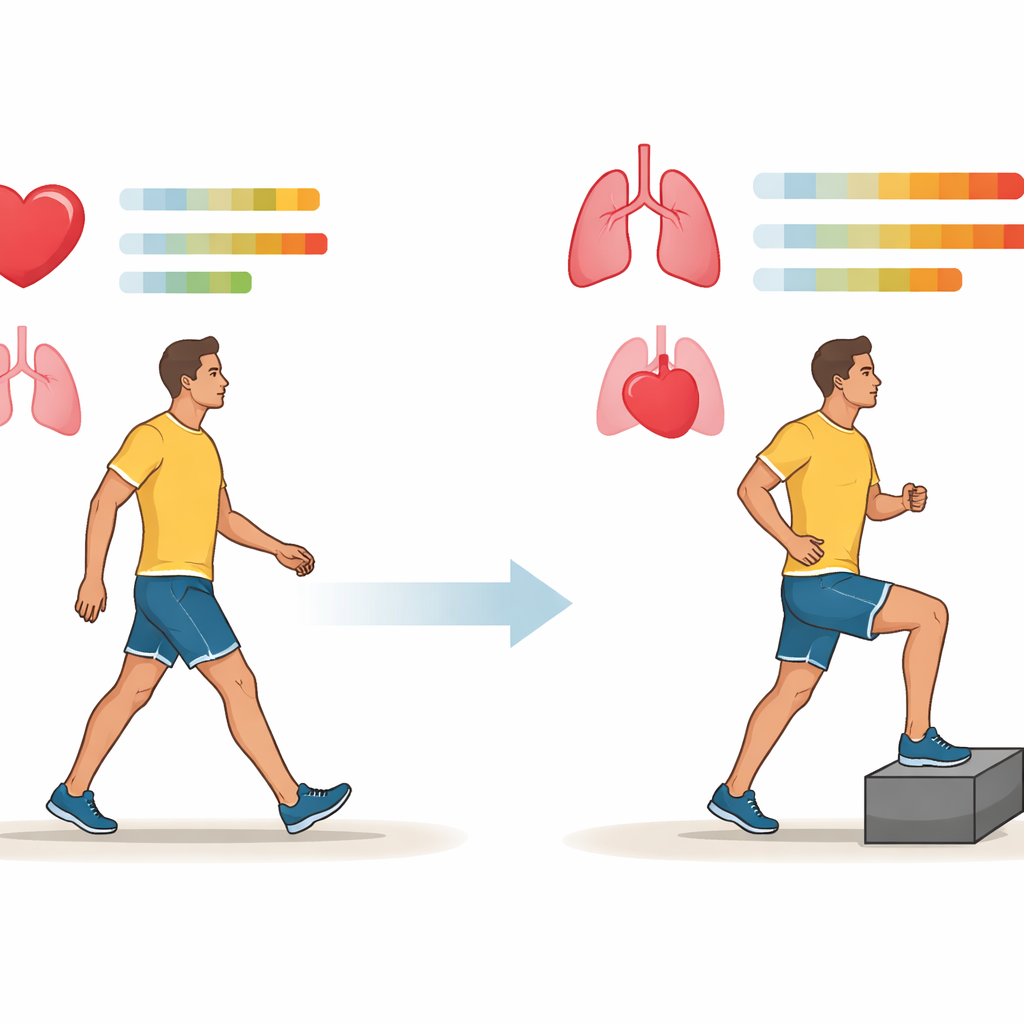
What shapes performance after mild COVID
The scientists then asked which personal features best explained who performed well and who struggled. For the step test, a mix of traditional factors—such as age, sex, body size, and maximum heart rate—combined with more detailed lung measures and body‑fat distribution explained roughly half or more of the differences in how many steps people could do and how much oxygen they used. In particular, tests of how well oxygen crosses from the lungs into the blood, and measures of total and leg fat, added useful information. By contrast, for the walking test, simple traits such as height, handgrip strength, and the distance walked explained far less of the variation in performance and oxygen use, suggesting that walking is a gentler, less discriminating challenge in this group.
Choosing the right test for the right person
Because the step test produces stronger heart and breathing responses, it may reveal subtle limitations in people who seem young and otherwise healthy after mild COVID‑19, especially when space or equipment is limited, such as during home‑based or remote rehabilitation. The walk test, however, remains an excellent reflection of real‑world walking ability and carries a long track record across many illnesses. The authors argue that the two tests should be seen as complementary tools rather than interchangeable ones: stepping is better when one wants to probe the limits of the cardiorespiratory system, while walking is better when the main concern is mobility in daily life and safety in more fragile patients.
What this means for life after mild COVID
In plain terms, this study shows that not all simple exercise tests are created equal. Even after a mild case of COVID‑19, going up and down a step for six minutes taxes the heart and lungs far more than walking on level ground for the same time. Measures of lung gas exchange and body fat help explain why some people cope well and others feel wiped out. For patients and clinicians, this means that carefully chosen field tests can give meaningful insight into lingering effects of COVID-19 and guide safer, more tailored exercise advice, without needing a full laboratory stress test.
Citation: Santos-de-Araújo, A.D., Bassi-Dibai, D., Marinho, R.S. et al. Comparing hemodynamic and cardiorespiratory responses during six-minute walk and step tests in mild acute COVID-19. Sci Rep 16, 10234 (2026). https://doi.org/10.1038/s41598-026-41337-1
Keywords: six-minute walk test, six-minute step test, mild COVID-19, exercise capacity, cardiorespiratory response