Clear Sky Science · en
Sleep deprivation alters hippocampal dendritic spines in a contextual fear memory engram
Why Losing Sleep After Trauma Matters
Most of us have heard that “sleep helps memories stick.” But what if, after a deeply frightening event, letting a memory stick is exactly what makes future anxiety and post-traumatic stress worse? This study in mice peeks into the brain at the level of tiny connections between nerve cells to ask: how does missing sleep right after a scary experience change the way that frightening memory is stored—and could that actually blunt its power later on?
The Brain’s Fear Traces
Memories do not float in the brain as abstract ideas; they are held in specific groups of neurons often called memory “traces” or “engrams.” In this work, the researchers focused on a brain region called the hippocampus, crucial for linking places and contexts to events—such as remembering which room was associated with a shock. They used genetically engineered mice in which neurons active during a particular learning event could be permanently tagged. When mice learned to fear a context paired with mild shocks, the neurons that carried this new fear memory were marked in one color, while neighboring, uninvolved neurons were marked in another. This allowed the team to directly compare the physical connections in “fear-memory cells” and “bystander cells.” 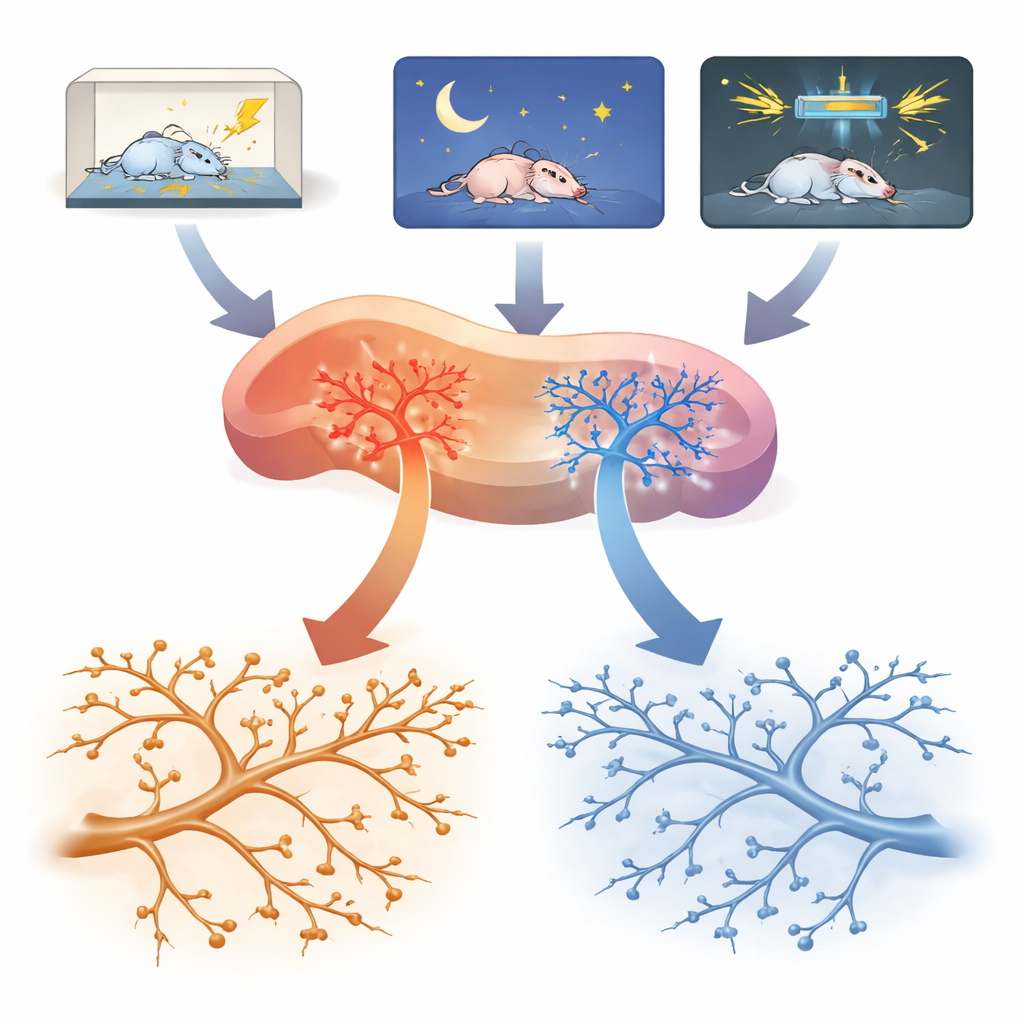
Zooming In on Tiny Connections
Neurons communicate through countless small protrusions called dendritic spines, which dot their branch-like extensions. These spines come in different shapes: thin and flexible, stubby, or mushroom-shaped with big heads that usually signal stronger, more stable connections. After fear learning, some mice were allowed to sleep normally, while others were gently kept awake for five hours, mimicking acute sleep loss right after a traumatic event. Using high-resolution confocal microscopy and 3D analysis, the team counted and measured spines on tagged fear-memory neurons and on nearby non-engram neurons in the hippocampus. This approach let them ask whether lost sleep selectively reshapes the very synapses that encode a frightening experience.
How Missing Sleep Reshapes Fear Memories
When the animals were examined soon after learning, sleep loss did not simply shrink all connections. Instead, it specifically reduced the number of mushroom-shaped spines on the fear-memory neurons, while leaving neighboring cells largely unchanged. In mice that slept, these engram cells showed more large, strong-looking spines and increases in the size and surface area of many thin spines—suggesting that, during sleep, fragile new connections were being strengthened and perhaps transformed into long-lasting ones. In contrast, sleep-deprived mice showed fewer of these robust spines, implying that missing sleep had interrupted the normal “upgrading” of the fear memory’s wiring. 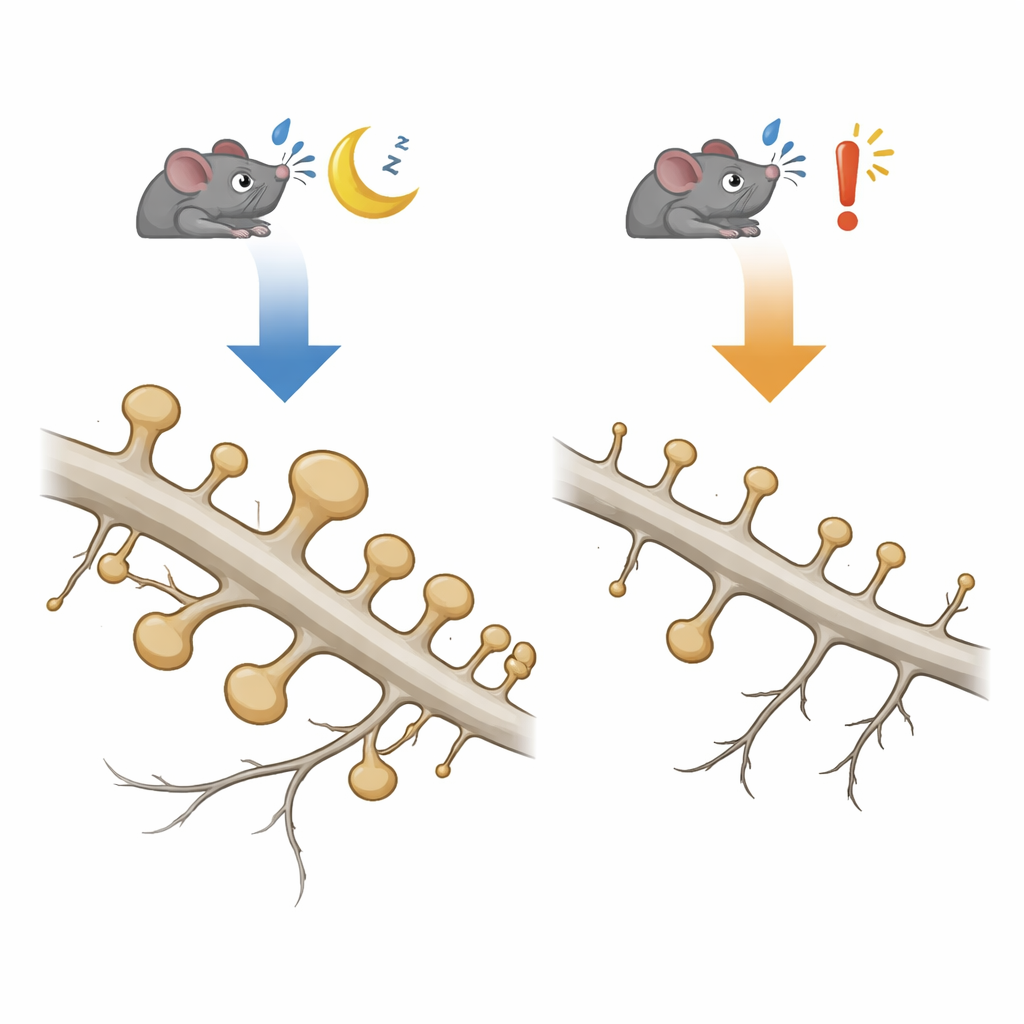
What Happens When Fear Returns
Real-life trauma is often repeated, so the researchers asked what would happen if the mice were re-exposed to the frightening context four weeks later. In control animals that had slept after the first event, this second exposure led to stronger-looking connections not only in the original fear-memory neurons but also in neighboring neurons that had not been part of the first trace, pointing to an expansion of the fear network. In mice that had been sleep-deprived after the initial trauma, re-exposure produced weaker overall spine density, especially in non-engram neurons, and behaviorally these mice tended to freeze less at first, a sign of reduced fear expression. Detailed measurements showed complex shifts in spine size and shape, but the broad picture was that early sleep loss blunted later synaptic strengthening linked to the traumatic memory.
Possible Clues for PTSD Prevention
At a practical level, the results support an intriguing and somewhat counterintuitive idea: while sleep is generally essential for learning and health, immediately after a severe emotional shock it may also lock in the detailed memory of that event. Briefly preventing sleep right after trauma, at least in this mouse model, weakens the tiny synaptic “footprints” of the fearful context and limits the later growth of the fear network. That, in turn, appears to soften the behavioral response to renewed threat. Although many steps remain before translating such findings to people, the work provides a cellular explanation for why carefully timed sleep disruption might one day help reduce the risk or severity of post-traumatic stress disorder by keeping traumatic contextual memories from becoming too deeply hardwired.
Citation: Tennin, M., Matkins, H.T., Rexrode, L. et al. Sleep deprivation alters hippocampal dendritic spines in a contextual fear memory engram. Sci Rep 16, 10381 (2026). https://doi.org/10.1038/s41598-026-41336-2
Keywords: sleep deprivation, fear memory, hippocampus, dendritic spines, PTSD