Clear Sky Science · en
Development of lightweight structural brick with polyurethane and composite fibers to increase mechanical performance
Why Lighter Bricks Matter for Safer Buildings
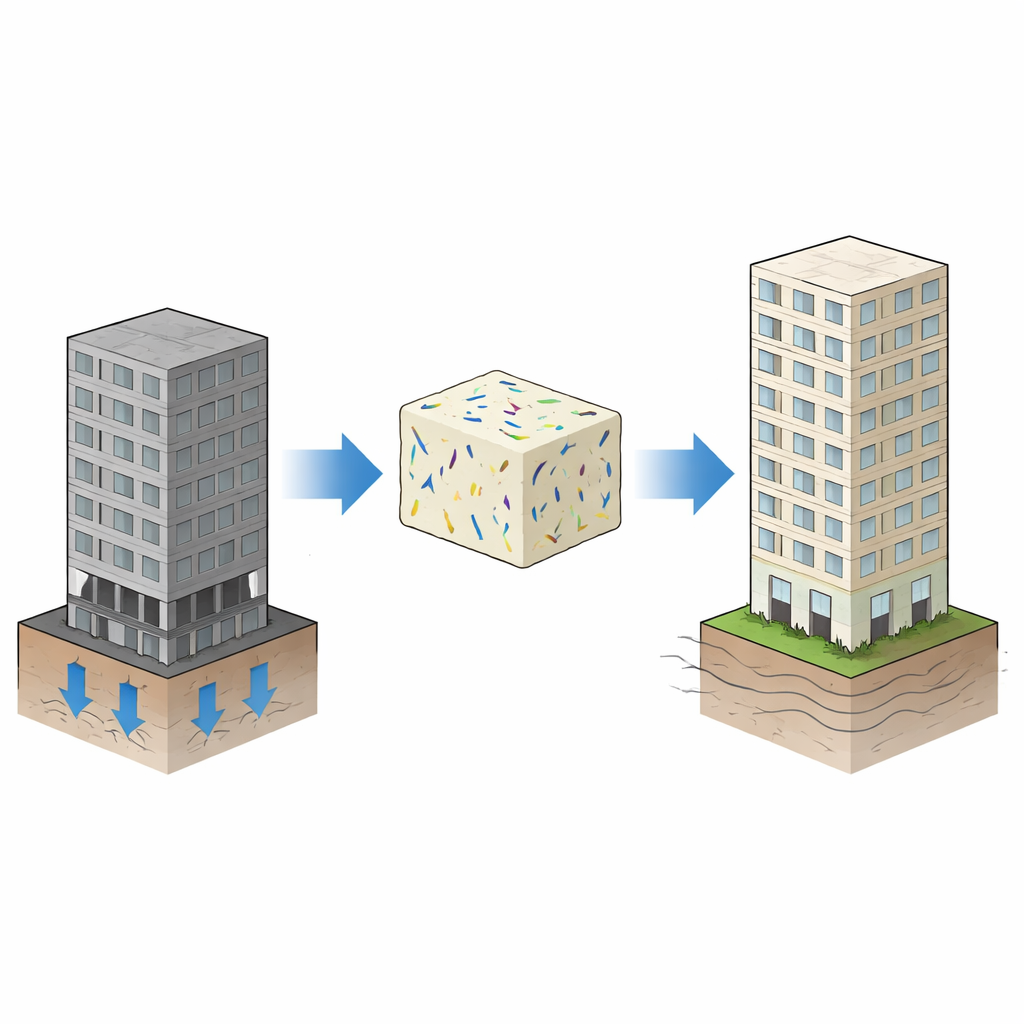
In earthquake-prone regions, the weight of a building can be the difference between minor damage and catastrophic collapse. Heavy walls and floors generate strong forces when the ground shakes. This study explores a new kind of ultra-light brick made from foam-like polyurethane strengthened with tiny fibers. The goal is to create building blocks that are much lighter than traditional clay bricks or concrete, yet still strong and stiff enough to carry loads and resist quakes.
Turning Foam into a Load-Bearing Brick
The researchers started with a rigid type of polyurethane, a plastic commonly used in insulation foams. On its own, this material is light and a good insulator but not strong enough to serve as a main structural element. To boost its performance, the team mixed in short fibers made of glass, basalt (a rock-based fiber), or carbon. These fibers act like miniature reinforcing bars inside the foam, helping it carry higher loads. By varying how much fiber they added and how long the fibers were, they could systematically test which combinations created the best balance of lightness and strength.
Testing Strength Under Crushing and Bending
Using carefully prepared blocks and beams of the foam-fiber mixture, the team measured how each recipe behaved when squeezed and bent. The test pieces were compressed to a small, controlled deformation and loaded in a three-point bending setup, similar to resting a short beam on two supports and pushing down in the middle. Even though the absolute strengths were modest compared with traditional masonry—around 1 megapascal in compression for the best samples—the material is dramatically lighter, which means a given wall or panel would put far less weight on a building’s frame and foundations.
Which Fibers Work Best Inside the Foam
The results showed that not all fibers are equal once they are buried inside the polyurethane. Samples reinforced with glass and basalt fibers carried higher loads and bent more stiffly and predictably than those reinforced with carbon fibers. Long fibers, about 12 millimeters in length, were especially helpful at boosting performance, while fiber content beyond a low level often brought diminishing returns or increased variability. Carbon fiber, despite being very strong in principle, performed poorly here because it clumped together and did not bond well to the surrounding foam, leading to weak regions where cracks could easily start.
Looking Inside the Material
To understand why some mixtures worked better, the researchers examined the internal structure of the foam blocks using optical microscopes and scanning electron microscopes. In the glass and basalt versions, fibers were spread fairly evenly, and the foam cells around them looked regular and undisturbed. In the carbon-fiber samples, however, the fibers tended to gather into dense clusters, leaving nearby voids and distorted foam cells. At high magnification, pulled-out carbon fibers appeared smooth and clean, showing that the polyurethane barely gripped them. In contrast, glass and basalt fibers often carried bits of hardened foam on their surfaces, evidence of better bonding and more effective stress transfer.
Computer Models Back Up the Experiments
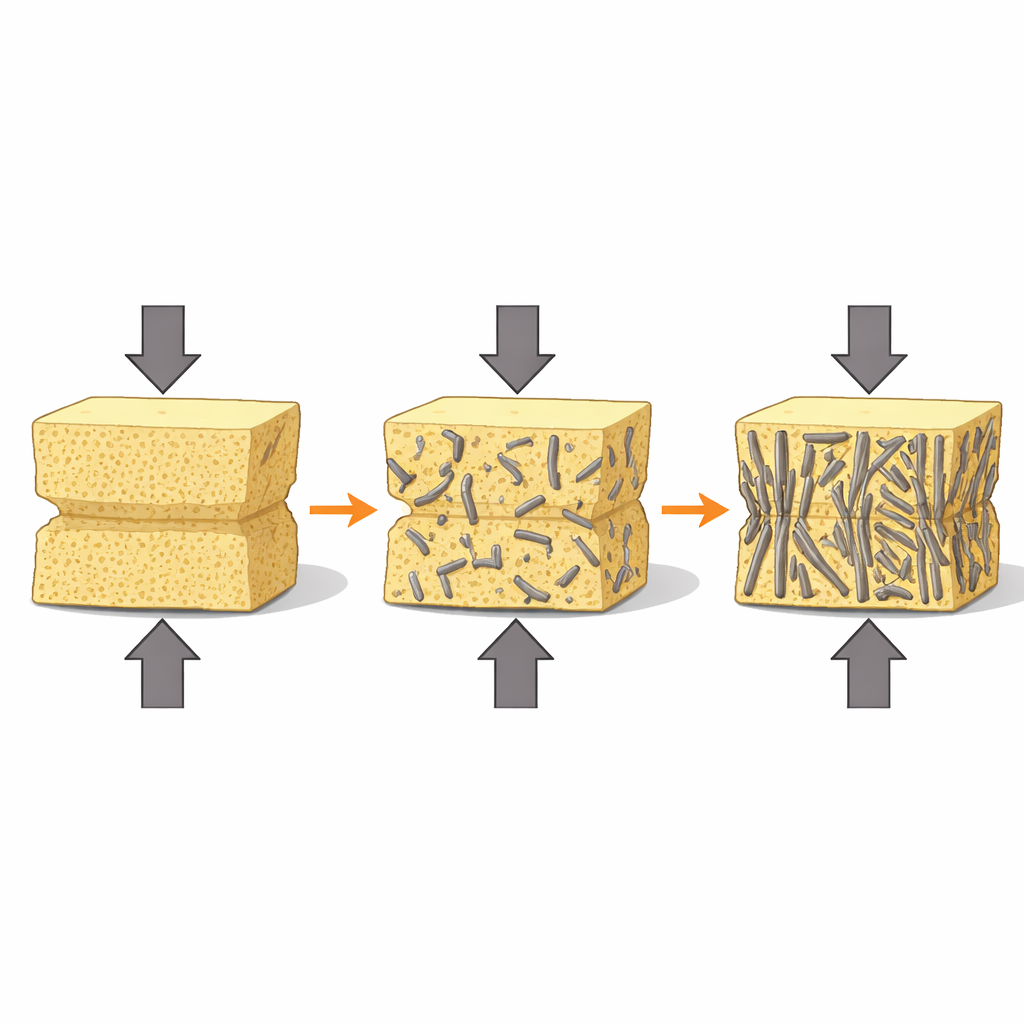
Beyond the lab tests, the team built computer simulations of the composite bricks using finite element modeling. These digital bricks included embedded fiber clusters similar to those in the real samples. When compressed, simulated bricks with added fibers showed higher internal stress resistance and less deformation than pure polyurethane blocks. In bending and in buckling-like loading of slender elements, the models reinforced with basalt fibers were the stiffest, echoing the experimental findings. As fiber content increased, the models became harder to deform, confirming that well-chosen additives can turn a lightweight foam into a more reliable structural material.
What This Means for Future Buildings
Taken together, the tests and simulations suggest that polyurethane bricks reinforced with well-dispersed glass or basalt fibers can function as very light, insulating, yet mechanically capable building units. Although each brick is weaker than a traditional clay brick, its low density means that entire walls and floors weigh far less. This reduced weight lowers the forces generated during an earthquake and could help buildings ride out shaking more safely. With further refinements—especially better bonding between fibers and foam and optimized manufacturing—these fiber-reinforced polyurethane bricks could become practical components for energy-efficient, earthquake-resistant structures.
Citation: Sak, Ö.F., Demir, S. & Şentürk, B.G. Development of lightweight structural brick with polyurethane and composite fibers to increase mechanical performance. Sci Rep 16, 11171 (2026). https://doi.org/10.1038/s41598-026-41331-7
Keywords: lightweight bricks, polyurethane composites, fiber reinforcement, earthquake-resistant structures, sustainable construction