Clear Sky Science · en
High-performance graphene oxide desalination membranes enabled by size-sieving, ion exclusion, and cation recognition mechanisms
Turning Seawater into Drinking Water
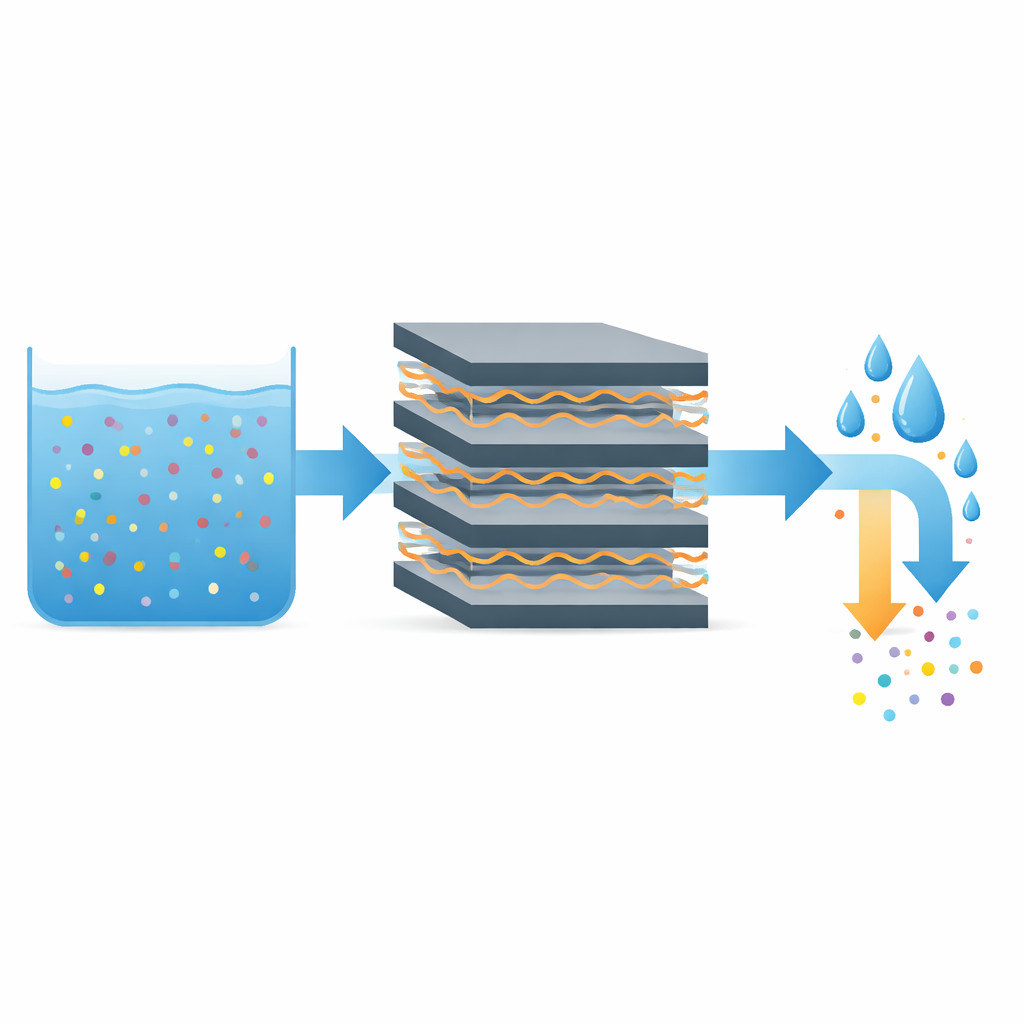
Access to fresh water is tightening worldwide, yet most of Earth’s water is locked in salty seas. Converting seawater into drinkable water already relies heavily on membranes—thin filters that let water through while holding back salt. This study explores a new type of ultra-thin filter made from graphene oxide and a natural sugar-based polymer called chitosan, aiming to clean water more efficiently while staying stable in harsh, real-world conditions.
Why Today’s Filters Need an Upgrade
Modern desalination plants mostly use polymer membranes that are energy efficient but far from perfect. They can clog, degrade under chemicals like chlorine, and struggle to balance two key goals: pushing a lot of water through while still blocking salt. Graphene oxide, a sheet of carbon only one atom thick decorated with oxygen groups, offers an exciting alternative. When stacked, these sheets form tiny channels that water zips through quickly. However, in water these stacks tend to swell and drift apart, widening the channels so much that salt ions slip through and long-term performance deteriorates.
A Natural Helper Between the Layers
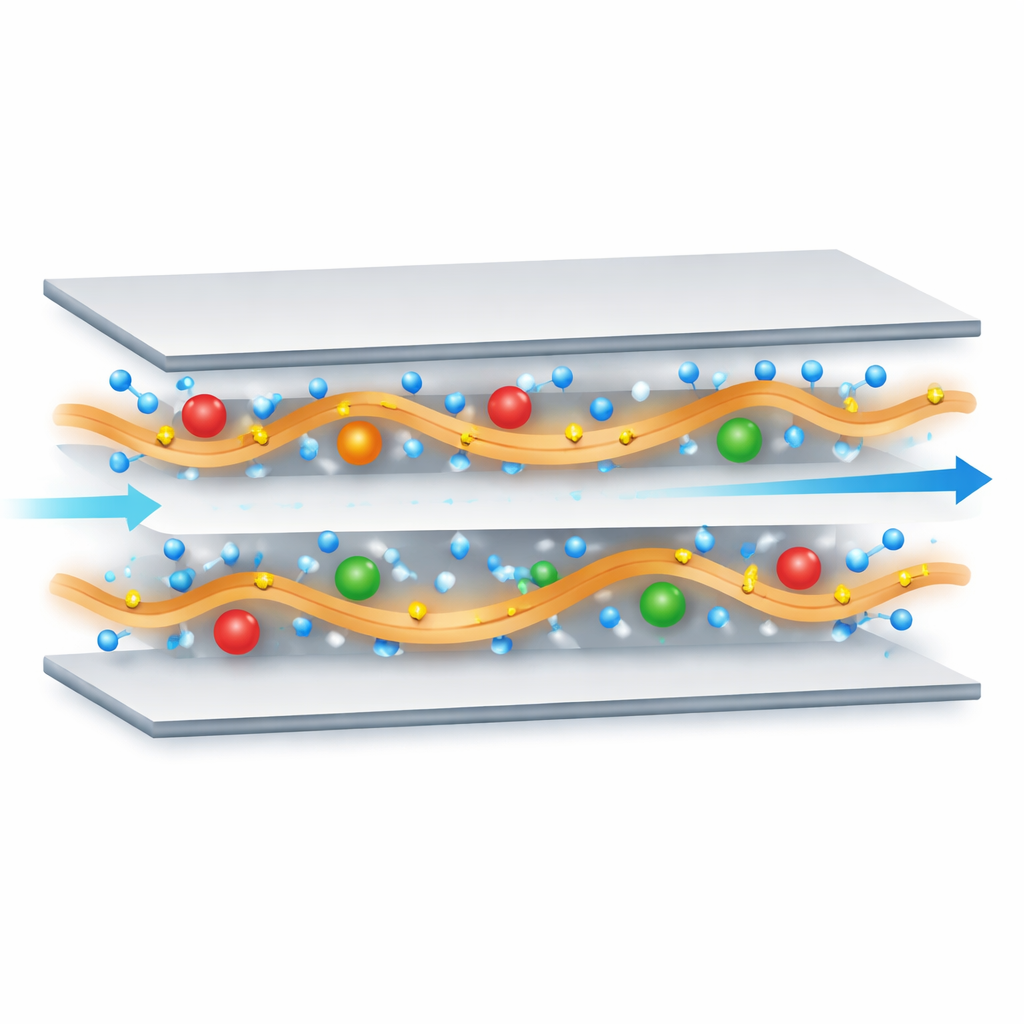
To tame this swelling and add new tricks to the membrane, the researchers threaded chitosan—derived from crustacean shells—between the graphene oxide sheets using a simple pressure-driven assembly process. Chitosan chains bind to the oxygen-bearing groups on graphene oxide through hydrogen bonding and electrostatic attraction. This effectively “stitches” the layers together, fixes the spacing between them, and adds positively charged sites along the channels. By carefully tuning how much graphene oxide and chitosan go into the thin “skin” of the membrane, the team could dial in the channel width, surface charge, and thickness of the active layer.
Three Ways to Keep Salt Out
The upgraded membrane does not rely on a single separation trick. First, its ultra-narrow channels act as a physical sieve: ions and large molecules that are too bulky simply cannot fit through. Second, the graphene oxide surfaces carry negative charges that repel negatively charged ions and indirectly limit the passage of their positively charged partners, an effect rooted in electrostatic balance. Third, the chitosan brings in positive sites that create a kind of “cation recognition.” These sites push away certain positively charged ions, such as magnesium, making it harder for them to move down the channel while still allowing water molecules to pass quickly. By juggling these three mechanisms—size sieving, charge-based ion exclusion, and cation recognition—the authors identify a sweet-spot composition that combines high salt rejection with strong water flow.
Finding the Sweet Spot in Structure and Performance
Through extensive measurements of structure and performance, the team showed that a membrane built with a modest amount of graphene oxide and an optimized loading of chitosan achieved standout behavior. It rejected over 90% of common salts like sodium chloride and magnesium sulfate while maintaining a water permeability that rivals or surpasses many reported graphene-based filters. Microscopy and surface analyses revealed that chitosan smooths and reinforces the layered structure, while charge measurements confirmed that the balance between negative graphene oxide groups and positive chitosan sites governs how different ions are screened or repelled. Long-term tests under pressure, in acidic and alkaline solutions, in ultrasonic baths, and even with real industrial feedwater demonstrated that the chitosan-stabilized membranes kept their structure intact and their performance nearly unchanged for weeks.
What This Means for Future Drinking Water
For non-specialists, the key takeaway is that the authors have engineered a “smart” water filter whose microscopic passageways are tuned not just in size but also in electrical personality. By inserting a naturally derived polymer between graphene oxide sheets, they created channels that are narrow, strongly charged, and selective in how they treat different ions. This design lets water stream through quickly while salts are largely turned away, and the layered structure remains stable under realistic operating conditions. The work points toward a new generation of desalination membranes that could help produce fresh water more efficiently and reliably, while relying on simple fabrication methods and a biobased additive.
Citation: Bashiri, E., Manteghian, M., Sharif, A. et al. High-performance graphene oxide desalination membranes enabled by size-sieving, ion exclusion, and cation recognition mechanisms. Sci Rep 16, 12913 (2026). https://doi.org/10.1038/s41598-026-41327-3
Keywords: graphene oxide membranes, desalination, chitosan, water purification, ion separation