Clear Sky Science · en
Accelerating a coherent Ising machine by XY-Ising spin transition
Why faster problem solvers matter
Many tasks in science, engineering, and even logistics boil down to searching through an enormous number of possibilities to find the best arrangement—for example, routing delivery trucks, designing communication networks, or training certain machine‑learning models. Conventional computers can struggle with such “combinatorial optimization” problems because the search space grows explosively. This paper explores a new way to speed up specialized optical machines that tackle these problems by letting them briefly behave less like rigid digital bits and more like smoothly adjustable dials.
Light-based machines that mimic magnets
The work focuses on coherent Ising machines, optical systems that solve hard problems by imitating how a collection of interacting spins (like tiny bar magnets) settles into a low‑energy configuration. In these machines, short laser pulses circulate in a fiber ring and interact through optical delay lines so that each pulse effectively “feels” every other one, encoding the problem to be solved. Traditionally, each pulse is forced into one of two stable phase states, analogous to spin up or spin down, so the machine behaves like a network of binary variables searching for the lowest-energy state of an Ising model that represents the optimization task.
Letting spins move in a smoother world
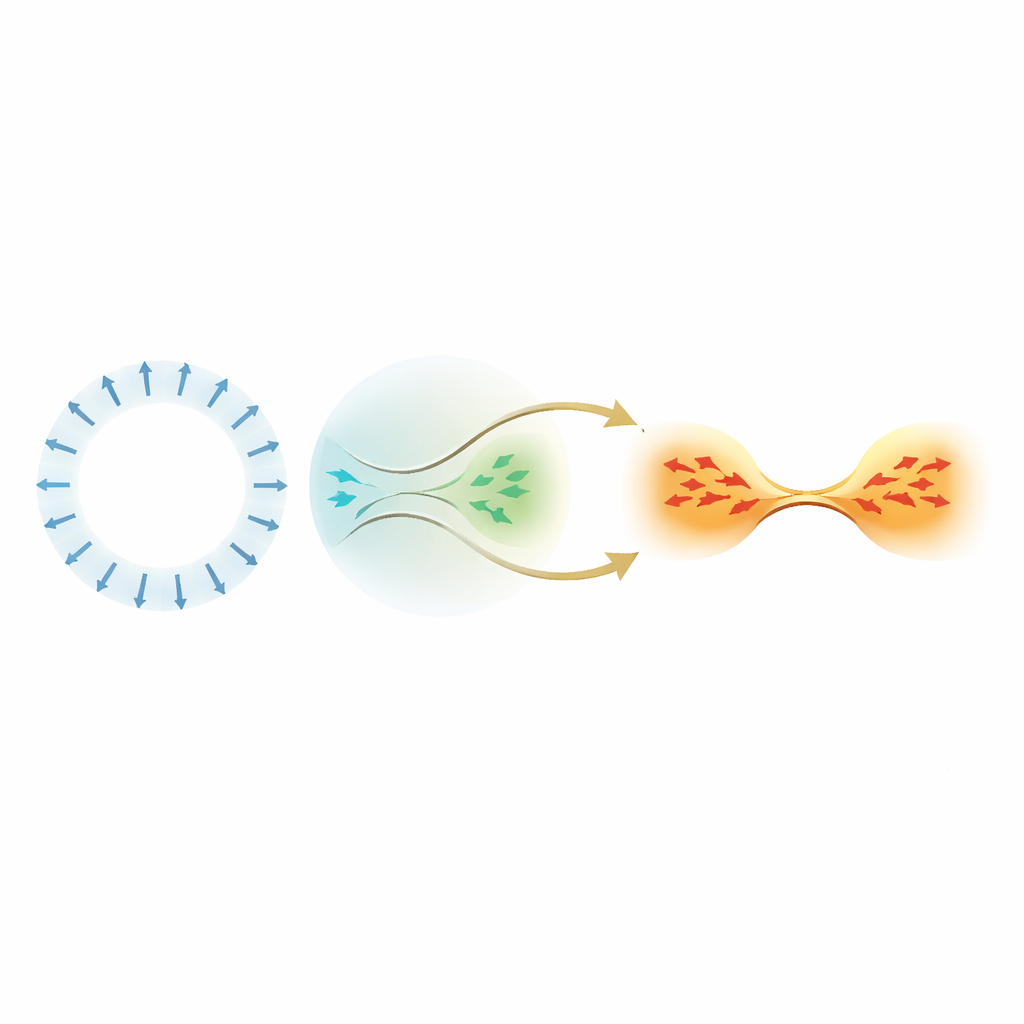
The authors show that this rigid two‑state behavior can actually slow the search. Once the pulses are locked into binary states, the system can become stuck in local energy minima, unable to flip individual spins easily to reach a better overall configuration. To loosen this constraint, they replace the usual phase‑sensitive optical amplifier with a phase‑insensitive one, creating what are called XY spins. Instead of being forced to choose between just two directions, each pulse’s phase can now point anywhere on a circle, giving the system extra freedom to slide around energy barriers. This added freedom provides continuous pathways for “spin flips” that help the machine escape local traps and keep exploring the landscape of possible solutions.

Blending smooth and binary behavior over time
Rather than running entirely in this smooth XY mode or entirely in the binary Ising mode, the researchers design a controllable crossover between the two. They do this by cascading two types of optical parametric amplifiers and adjusting their pump powers over time, gradually shifting the machine from XY‑like behavior to Ising‑like behavior during a run. Early on, spins roam freely in two dimensions, sampling many configurations; later, the dynamics sharpen and project those continuous phases onto binary choices that define the final answer. Numerical simulations on a class of benchmark problems called Wishart‑planted instances—where the correct solution is known in advance and the difficulty can be tuned—show that this XY‑to‑Ising schedule substantially improves the chance of reaching the true optimum within a given runtime.
Tuning the timing for hardest problems
The team quantifies performance using “time to solution,” the expected total number of cavity round trips needed to achieve a high target success probability. For medium‑sized problems (60 spins), a conventional binary Ising machine requires many thousands of round trips. Allowing pure XY spins already cuts this time, but the hybrid strategy that starts in XY mode and slowly transitions to Ising mode reduces the time to solution by roughly a factor of three. For particularly hard problem instances—where the energy landscape is extremely rugged—the improvement can approach an order of magnitude. The authors further show that performance depends sensitively on how fast the transition is made: too fast and the system behaves like the old binary machine; too slow and it never reaps the full benefit of binarization.
Smartly reintroducing flexibility
Going a step further, the researchers allow the machine to switch back to the XY regime multiple times during a run. Using an optimization method that treats the transition schedule itself as a tunable object, they discover patterns in which the system periodically relaxes into the smooth XY dynamics when it becomes trapped, then returns to the stricter Ising behavior to lock in improvements. This adaptive schedule yields an additional speedup over the simple one‑way transition, suggesting that dynamic control over the internal “dimensionality” of spins—how many directions they are allowed to point—can be a powerful design tool for future physical optimizers.
What this means for future computing
In everyday terms, the paper shows that an optical problem‑solving machine works better when its internal variables are first allowed to wiggle freely in many directions before being snapped into a yes‑or‑no decision. By engineering how and when this freedom is granted or taken away, the authors demonstrate large reductions in solution time on demanding test problems, and they outline how such hybrids could be built entirely with optical components. This approach points toward faster, energy‑efficient hardware for tackling complex optimization tasks that are increasingly central to technology and data science.
Citation: Kim, K., Yamamoto, Y. Accelerating a coherent Ising machine by XY-Ising spin transition. Sci Rep 16, 10396 (2026). https://doi.org/10.1038/s41598-026-41315-7
Keywords: coherent Ising machine, optical computing, combinatorial optimization, XY spin dynamics, physical annealing