Clear Sky Science · en
Comparing placement and polarity configurations of a two-magnet fingertip vibrotactile device
Feeling Digital Worlds at Your Fingertips
As virtual and augmented reality move from labs into living rooms, a missing ingredient is touch that feels natural. This paper explores a tiny wearable device that slips over your fingertip and uses magnets to create convincing vibrations. By studying how to arrange these magnets and how people perceive the resulting sensations, the researchers aim to make virtual textures, buttons, and objects feel more like the real thing—using signals as simple as recorded sound.
A Soft Sleeve with Hidden Magnets
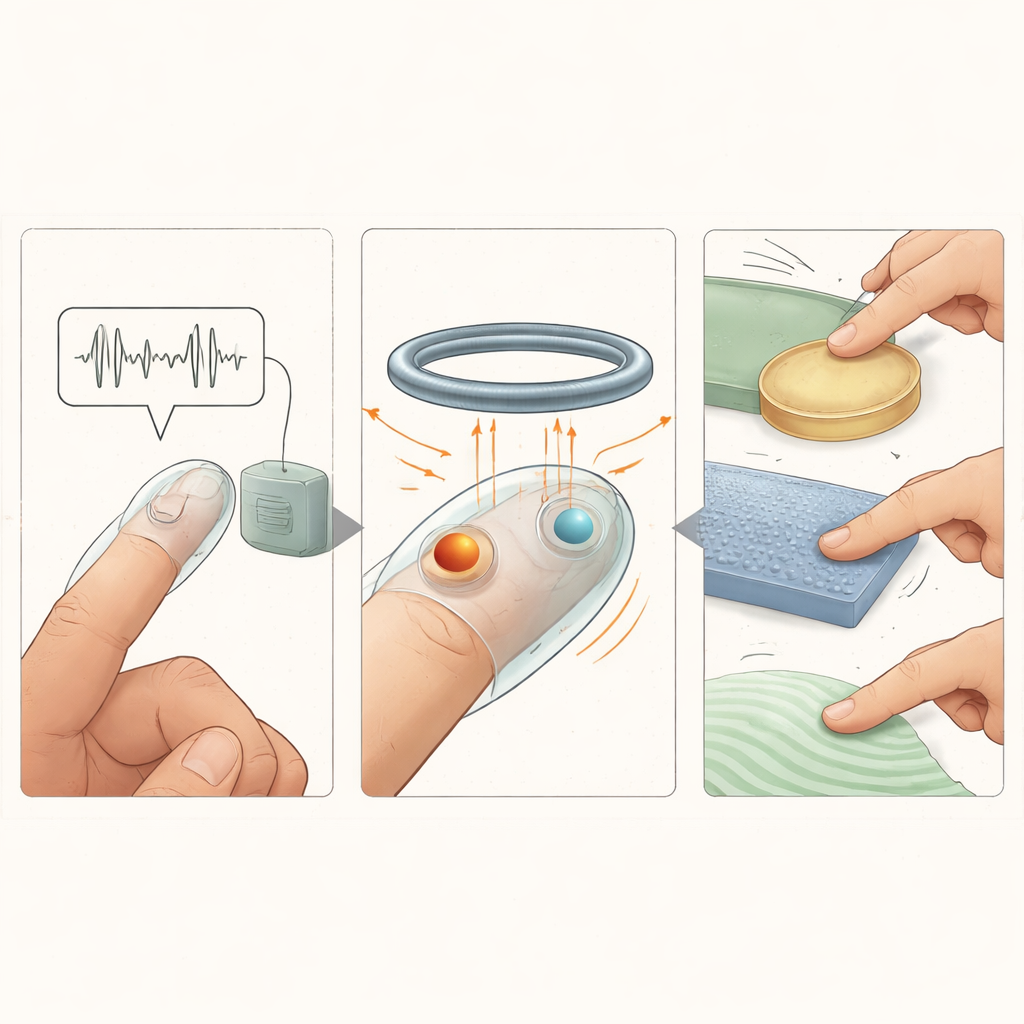
The team built on earlier work that used a single magnet inside a soft silicone fingertip sleeve. In the new design, two miniature magnets are embedded in the rubber sheath and driven by a nearby wire coil that produces a changing magnetic field. The magnets then push and pull on the surrounding soft material—and thus the skin—creating vibrations. The researchers tested different layouts: placing the magnets along the length of the finger versus across it, and orienting them so they move in the same direction or in opposite directions when the coil is powered.
Simulating How the Finger Moves
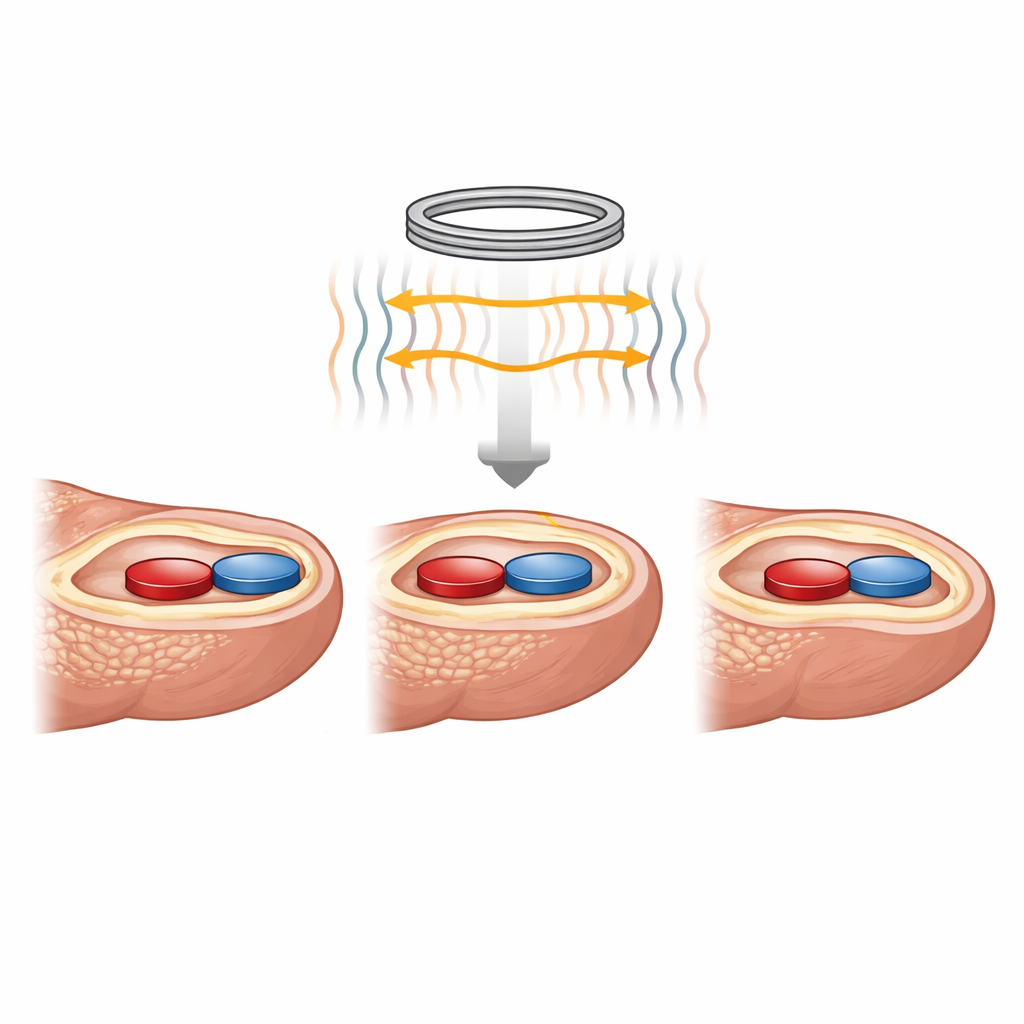
Before building the devices, the team used a detailed computer model of a fingertip, including skin layers, soft tissue, and bone, wrapped in the silicone sheath with the two magnets. They simulated how the fingertip deforms when the magnets are driven at different frequencies, from very low rumbles to rapid buzzes. The model showed that placing the magnets across the finger (from the thumb side to the little-finger side) produces larger overall motion than placing them along the finger. It also revealed that certain frequency bands—around 180 to 360 cycles per second—naturally make the whole pad move more strongly, hinting that these vibrations should feel especially vivid.
What People Actually Feel
The researchers then fabricated soft sleeves in several sizes and invited 24 volunteers to wear them in the lab. Participants could not see the device; they simply rested their fingertip under the coil and reported what they felt. In one experiment, they indicated the faintest vibration they could detect at different frequencies. Sensitivity was highest in the mid-frequency range, matching both the simulations and known properties of human touch. Crucially, detection thresholds were almost the same for both magnet orientations, suggesting that how the magnets are flipped does not change how easily vibrations can be felt.
Together or Alternating? How the Pattern Feels
In a second experiment, participants judged whether the two vibrating spots on the finger felt as if they were moving “together” or “alternating,” and where on the pad the motion seemed strongest. At low frequencies, people tended to describe the sensation as alternating between two spots, regardless of how the magnets were actually oriented. At higher frequencies, they more often felt a single, unified vibration. This implies that, for quick buzzes, the brain is less sensitive to subtle timing differences between different parts of the finger. Many participants also chose illustrations that showed a broad band of motion across the pad, especially in the mid-frequency band where the model predicted strong movement.
Playing Back the Sound of Touch
To explore everyday uses, the team drove the device not with pure tones but with recorded sounds of finger interactions—sliding over fabrics and rubber, plucking a band, tapping a drum, crumpling a can, or squeezing a spray bottle. The audio signal, filtered to keep only the frequency range the skin can feel, was sent simultaneously to speakers and the fingertip device. Participants rated how well the fingertip sensation matched what they saw and heard, how realistic it felt, and how pleasant it was. Interactions with objects, especially tapping a hand drum, were rated as more realistic and better matched than sliding over textures. Overall, users slightly preferred the configuration where the two magnets tend to move in sync, describing it as clearer and more enjoyable.
Bringing Simple Touch into Virtual Reality
The authors demonstrate how this fingertip sleeve could be plugged into a virtual reality system: a headset plays a short recorded sound whenever the user taps or squeezes a virtual object, and that same sound is simultaneously routed through an amplifier to the coil at the fingertip. Without any complex custom signals or heavy hardware, the user feels a brief, convincing vibration that matches the virtual event. The study concludes that a two-magnet sleeve with magnets placed across the finger and driven by audio is a practical, comfortable way to add believable “tap” and “click” sensations to digital worlds, even though more sophisticated schemes will be needed for rich, continuous textures.
Citation: Gertler, I., Ballardini, G., Tangolar, D. et al. Comparing placement and polarity configurations of a two-magnet fingertip vibrotactile device. Sci Rep 16, 12600 (2026). https://doi.org/10.1038/s41598-026-41307-7
Keywords: haptic feedback, vibrotactile fingertip device, wearable interfaces, virtual reality touch, audio-driven vibration