Clear Sky Science · en
Centrifuge model study on consolidation characteristics of sand-based fill soil subjected to pulse-induced water bag + vacuum preloading
Stronger Ground for Growing Coastal Cities
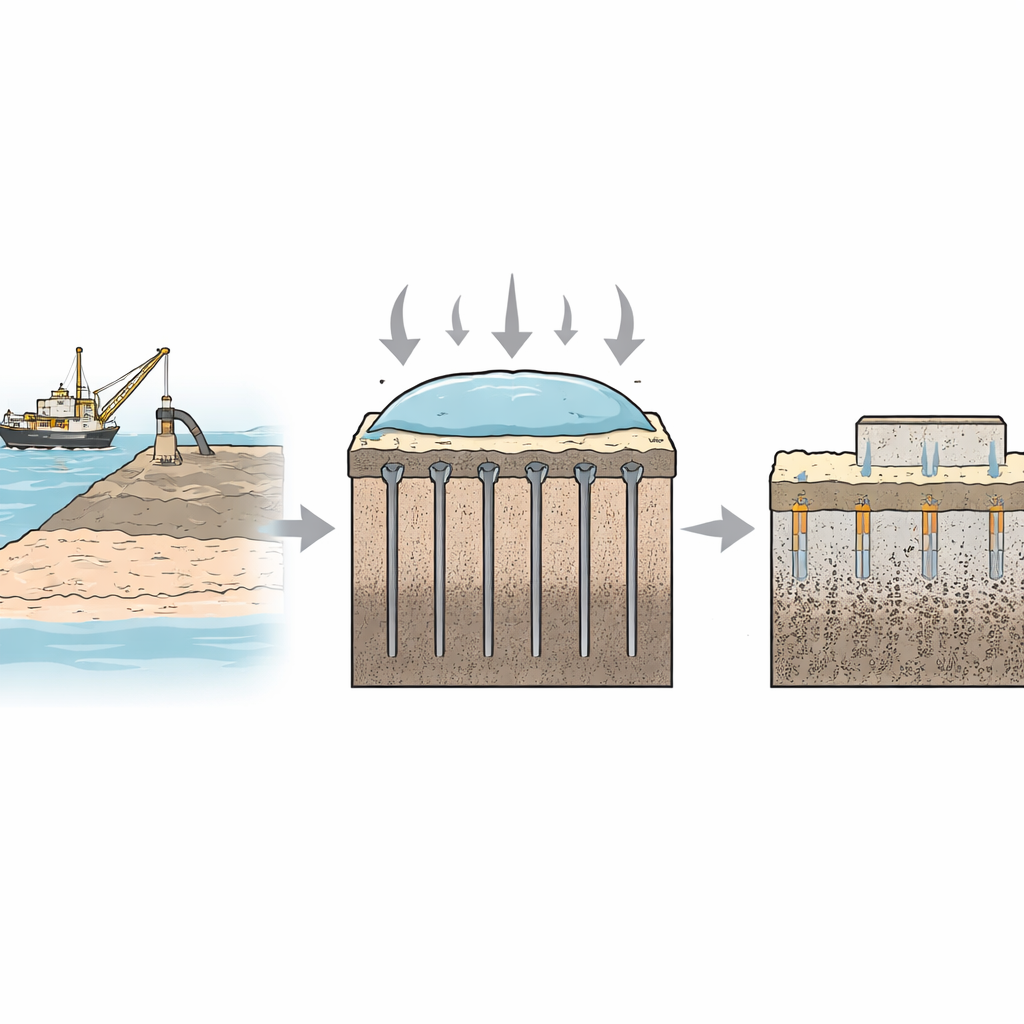
As coastal cities expand, engineers often create new land by pumping sand and silt from the seafloor into shallow bays. This fresh ground looks firm once it dries at the surface, but deep below it can behave like pudding—soft, waterlogged, and unable to support buildings, roads, or ports. The study in this paper explores a smarter way to stiffen this artificial land more quickly and reliably, using a combination of water-filled bags, vacuum pressure, and carefully timed bursts of air.
Why New Land Can Behave Like Quick Sand
Reclaimed coastal land made from dredged sand and silt typically has a very high water content and many tiny voids between grains. That means low strength and a tendency to compress slowly under weight. To make it safe for construction, engineers try to squeeze out the water and compact the soil, a process known as consolidation. Common methods push down on the ground with heavy loads or use vacuum systems connected to vertical drains that draw water upward. However, over time, fine particles can clog these drains, slowing water flow and stretching out construction schedules.
A Miniature Earth in a Spinning Drum
The researchers focused on a real land reclamation project in Dongguan City, on China’s southeastern coast. There, engineers already use water bags as a cheap, adjustable way to press down on the soft ground, together with vacuum systems. To test improvements without risking the actual site, the team turned to a powerful tool: a geotechnical centrifuge. By spinning a small soil model at 50 times Earth’s gravity, they could mimic the stress and drainage behavior of a full-size foundation in just hours instead of months. In their spinning model box, they installed zones with different numbers of drainage boards, added a simulated water bag and vacuum load on top, and monitored settlement, water pressures, and changes in strength.
Shaking Loose Hidden Blockages
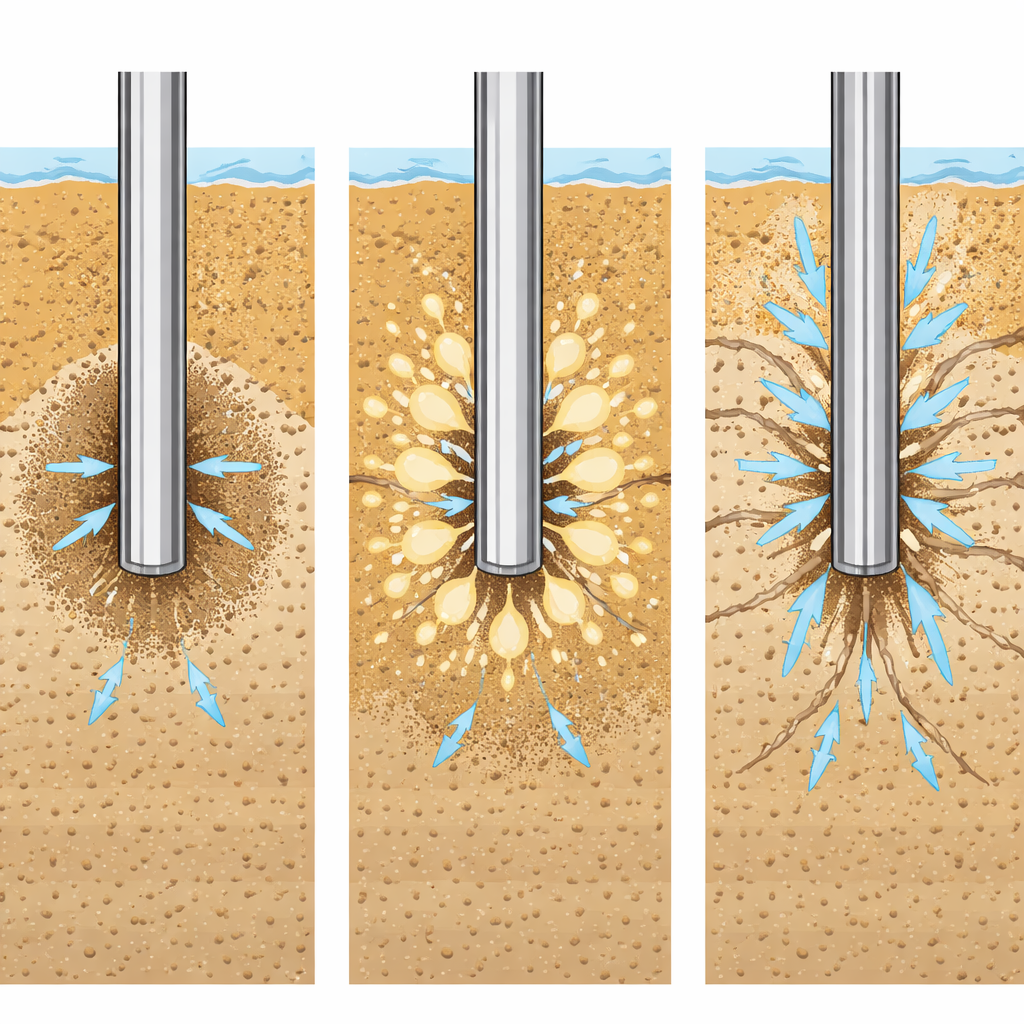
The key twist in the study is the use of pulsed air pressure. In one set of tests, the team ran the combined water bag and vacuum system in the usual way. In another, they periodically stopped the centrifuge, connected an air compressor to the drainage boards, and sent in bursts of high-pressure air. Sensors buried in the soil recorded how pore water pressure, soil pressure, and surface settlement evolved over the equivalent of about 100 days of field treatment. The data showed that after roughly two weeks of simulated time, the drains became clogged enough that water pressures and settlement rates leveled off. Each time the researchers applied pulsed air, the water pressure briefly jumped, then dropped more rapidly as flow pathways reopened and water escaped.
More Drains, Drier Soil, Stronger Ground
By comparing zones with one, two, and many drainage boards, the team found a clear pattern: more drains led to more water removal, greater settlement, and markedly stronger soil. Measurements of moisture content after testing revealed that areas with multiple boards ended up significantly drier. Shear strength tests, both simple in-place measurements and laboratory triaxial tests on undisturbed samples, showed that the ground’s resistance to deformation increased as water left the pores and grains packed more tightly together. In zones where pulsed air was used, the gains were even larger; these areas settled more and developed higher strength than similar zones without air pulses.
What This Means for Coastal Building
For non-specialists, the takeaway is straightforward: the study shows that combining water-bag loading, vacuum systems, and timed bursts of air can turn soft, newly made seabed into firmer, safer ground more quickly. The centrifuge results suggest that drains in such soils may clog within about two weeks, and that regularly “clearing their throats” with pulsed air restores drainage and speeds consolidation. Using more drainage boards further enhances the effect, drying the soil and boosting its strength. Together, these findings point toward faster, more reliable preparation of reclaimed coastal land, helping cities build ports, roads, and buildings on ground that is both newer and more secure.
Citation: Chen, Q., Xu, X., Wang, G. et al. Centrifuge model study on consolidation characteristics of sand-based fill soil subjected to pulse-induced water bag + vacuum preloading. Sci Rep 16, 12777 (2026). https://doi.org/10.1038/s41598-026-41306-8
Keywords: coastal land reclamation, vacuum preloading, dredged fill soil, ground improvement, centrifuge modeling