Clear Sky Science · en
Lone pair localization governs ferroelectric stability and excitonic properties in lead free halide perovskites
Why this work matters for future solar and memory tech
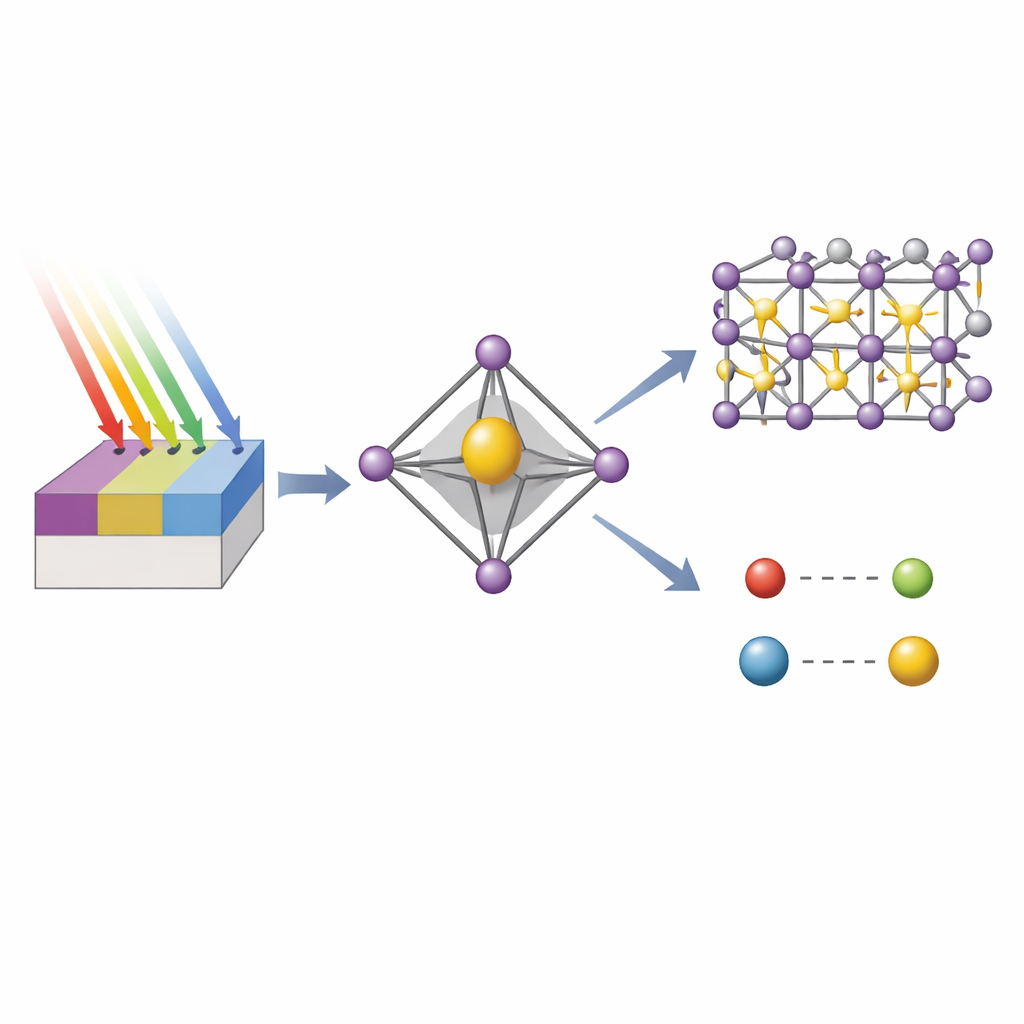
Perovskite materials have become stars in solar cells and light-emitting devices, but most of the best performers still rely on toxic lead. This study explores a safer, lead-free family based on germanium that not only absorbs light efficiently but can also remember electric states, like a tiny built-in battery. The authors show that a subtle cloud of electrons around germanium atoms—the so‑called “lone pair”—quietly governs both how strongly the material traps light-made electron–hole pairs and how robustly it holds an electric polarization. Understanding and controlling this lone pair could make it possible to design single materials that act as efficient solar absorbers, light emitters, and non‑volatile memories all at once.
Cleaner building blocks for light-harvesting devices
All‑inorganic halide perovskites convert light to electricity with remarkable efficiency, but the widely studied cesium–lead compounds raise concerns about lead toxicity and long‑term stability. Germanium‑based perovskites with the formula CsGeX3 (where X is chlorine, bromine, or iodine) offer a lead‑free alternative. They naturally form polar crystal structures that can support ferroelectricity—a built‑in, switchable electric polarization. This polarization can help separate photo‑generated charges, potentially boosting solar cell performance or enabling devices whose electrical response can be toggled with light. However, engineers have struggled to tune optical absorption and ferroelectric stability at the same time. Changing the crystal structure to improve one property often harms the other.
A hidden electron cloud that ties everything together
The authors propose that the key to unifying these behaviors lies in the germanium atom’s 4s2 “lone pair,” a concentrated blob of electrons that pushes the atom off center in its surrounding octahedral cage of halogens. Using advanced quantum‑mechanical calculations, they map how this lone pair reshapes charge density, how tightly electron–hole pairs (excitons) are bound after light absorption, and how strongly the material polarizes. They find that it is not simply how stretched or squashed the lattice is that sets the ferroelectric strength; rather, it is how asymmetric the electron cloud becomes around germanium. A new quantitative measure—the lone‑pair localization index, extracted from electron localization function maps—tracks this behavior across the chlorine, bromine, and iodine variants and correlates directly with exciton binding energy, dielectric response, and spontaneous polarization.
Chemical pressure versus physical pressure
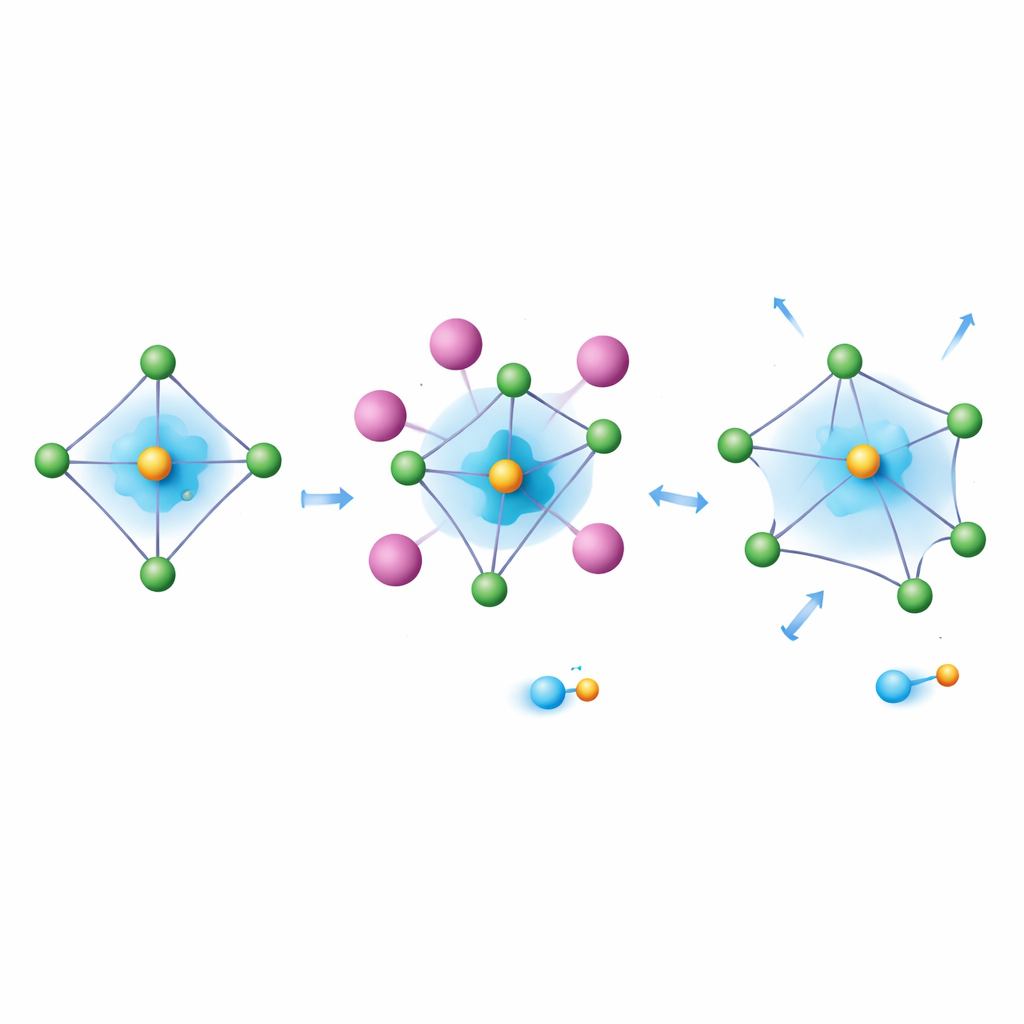
To control the lone pair without introducing harmful defects, the team explores two tuning knobs. The first is “chemical pressure”: partially replacing cesium ions with slightly smaller rubidium ions. This substitution hardly changes the band edges and does not create unwanted electronic trap states, but it subtly distorts the lattice and tightens the Ge–X bonding framework. The calculations show that this chemical pressure deepens the characteristic double‑well energy landscape of a ferroelectric, increases the spontaneous polarization, and sharpens excitonic absorption features by reducing dielectric screening—especially in the chlorine‑based compound, which starts from a relatively rigid, weakly screening lattice. The second knob is ordinary hydrostatic pressure. Squeezing the crystal makes electronic states more delocalized, increases screening, weakens exciton binding, and softens the ferroelectric barrier. Together, rubidium alloying and external pressure act as complementary, reversible levers that move the material between regimes dominated by tightly bound excitons and regimes where free carriers are favored.
Design map from atoms to device function
By systematically comparing the three halides, the authors construct a design map that links chemical choice, strain, and device role. Chloride and bromide versions of CsGeX3, particularly when lightly alloyed with rubidium, exhibit large polarization, strong exciton binding, and low dielectric loss. These traits suit them to light‑emitting diodes, polariton devices where light and matter are strongly mixed, and ferroelectric memories that rely on stable electric states. Iodide‑rich compositions, in contrast, have softer polarization wells and more weakly bound excitons, making it easier for light‑generated charges to separate and flow—ideal for photovoltaic operation. Importantly, the same underlying lone‑pair physics explains trends in band gaps, exciton binding energies, and polarization across this whole family, meaning that engineers can target a desired “excitonic strength” or polarization level by adjusting composition and strain rather than performing blind trial‑and‑error searches.
From microscopic electron clouds to practical materials
In plain terms, the study shows that a small, asymmetric lump of electrons on each germanium atom can decide whether a perovskite behaves more like a bright light emitter, a stable memory element, or an efficient solar absorber. By measuring and tuning how localized this lone pair is—through clean rubidium substitution or applied pressure—researchers can co‑design the way these materials absorb light and how firmly they hold an electric polarization. This “lone‑pair engineering” offers a roadmap for crafting lead‑free perovskites that unite optical performance with ferroelectric robustness, advancing safer, multifunctional materials for the next generation of sustainable optoelectronic technologies.
Citation: Rahimi, S., Jalali-Asadabadi, S. Lone pair localization governs ferroelectric stability and excitonic properties in lead free halide perovskites. Sci Rep 16, 11409 (2026). https://doi.org/10.1038/s41598-026-41305-9
Keywords: lead-free perovskites, ferroelectricity, excitons, chemical pressure, optoelectronics