Clear Sky Science · en
Blockchain-driven trust management and AI computing for sensor networks optimization
Smarter Cities Need Safer Connections
From smart watches and traffic lights to factory machines, billions of tiny devices are now talking to each other. This web of sensors, known as the Internet of Things, promises smoother city life, better healthcare, and more efficient industry. But as more devices join the party, keeping their conversations fast, reliable, and safe from prying eyes becomes harder. This paper explores a new way to manage those digital conversations so that data moves quickly, avoids breakdowns, and stays trustworthy, even when some devices misbehave.
Everyday Devices, Hidden Fragility
Modern smart systems rely on huge numbers of small, battery-powered sensors scattered across homes, roads, factories, and hospitals. These devices constantly collect information and send it toward local computers at the network’s edge, which then pass important data on to distant cloud servers. When everything works, this setup can react in real time—rerouting traffic, adjusting power use, or alerting doctors. Yet the same strengths also create weak points. Limited batteries, crowded radio channels, and untrusted intermediate devices can slow traffic, drop messages, and open the door to eavesdropping or data tampering. Existing solutions improve pieces of the problem—such as choosing efficient routes or detecting attacks—but often add heavy processing costs or struggle when networks grow.
A Dual Engine for Faster, Fairer Data Flow
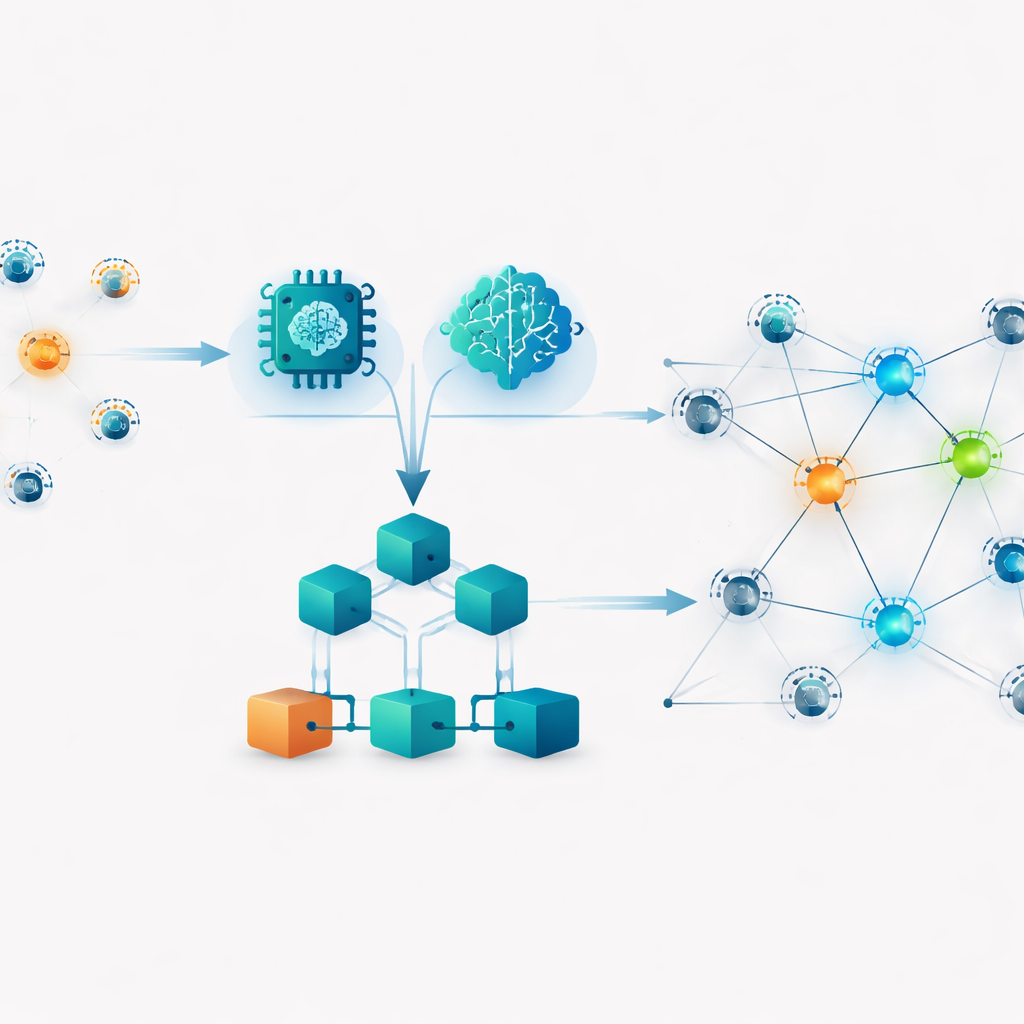
To tackle these issues, the authors propose a lightweight model that combines artificial intelligence with a distributed ledger technology often associated with digital currency. In the first phase, an AI engine watches how each device behaves: how much energy it uses, how many packets it loses, and how often its messages succeed. Using a machine learning method, it predicts how trustworthy each device is and which paths are likely to carry data efficiently. A smart path-finding strategy then uses these predictions to choose data routes that balance the load across the network, avoid overloaded or unreliable links, and conserve battery power. This allows the network to adapt to changing conditions without asking too much computing effort from tiny devices.

Locking In Trust with a Digital Ledger
The second phase uses blockchain to make these trust decisions tamper-resistant. Once the AI engine has estimated how reliable each device is, those trust scores are stored as records in a shared digital ledger spread across multiple nodes. Because the ledger entries are chained together and agreed upon collectively, it becomes very difficult for a malicious device to rewrite its own history or forge a better reputation. A swarm-inspired routing method then favors paths composed of devices with stronger recorded trust, reinforcing good behavior. As devices act over time, their records are updated in the ledger, but past entries remain visible, providing a verifiable trail of conduct that others can check before forwarding data.
Putting the Model to the Test
To see whether their approach works in practice, the researchers built a simulated smart-city-like setting with up to 500 sensors, a handful of edge nodes, and a mix of honest and malicious devices. They compared their model with two recent routing schemes designed to be efficient and secure. Across a range of conditions, the new approach reduced energy use by roughly a quarter to a third, cut data loss significantly, and shortened the time needed to establish working connections. Even when up to half of the devices were set to behave badly by dropping or flooding packets, the combined AI and blockchain framework maintained higher levels of “behavioral trust” in the active paths and kept the data flowing more smoothly. These gains came from continuously steering traffic away from suspicious or congested links and spreading the workload more evenly.
What This Means for Future Smart Systems
In simple terms, the study shows that giving networks a way to learn who can be trusted—and then writing that trust down in a shared, hard-to-fake log—can make everyday connected systems both tougher and more efficient. Instead of treating every sensor as equally honest or endlessly rechecking credentials, the network gradually builds a memory of good and bad behavior and uses it to guide future decisions. For city planners, hospital IT teams, or industrial operators, such an approach could mean fewer communication failures, better battery life, and stronger protection against quiet attacks hidden inside the device swarm. The authors suggest that future work could bring in deeper learning methods and real-world testbeds, but the central message is clear: pairing intelligent prediction with secure record-keeping is a promising path toward safer, more dependable sensor networks.
Citation: Alharbi, M., Haseeb, K., Jhanjhi, N.Z. et al. Blockchain-driven trust management and AI computing for sensor networks optimization. Sci Rep 16, 13817 (2026). https://doi.org/10.1038/s41598-026-41302-y
Keywords: Internet of Things, sensor networks, blockchain security, trust management, edge computing