Clear Sky Science · en
Research on deep well drilling rate of penetration prediction method based on TCN-transformer model
Why drilling speed matters underground
Every extra hour spent drilling an oil or gas well costs money, equipment wear, and fuel. A key number that engineers track is how fast the drill bit chews through rock, called the rate of penetration. If this rate could be predicted accurately in advance, companies could design smarter drilling programs, avoid wasted time in difficult rock, and reduce risks in deep, hot formations. This study introduces a new way to forecast drilling speed in very deep wells by blending two modern artificial intelligence tools into a single, more accurate model.
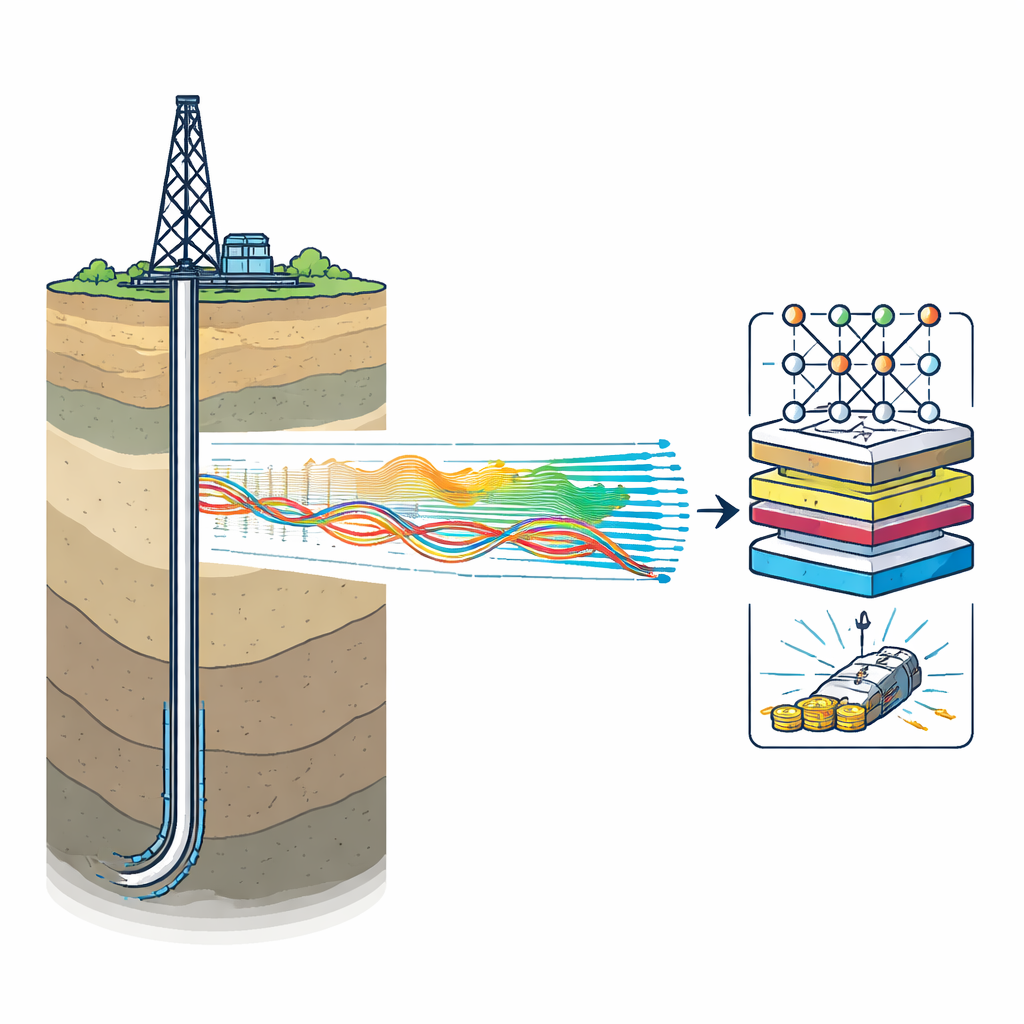
The challenge of drilling miles below the surface
Deep wells face far harsher conditions than shallow ones. At several kilometers below ground, temperatures can exceed 150 °C and pressures soar, altering both the rocks and the cement that seals the well. In places such as China’s Tarim and Sichuan basins, some wells reach depths beyond 7,000 meters. Under these extreme conditions, traditional formula-based methods struggle to estimate drilling speed because the rock strength, fluid behavior, and drilling hardware all influence the outcome in complex, changing ways. Earlier statistical and machine-learning methods helped, but they often treated each measurement as an isolated point, ignoring how drilling unfolds as a continuous process along the well.
Turning drilling into a time-based story
The authors treat drilling speed as a time series: a story that evolves steadily with depth and time. They draw on two modern sequence-modeling ideas from the field of artificial intelligence. The first, called a temporal convolutional network, scans along the sequence with overlapping windows, spotting short- and medium-range patterns—such as how a change in weight on bit or rotation speed affects drilling a few moments later. The second, known as a transformer, excels at linking distant points in a sequence, capturing long-range relationships that might span thousands of meters of drilling. By fusing these two, the model first extracts detailed local features and then learns broader, global trends connecting different stages of the well.
Building a smarter predictor from real field data
To train and test their approach, the researchers used real drilling data from multiple wells in a single block of the Sichuan Basin. They began with 12 common measurements, including depth, rotation speed, mud properties, and force on the bit, then used a standard correlation test to narrow this to 10 that mattered most for predicting drilling speed. Because drilling data are naturally ordered in time, they avoided random shuffling and kept the sequence intact, using the first 80 percent of each ordered dataset for training and the remaining 20 percent for testing. They also discovered that shallow sections above 3,000 meters showed wild fluctuations due to variable geology and frequent equipment adjustments, making them noisy and hard to model. By focusing on deeper, more stable sections, they improved accuracy substantially.
What the hybrid model does better
The team carefully compared different ways of arranging the data and different model designs. When they used only one well at a time, prediction quality was modest. Combining multiple wells from the same block, and ordering the data by the actual sequence of drilling in each well, improved performance, as it preserved the natural cause-and-effect between operating choices and the rock response. A transformer-only model already did better than traditional methods, but the hybrid model—where the temporal convolutional network feeds into the transformer—performed best of all. It achieved a coefficient of determination near 0.99 on block data and kept similar accuracy when predicting a new well that was not used for training, clearly outperforming standard gradient-boosted trees and a convolution-plus-LSTM model.
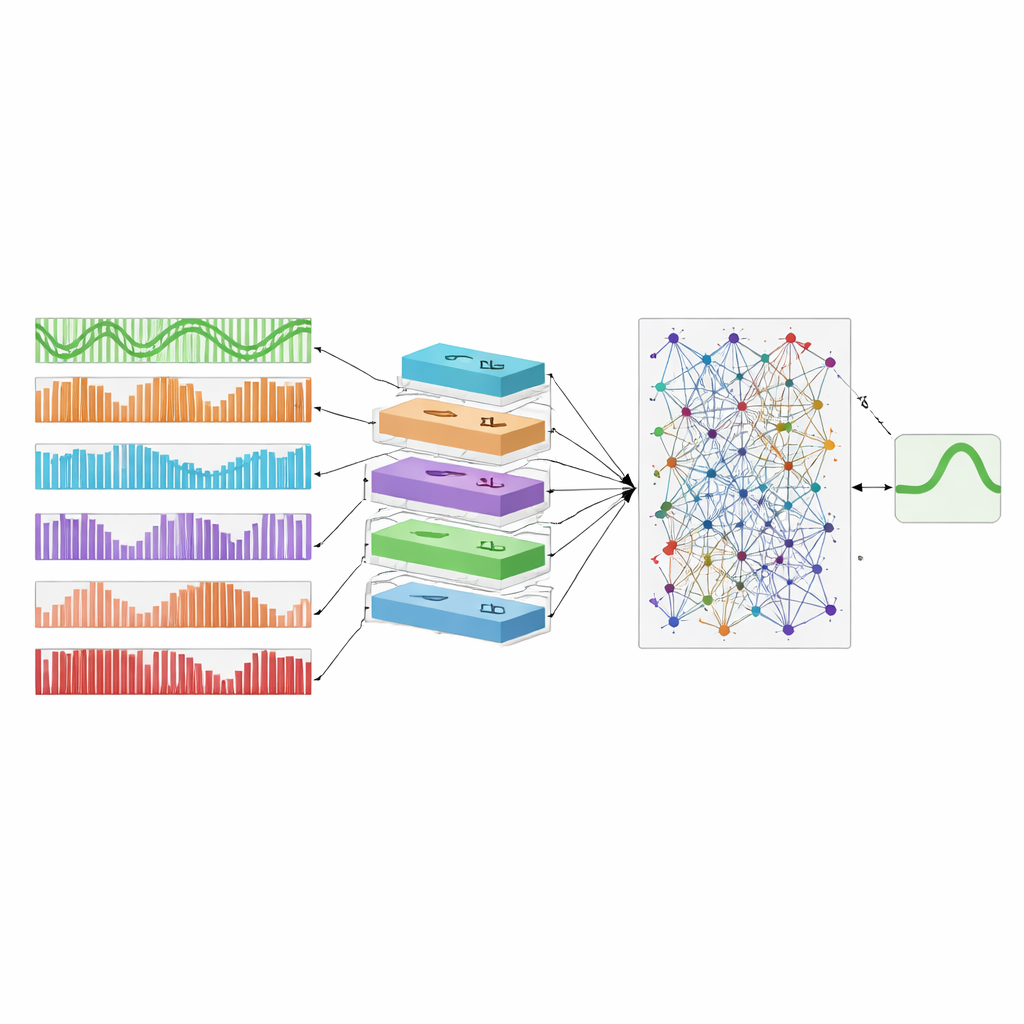
From research model to field tool
To understand why the fusion works so well, the authors ran tests that disabled or altered individual pieces of the model. Removing the "dilated" structure of the temporal convolutions, shrinking the window of past data, or replacing the temporal convolutional network with a simpler convolutional front end all reduced accuracy. The best results came when the model could see about 30 consecutive time steps, use carefully tuned convolution settings to capture short- and medium-range patterns, and let the transformer handle the long-range links. This combination allowed the system to generalize across wells with similar geology, suggesting that, with some fine-tuning, it could be adapted to other blocks as well.
What this means for future drilling
The study shows that a thoughtfully designed hybrid of two modern AI techniques can predict deep-well drilling speed with high precision in a real oilfield setting. For engineers, this means more reliable forecasts of how quickly a well can be drilled, better planning of bit runs and mud programs, and quicker reactions to emerging downhole problems. While the current model does not yet include detailed rock-property measurements and still needs testing in more geologically diverse regions, it marks a significant step toward intelligent, real-time support systems that help drill safer, faster, and at lower cost.
Citation: Yuehao, L., Guodong, Z., Xiangchao, S. et al. Research on deep well drilling rate of penetration prediction method based on TCN-transformer model. Sci Rep 16, 11075 (2026). https://doi.org/10.1038/s41598-026-41298-5
Keywords: deep well drilling, rate of penetration prediction, machine learning in drilling, time series modeling, hybrid neural networks