Clear Sky Science · en
Responses of tree defoliators to traffic-derived particulate matter and trace elements along a roadside pollution gradient
Why roadside bugs matter to city life
Along busy roads, trees and shrubs quietly scrub the air by catching soot and dust from passing traffic. This hidden clean‑up service helps people breathe easier, but it also changes what ends up on the leaves that insects eat. This study asks a simple question with big ecological implications: when leaves near roads are coated with traffic pollution, how do the caterpillars that feed on them respond, and what does that mean for the insects’ survival and the health of roadside habitats?
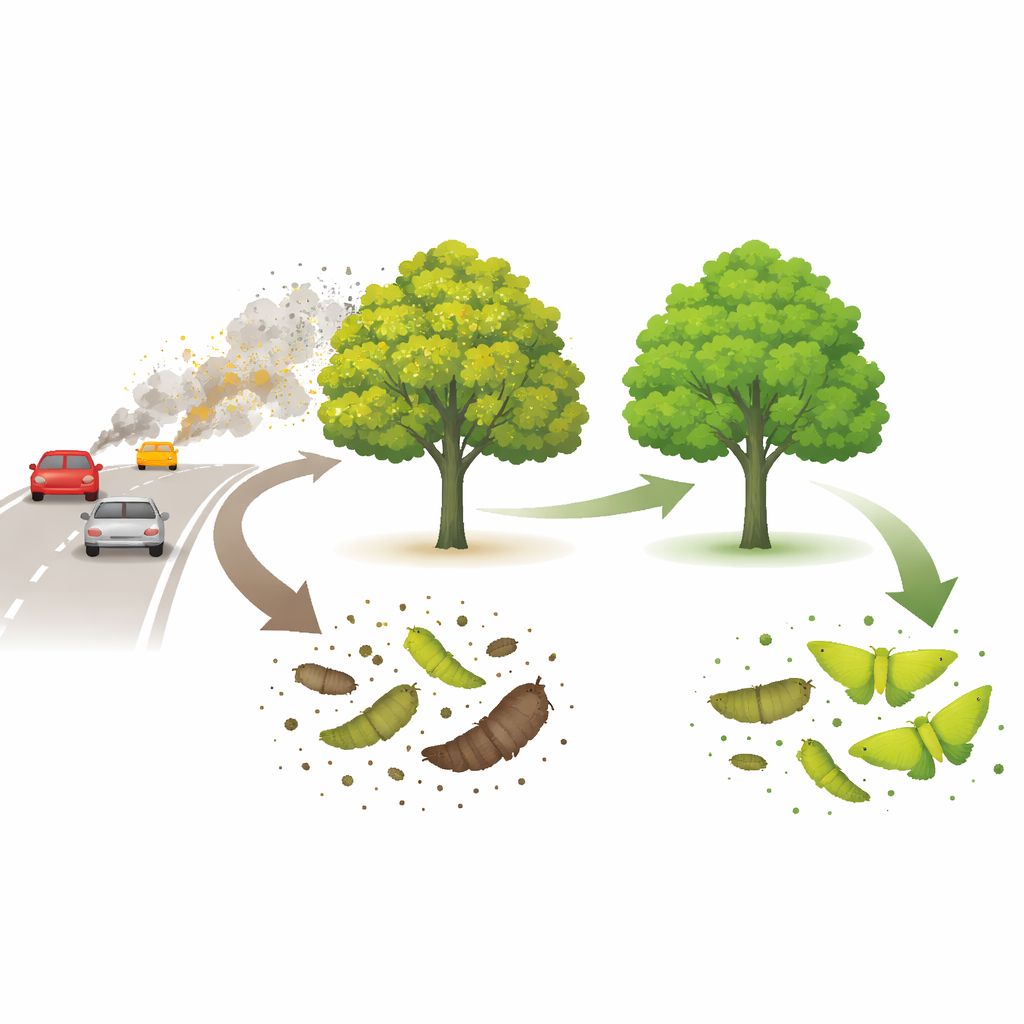
Dirty air, dusty leaves
Car and truck traffic releases a haze of tiny particles made of soot, metal fragments from brakes and tires, and other pollutants. Much of this particulate matter settles onto nearby vegetation or is drawn up through plant roots from polluted soil. The researchers focused on two common roadside trees—hawthorn and cherry plum—that are often planted along city streets. They sampled leaves from three positions that formed a real‑world pollution gradient: directly next to a major road, along an adjacent sidewalk partly shielded by other plants, and behind a tall noise barrier in a park used as a cleaner control area. Measurements confirmed that leaves closest to the road carried the heaviest loads of dust of all size classes, along with elevated levels of several metals linked to vehicle wear.
Caterpillars choosing their meals
To see whether insects can detect and avoid polluted food, the team worked with the orchard ermine moth, whose caterpillars naturally feed on hawthorn and cherry plum. In laboratory arenas, individual caterpillars were given a free choice between three leaves of equal size and age, one from each pollution level. The pattern was strikingly clear: for both tree species, about two‑thirds of the caterpillars chose the clean park leaves, while only a small minority selected leaves from the sidewalk or the road edge. This showed that the animals can sense differences in leaf quality linked to pollution and strongly prefer uncontaminated foliage when they have the option.
Growing up on polluted food
In nature, however, these caterpillars are not free to roam. They hatch on a particular branch chosen by their mother and usually stay within their silk nests, feeding on nearby leaves. To mimic this limitation, the researchers raised groups of late‑stage larvae in the lab on leaves collected exclusively from one of the three site types. They then tracked how quickly the insects pupated and emerged as adults, how many survived, and how heavy the adults were. Across both tree species, development was fastest on clean leaves, slower on sidewalk leaves, and slowest on heavily polluted roadside leaves. Survival to adulthood also declined steadily along this gradient, dropping from about nine in ten on clean foliage to fewer than eight in ten on roadside leaves. Adults emerging from the roadside treatment were consistently lighter than those raised on cleaner diets.
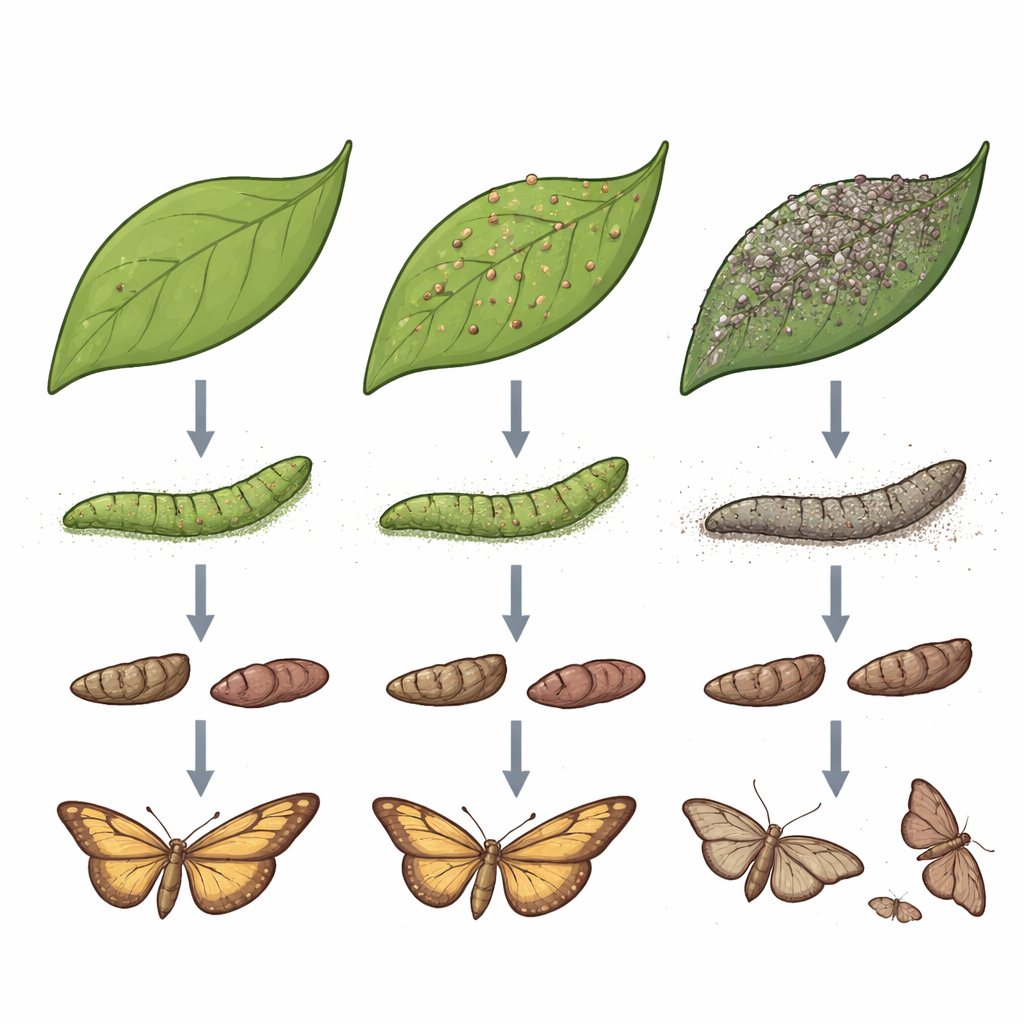
When place matters more than plant
The two tree species differed in leaf thickness, toughness, and how much pollution they trapped, yet these plant traits turned out to be less important than location. Whether caterpillars fed on hawthorn or cherry plum, the key predictor of their fate was how close their host tree grew to the traffic. The combination of particle buildup on leaf surfaces and associated metals likely reduces the nutritional value of the food and exposes larvae to chemical and mechanical stress. On top of this, roadside environments bring heat, dryness, and noise, all of which can further strain insect development. Together, these pressures act like a filter, allowing only some individuals to survive and reproduce successfully in the most polluted spots.
What this means for life along roads
The study reveals that traffic pollution does more than harm human lungs—it also quietly reshapes insect life along our roads. Even a moth species often viewed as a hardy pest suffered slower growth, lower survival, and smaller adult size when forced to feed on dusty, metal‑laden leaves. While trees and shrubs near highways help clean the air, they may at the same time become poor‑quality habitat for the insects that depend on them. For a layperson, the takeaway is straightforward: cleaner air and smarter roadside planting benefit not only people but also the hidden army of caterpillars, moths, and other small creatures that keep urban ecosystems functioning.
Citation: Moniuszko, H., Popek, R., Przybysz, A. et al. Responses of tree defoliators to traffic-derived particulate matter and trace elements along a roadside pollution gradient. Sci Rep 16, 10069 (2026). https://doi.org/10.1038/s41598-026-41296-7
Keywords: roadside pollution, particulate matter, urban insects, tree leaves, moth development