Clear Sky Science · en
Discrete element study on mechanical properties of layered sand-cobble strata under unloading stress path of shield construction
Why underground digging affects city life
As cities expand their subway and utility networks, more tunnels are being drilled beneath streets and buildings. When a giant shield machine bores a tunnel, it changes how the surrounding ground is squeezed and released. In layered soils made of loose sand and coarse cobbles, these changes can cause the earth to settle or shift in unexpected ways, threatening nearby structures. This study asks a practical question: how do different ways of releasing underground pressure during tunneling affect the strength and stability of such mixed ground, and how much does the layer makeup matter?
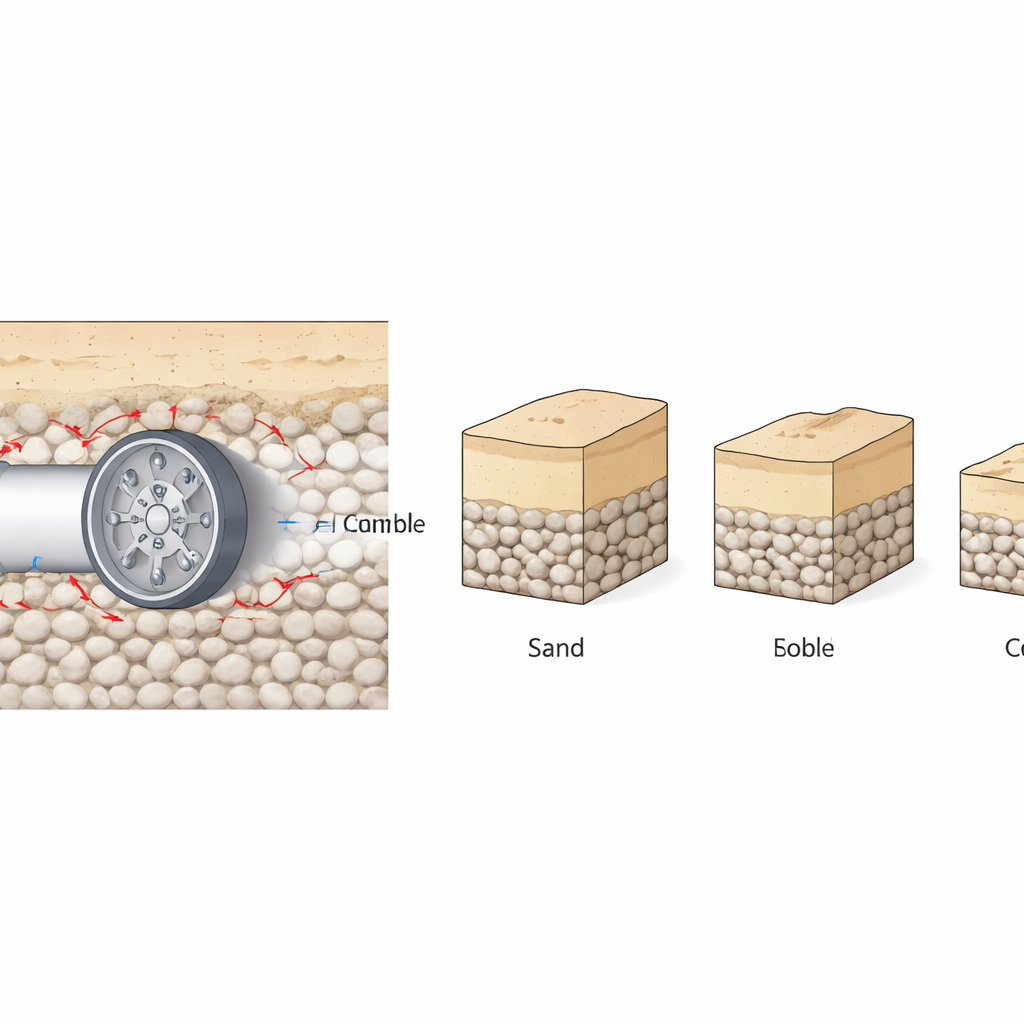
Layers of sand and stones beneath our feet
Many Chinese cities—and indeed many cities worldwide—are built on "composite" ground made of alternating layers of fine sand and chunky cobbles or gravel. These materials behave very differently when squeezed: sand can flow and rearrange, while cobbles form a stiffer skeleton. During shield tunneling, the ground ahead of the machine experiences a complex journey of being compressed, sheared and then unloaded as material is removed. Traditional lab tests, which usually just squeeze a single, uniform soil under constant side pressure, do not capture this real stress journey, especially the crucial unloading stage when the tunnel face advances and support conditions change.
Following how the ground is squeezed and released
To mimic real tunneling more faithfully, the researchers used a numerical approach called the discrete element method, which represents soil as countless individual particles that can move, rotate and interact. They first built a virtual model of a tunnel advancing through dense sand and tracked how the stresses evolved at several points ahead of the tunnel face. This revealed two main patterns: in some zones both vertical and horizontal pressures drop together as excavation progresses; in others, vertical pressure drops while horizontal pressure stays nearly constant. These patterns, or "stress paths," became the basis for three test schemes, ranging from fast, simultaneous pressure release to slower or one-sided unloading, designed to bracket realistic tunneling conditions.
Virtual soil samples under controlled tests
The team then constructed digital "triaxial" samples composed of an upper sand layer and a lower cobble layer, stacked like a two-layer cake. They carefully calibrated the particle properties so that pure sand-only and cobble-only samples matched large-scale laboratory tests. By changing the height ratio of sand to cobble, they created different composite specimens and subjected them to the three unloading schemes at various initial stress ratios (how strongly the sample is squeezed vertically relative to sideways). Watching how these samples shortened, softened or held together under controlled unloading allowed the researchers to link stress paths, layer makeup and overall strength in a way that is difficult to achieve with physical tests alone.
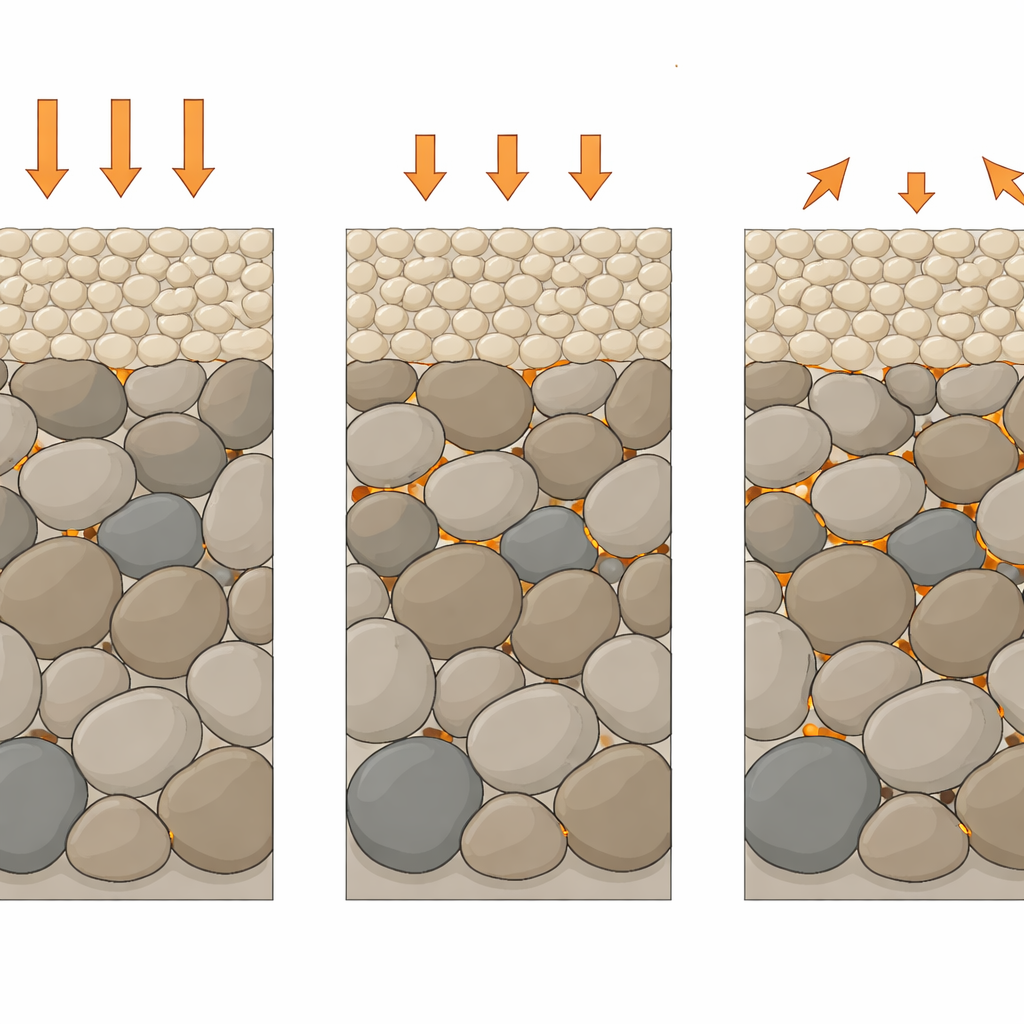
What happens when you change how and how fast you unload
The simulations show that the way pressure is released strongly controls how the ground responds. When both vertical and side pressures are reduced quickly, the internal forces between particles drop sharply, and the sample softens and fails more rapidly. If the side pressure is released more slowly, the soil has time to rearrange; the stress–strain curve falls more gently and the sample behaves tougher, failing later. When side pressure is held nearly constant and only vertical pressure is reduced, deformation remains more limited and the sample stays comparatively stable. Across all cases, increasing the thickness of the cobble layer strengthens the sample and makes its post-peak weakening more gradual, because the cobbles carry larger contact forces and provide a more robust skeleton. Higher initial stress ratios likewise enhance interlocking between particles, helping the material resist softening as stresses are released.
Why these findings matter for city tunnels
Put simply, the study finds that both the "recipe" of sand versus cobbles in the ground and the exact way tunneling changes pressure control whether the soil around a new tunnel will soften or stay firm. Ground with more cobbles and higher initial squeezing can better maintain its shape as pressure is relieved, while rapid, simultaneous unloading of vertical and horizontal stress near the tunnel face is more likely to trigger loss of strength. For engineers, this means that careful control of support pressure, excavation rate and lining timing, combined with attention to the local layering of sand and cobbles, can reduce the risk of excessive settlement or instability in urban tunneling projects.
Citation: Liang, L., Shi, Y., Wei, G. et al. Discrete element study on mechanical properties of layered sand-cobble strata under unloading stress path of shield construction. Sci Rep 16, 11502 (2026). https://doi.org/10.1038/s41598-026-41291-y
Keywords: shield tunneling, sand-cobble ground, stress path, underground excavation, discrete element simulation