Clear Sky Science · en
Unveiling the poroelastic evolution of agar hydrogels through the drying process
Why Drying Soft Gels Matters
Agar gels made from seaweed quietly underpin everyday technologies, from lab tests and drug delivery to desserts and plant-based foods. These gels are mostly water, yet their strength and texture can change dramatically as they dry out in air. This study asks a simple but important question: what exactly happens inside these water-rich materials as they lose moisture, shrink, and stiffen? By watching agarose hydrogels dry and carefully measuring how their shape and firmness evolve, the authors reveal a hidden, two-step story of softening and hardening that could help engineers better design gels that hold up under real-world conditions.
From Seaweed Powder to Soft Solid
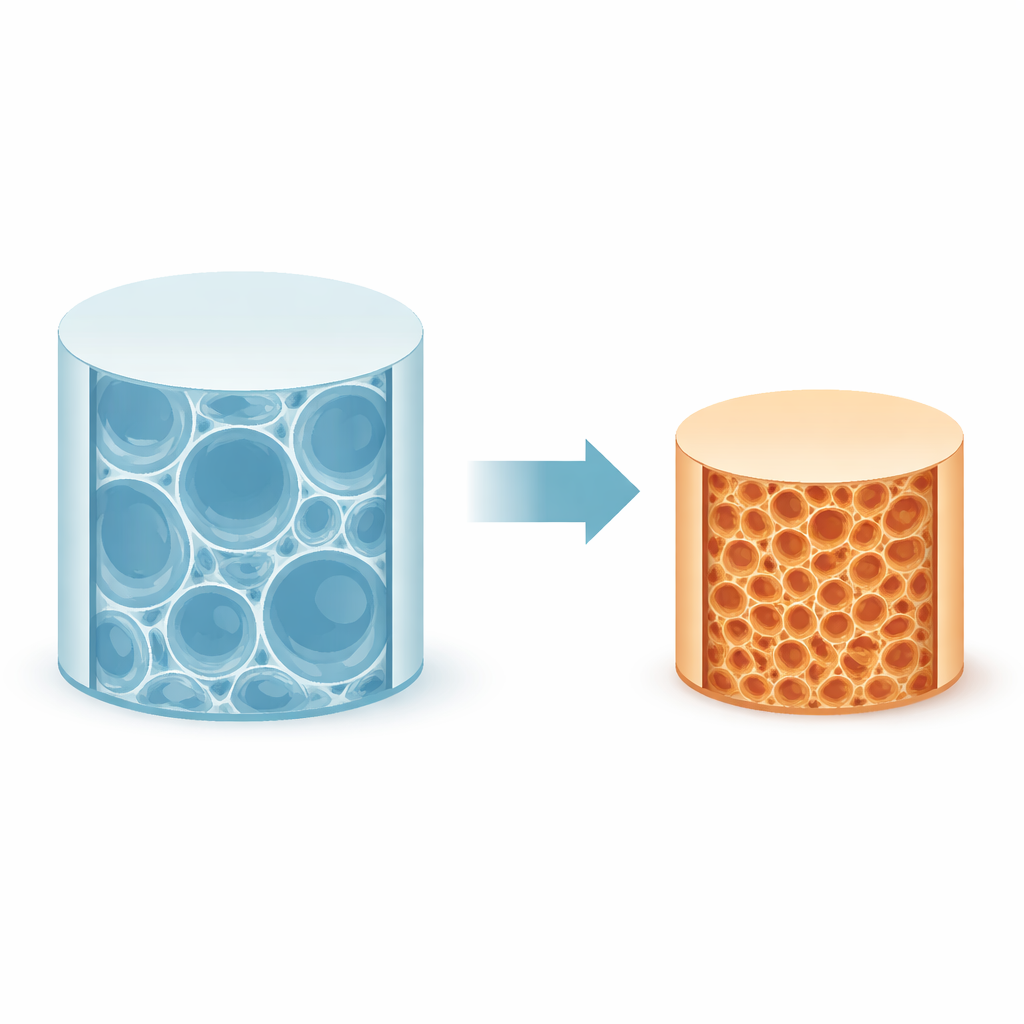
The researchers focused on hydrogels made from agarose, a purified component of agar extracted from red algae. Agarose forms a three-dimensional network of tiny fibers that trap water, creating a clear, jelly-like solid. Because it is biocompatible and its pore size and stiffness can be tuned, agarose is widely used as a support for cells, as a medium for separating biomolecules, and as a thickener in food and pharmaceutical products. In many of these uses, the gel is not kept perfectly wet: it may dry out at the edges, be stored for long periods, or experience temperature and humidity changes. Yet, compared to fully hydrated gels, much less is known about how their internal structure and mechanical behavior evolve while they are actually drying.
Watching Gels Shrink and Stiffen
To track this evolution, the team prepared cylindrical agarose and agar gels at different concentrations and let them dry in air for up to three days. High-resolution images taken every few hours revealed gradual shrinkage and color changes as water evaporated. At key times—after 2, 4, 24, and 72 hours—they compressed the samples along their height using a force-measuring device, extracting the Young’s modulus, a standard measure of stiffness, from the initial linear part of the stress–strain curve. They also freeze-dried some samples and imaged them with scanning electron microscopy to capture the porous network before and after drying. Finally, they modeled water loss using a classic diffusion equation, estimating how quickly water moves through gels of different solid content.
A Surprising Two-Stage Change in Firmness
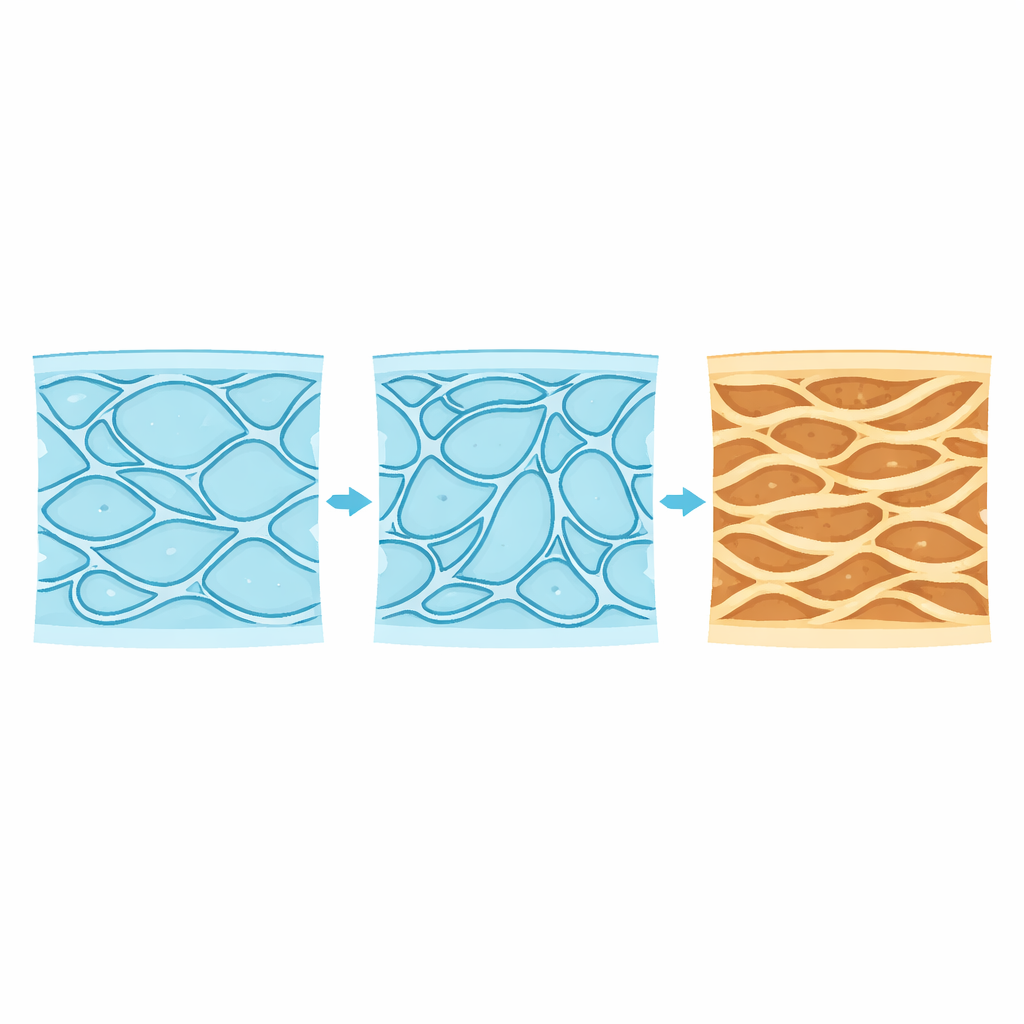
The measurements revealed that the gels do not simply harden steadily as they dry. Instead, the stiffness first drops slightly during the first day and then rises sharply over the next days. Microscopy and volume data suggest that two different buckling events drive this non-monotonic behavior. Early on, as a little water leaves mainly from the outer regions, the overall volume shrinks just enough to make the semi-flexible fiber network buckle and sag. This internal instability temporarily softens the material, even though it is losing water. Later, as drying continues and more water escapes, the pores themselves begin to collapse. Fibers pack closer together, the network densifies, and the gel becomes markedly stiffer—and ultimately more brittle.
How Concentration Controls Drying
The diffusion analysis showed that water escapes faster from dilute gels and more slowly from dense ones. Low-concentration gels, with wide, open pores, have higher diffusion coefficients and dry quickly, but this rapid shrinkage can lead to surface crusts, uneven internal stresses, and a higher risk of cracking. High-concentration gels dry more slowly because their tighter networks hinder water movement. In these samples, shrinkage and stiffening are more gradual, with late-stage pore buckling producing strong, rigid structures. Across all concentrations, the same basic two-stage pattern emerges: initial network buckling and softening, followed by pore collapse and reinforcement.
Why These Findings Are Useful
By connecting water loss, micro-scale structure, and bulk mechanical response, this work provides a clear physical picture of how agarose hydrogels evolve as they dry. For engineers and scientists designing gels for tissue scaffolds, diagnostic devices, soft robotics, or food textures, the message is that drying is not just a simple loss of moisture. It is a dynamic sequence in which the internal network first weakens and then locks into a denser, stiffer state, with the pace and extent of these changes controlled by the gel’s concentration. Understanding and tuning this two-step process can help create hydrogel-based materials that maintain the right balance of softness, strength, and stability over time.
Citation: Ed-Daoui, A., Chafi, N., Khoshnaw, F. et al. Unveiling the poroelastic evolution of agar hydrogels through the drying process. Sci Rep 16, 11929 (2026). https://doi.org/10.1038/s41598-026-41283-y
Keywords: agarose hydrogels, drying, mechanical properties, poroelasticity, buckling