Clear Sky Science · en
Effects of temperature, hyposalinity, and diminishing sperm concentration on fertilisation and embryonic development in Acropora tumida and Platygyra carnosa
Why coral baby steps matter
Coral reefs begin with invisible events: clouds of eggs and sperm released into the sea on a few nights each year. If these cells fail to meet, fuse, and grow into healthy larvae, whole reefs can slowly vanish, even if the adult corals still look alive. This study asks a simple but urgent question for Hong Kong’s already stressed coral communities: when the ocean suddenly becomes hotter or cooler and much fresher after heavy rain, and there is less sperm in the water because reefs are degraded, can corals still reproduce well enough to recover?
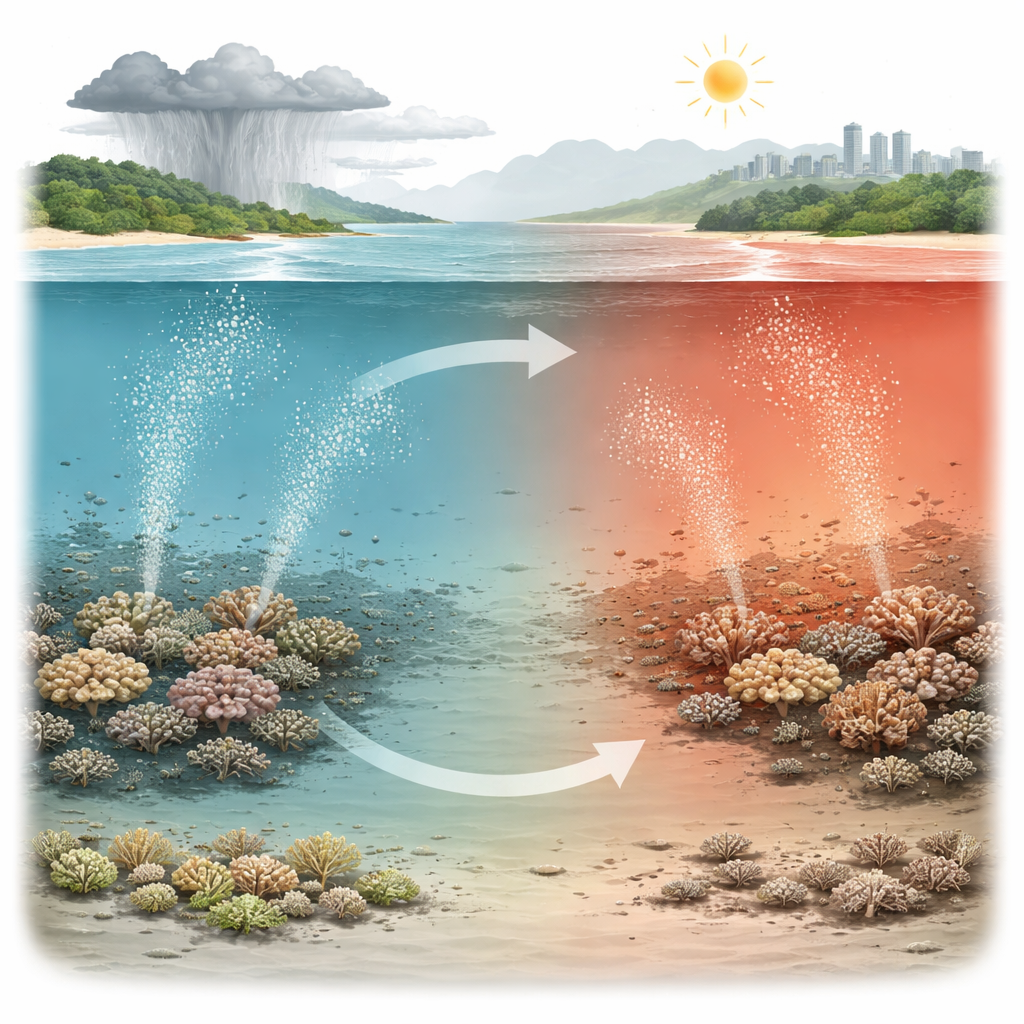
Stormy seas and changing coasts
Hong Kong lies in a “marginal” coral environment, where water temperature and saltiness already swing widely through the year. Climate change is making these swings more extreme, with marine heatwaves and stronger rainstorms now overlapping the coral spawning season in late spring and early summer. Heavy downpours push large plumes of low-salt water over coastal reefs for days to weeks, just when corals release their eggs and sperm. At the same time, human-driven reef degradation means there are fewer coral colonies packed together, so the sperm they release is rapidly diluted by waves and currents.
Testing coral reproduction in the lab
The researchers collected eggs and sperm from two common hard coral species, Acropora tumida and Platygyra carnosa, in a Hong Kong marine park. In the laboratory, they carefully mixed known numbers of sperm with small batches of eggs under combinations of three temperatures (a cooler setting, the local average, and a warmer setting) and four salt levels, from normal seawater to very fresh, rain-diluted water. By repeating this across a wide range of sperm concentrations, they could see not only how many eggs were fertilised, but also how many embryos went on to develop normally or became misshapen.
When fresh water and thin sperm clouds collide
The most damaging factor for fertilisation was low salinity. When the salt level dropped to a value typical of strong rainstorms in Hong Kong, fertilisation success fell by about 80% for both species, even when sperm were abundant. At a milder drop in salinity, A. tumida already showed noticeably lower fertilisation, while P. carnosa was somewhat more tolerant. Importantly, the team found that simply adding more sperm could partly compensate for fresher water: to reach the same fertilisation level under low salinity, many more sperm were needed. This is troubling in the real ocean, where fewer adult colonies and strong mixing mean sperm densities are often much lower than those used in standard lab experiments.
Heat, cold, and misshapen embryos
Temperature changes had species-specific effects. For A. tumida, both cooler and warmer water than normal reduced fertilisation success, suggesting it has a narrow comfort zone for this life stage. For P. carnosa, cooler water lowered fertilisation but slightly warmer water actually improved it, hinting that its current spawning season may already be a bit cooler than ideal. However, when the researchers followed embryos after fertilisation, they saw a different pattern of stress. A moderate drop in salinity caused roughly one-third to nearly half of embryos in both species to develop abnormally. Warmer water greatly increased abnormal embryos in P. carnosa, while cooler water had a stronger effect on A. tumida. These deformed embryos are unlikely to become healthy swimming larvae capable of settling and building new reef.
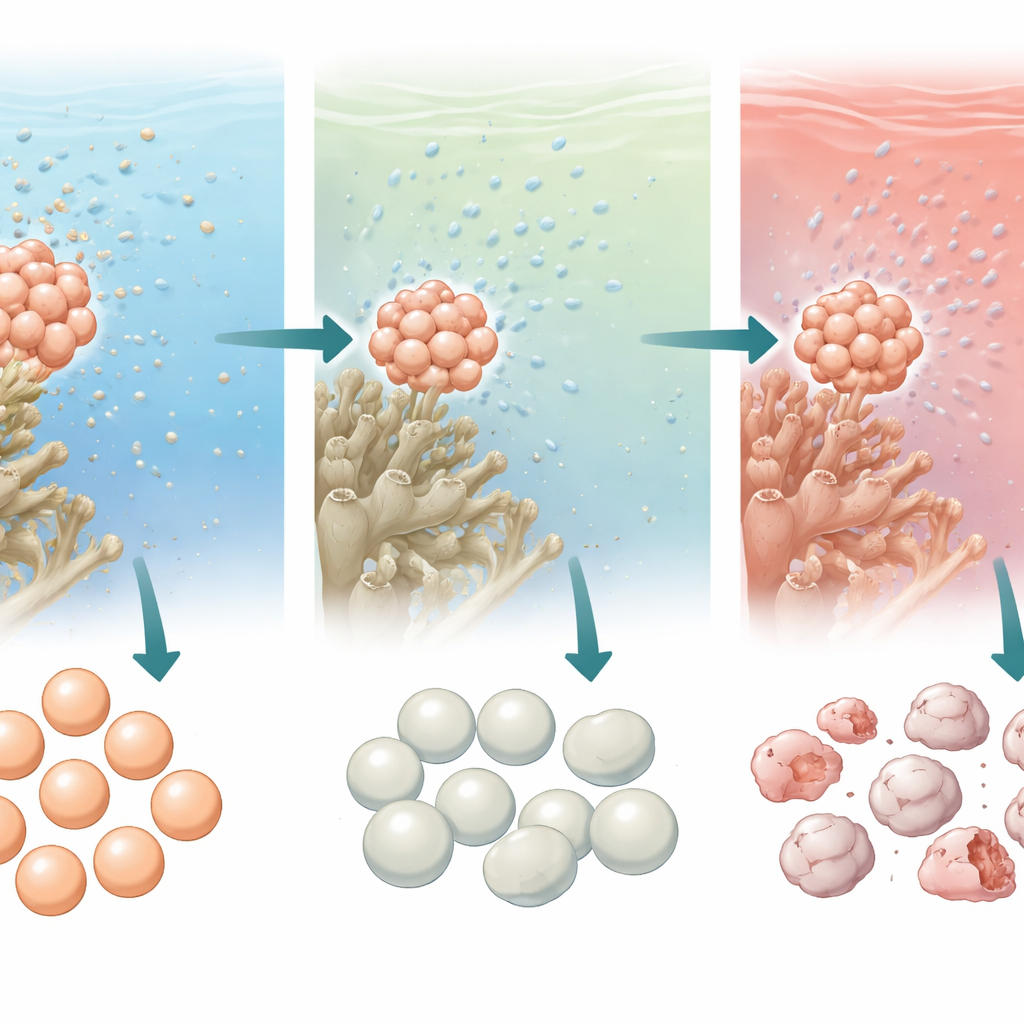
What this means for future reefs
Taken together, the study shows that fresher seawater from intense rain, temperature swings of just a few degrees, and dwindling sperm supplies from degraded reefs can jointly choke coral reproduction at its very first step. Even if some adults survive heatwaves and pollution, far fewer fertilised eggs and normal embryos may be produced, leaving too few young corals to replace losses. For marginal coral communities like those in Hong Kong, this reproductive bottleneck could decide whether reefs persist or quietly fade. The findings highlight that protecting coral breeding grounds, limiting further reef degradation, and prioritising restoration in vulnerable coastal areas are essential if coral populations are to keep renewing themselves in a more chaotic climate.
Citation: Chang, T.K.T., Chan, J.T.C., Cheung, B.C.T. et al. Effects of temperature, hyposalinity, and diminishing sperm concentration on fertilisation and embryonic development in Acropora tumida and Platygyra carnosa. Sci Rep 16, 14338 (2026). https://doi.org/10.1038/s41598-026-41257-0
Keywords: coral reproduction, climate change, salinity stress, thermal stress, Hong Kong reefs