Clear Sky Science · en
Ethical performance predicts missed nursing care in critical and general care settings
Why this study matters for hospital patients
When you or a loved one is in the hospital, you usually worry about mistakes: the wrong drug or the wrong dose. But a quieter danger is much more common—the important things that never get done at all. This study looks at how often critical nursing tasks are left undone and asks a deceptively simple question: do nurses who more consistently live out their professional values manage to miss less care, even in busy, stressed hospital environments?
The quiet problem of unfinished care
Missed nursing care means skipping or delaying essential tasks such as helping patients walk, checking pain, turning them in bed, teaching them about their illness, or updating families. Globally, many nurses say they leave at least one such task undone on almost every shift. These gaps are strongly linked to falls, bedsores, infections, readmissions, and preventable deaths. Most research has blamed hospital conditions like short staffing and heavy workloads. The authors of this paper explore another, more personal factor: nurses’ ethical performance, or how reliably they act on values like advocacy, accountability, and putting the patient first, even when the system is under strain. 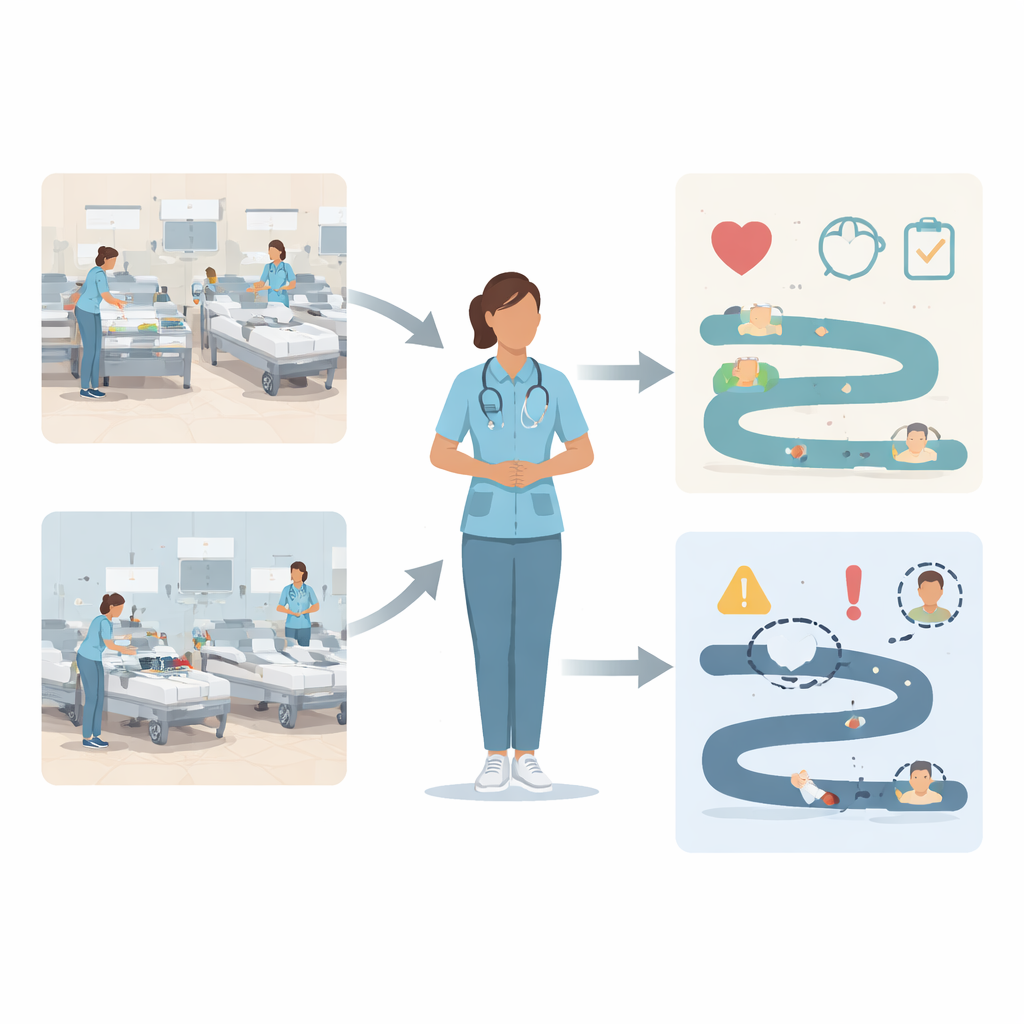
Taking a closer look inside Iranian hospitals
The research team surveyed 342 nurses working in 41 large teaching hospitals across three major Iranian cities. Half of the nurses worked in intensive care units (ICUs), where patients are critically ill but staffing is usually better; half worked on general medical–surgical wards, where more stable yet numerous patients compete for nurses’ attention. Each nurse filled out two detailed questionnaires: one measuring how often key tasks were missed on their last shift, and one measuring how often they engaged in concrete ethical behaviors, such as speaking up for patients, protecting privacy, and taking part in ethics discussions. The researchers then used advanced statistical models that account for differences between wards and hospitals to see how strongly these two patterns—ethics and missed care—moved together.
Ethical behavior and care completeness go hand in hand
The findings were striking. Nurses with higher ethical performance scores reported missing fewer essential care activities, and this link was very strong. In numbers, higher ethics explained about half of the variation in how much care was missed. Even after adjusting for age, work experience, education, city, work shift, and the particular ward, ethical performance remained the only factor that clearly predicted whether care was left undone. A modest improvement in ethical performance was tied to a noticeable drop in missed tasks—roughly one fewer important activity skipped per shift on average. Yet the study also showed that about half of the differences in missed care could not be explained by ethics or basic demographics, pointing to deeper organizational issues like real-time staffing and safety culture.
Surprising differences between intensive and general wards
Many people assume that ICUs, with their constant alarms and life-or-death decisions, would be where most care falls through the cracks. This study suggests the opposite. ICU nurses had higher ethical performance and reported fewer missed tasks than their colleagues on general wards. The authors suggest that better nurse-to-patient ratios and stronger team structures in ICUs may give nurses the breathing room needed to act on their values. On crowded general wards, where one nurse may care for five to eight patients at once, tasks may be dropped not because nurses do not care, but because they feel powerless to keep up. Across the three cities, however, overall levels of both ethical performance and missed care were remarkably similar, hinting at nationwide patterns rather than isolated local problems. 
What this means for patients and health systems
For lay readers, the takeaway is both reassuring and sobering. On one hand, nurses who consistently live out their professional values tend to provide more complete care, and this holds true across very different hospital units. On the other hand, ethics alone cannot overcome a system that spreads nurses too thin or punishes them for speaking up. The authors caution that their cross-sectional snapshot cannot prove cause and effect, and that self-reported data may understate problems. Still, their work supports a clear message: protecting patients requires not only teaching ethics, but also building hospital environments—especially on general wards—where nurses have the time, support, and psychological safety to do what they already believe is right.
Citation: Atefeh, S., Narges, H. & Fatemeh, L. Ethical performance predicts missed nursing care in critical and general care settings. Sci Rep 16, 11043 (2026). https://doi.org/10.1038/s41598-026-41241-8
Keywords: missed nursing care, nursing ethics, patient safety, hospital staffing, intensive care