Clear Sky Science · en
Sex-specific but not urbanisation-related behavioural differences in a wolf spider, Pardosa alacris
City Life Through the Eyes of a Spider
As our cities spread, many animals are forced to cope with noisy streets, artificial lights and fewer hiding places. This study asks a surprisingly down-to-earth question: do spiders that live in cities behave differently from their country cousins? By watching how a common wolf spider moves, explores and reacts to danger, the researchers hoped to learn whether urban life favors bolder, more adventurous individuals—and whether males and females respond to city living in the same way.
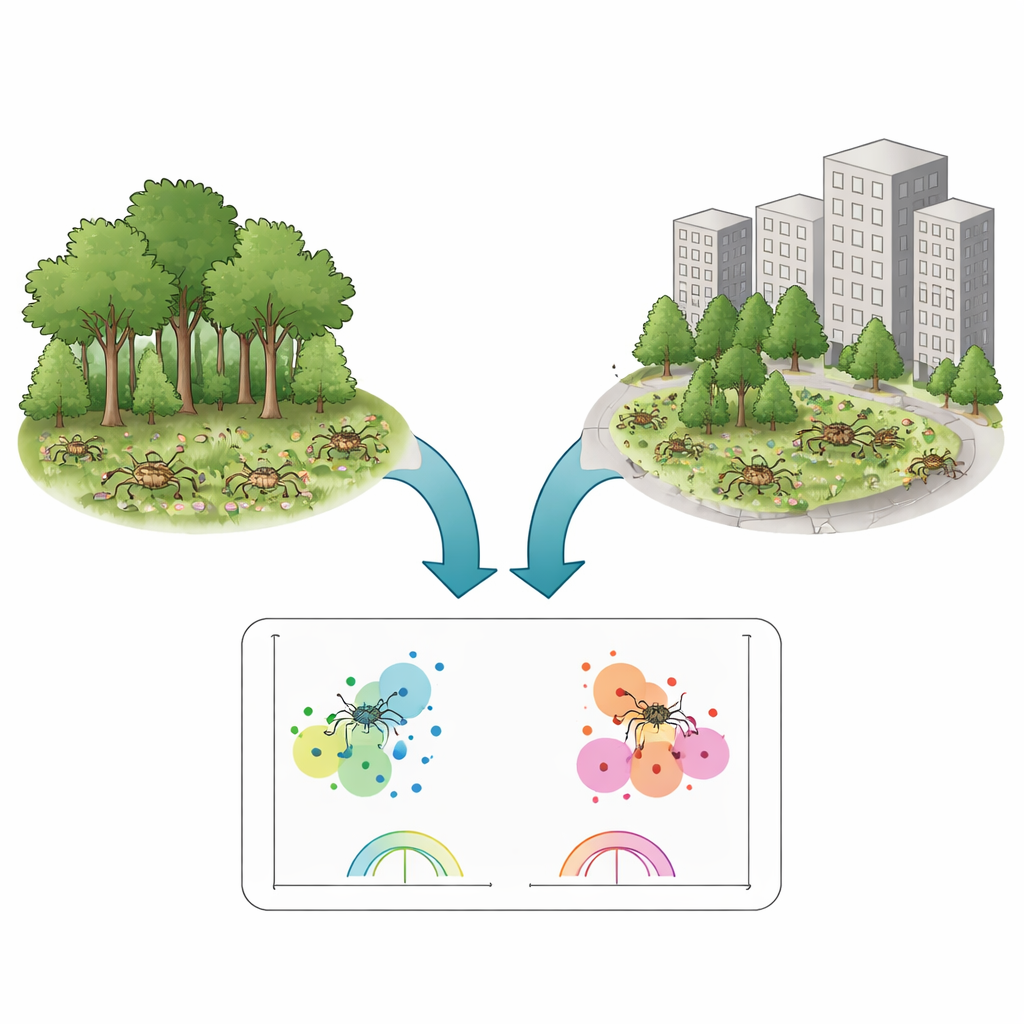
From Old-Growth Woods to City Fragments
The work focused on Pardosa alacris, a ground-hunting wolf spider that prowls the leaf litter of European oak forests. Around the city of Debrecen in Hungary, the same ancient forest continues outside town while smaller fragments are embedded within the urban fabric. This natural experiment allowed the team to compare spiders from four rural and four urban forest patches that share similar trees, soils and climate, but differ sharply in surrounding buildings, paved surfaces, management and trampling. Across these sites, they collected 253 adult spiders—both males and females—and brought them to the laboratory for a close look at their behaviour.
Spiders in a Test Arena
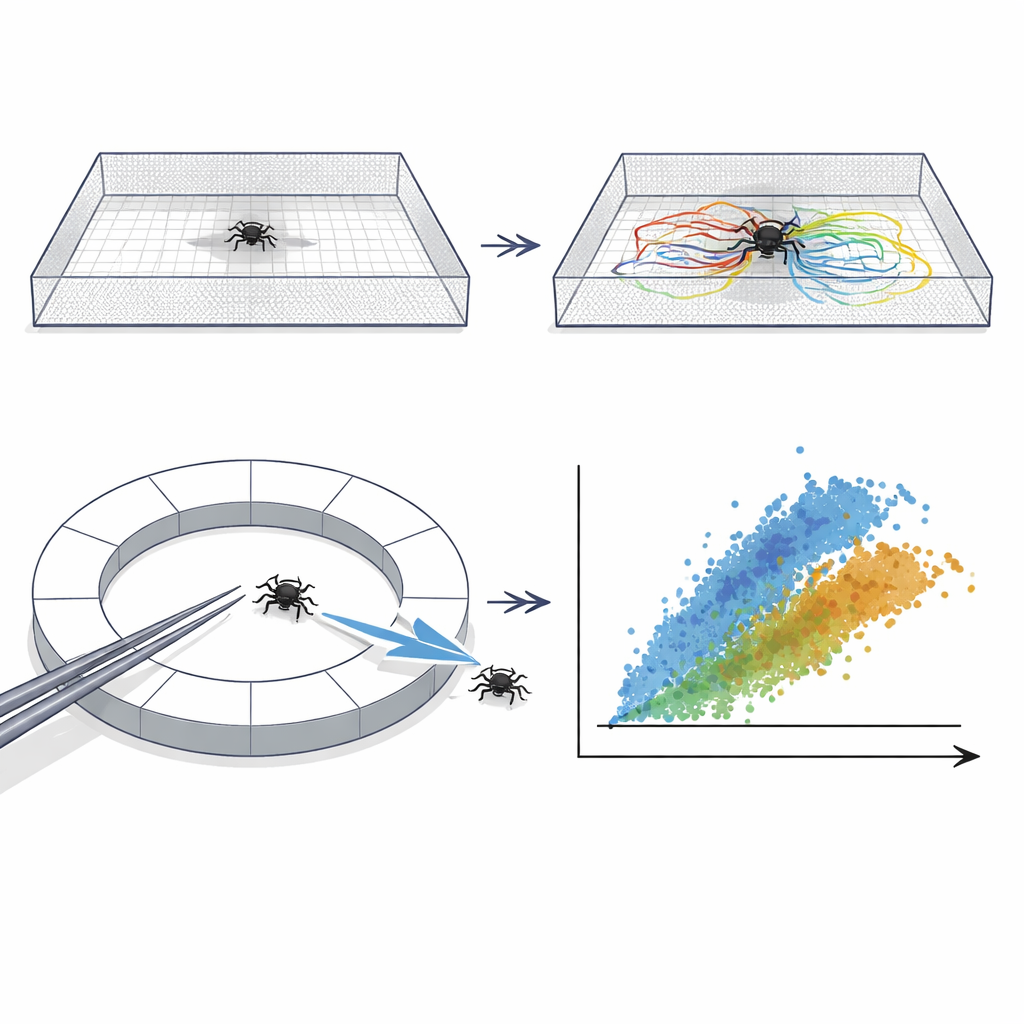
To probe how the spiders behave, the researchers used two standard tests. In the first, each spider was placed in a bright, unfamiliar box with a grid on the floor, and its movements were filmed for 90 seconds. From these videos, the team counted how many grid squares the spider crossed, how quickly it reached the wall and how much time it spent near the edge versus the centre. These measures capture how active, exploratory and “bold” a spider is when facing a new situation. In the second test, each spider stood in a ring-shaped arena. After it had settled, the experimenter gently tapped it with forceps to simulate an attack and then measured how long and how far it ran, as a gauge of risk-taking or escape behaviour.
Boiling Many Behaviours Down to a Few Patterns
Because these six measurements are strongly related to one another, the scientists combined them into two broader scores. One composite captured activity, exploration and boldness in the unfamiliar box. The other reflected how strongly a spider fled in the escape test. They repeated all tests 24 hours later to see whether individual spiders behaved consistently. The activity–exploration–boldness score turned out to be repeatable: the same spiders tended to be more or less active in both trials, suggesting stable individual tendencies at least over short time scales. By contrast, the risk-taking score based on the simulated attack was not repeatable, likely because spiders sometimes responded by attacking the forceps rather than running away, making this measure too erratic to serve as a reliable personality trait.
City Versus Countryside—and the Battle of the Sexes
The big surprise was what did not differ. Urban and rural spiders showed no clear differences in either of the composite scores. City living did not make this species more exploratory, bolder or more risk-prone on average. However, sex mattered a great deal. Males were consistently more active, more willing to leave the arena’s edge and generally bolder than females, regardless of whether they came from town or country. This likely reflects different life strategies: males roam widely in search of mates and may accept higher risks, while females invest heavily in egg production and may benefit from a more cautious style. The data also hinted that city spiders show more consistent behaviour over time and greater variation among individuals, which could help them cope with predictable but demanding urban conditions.
What These Spiders Tell Us About Urban Wildlife
For this forest-dwelling wolf spider, the shift from rural woods to city forest fragments has not reshaped basic behavioural tendencies—at least not in ways that show up in these tests. Instead, the sharpest divide runs between males and females, not city and countryside. That suggests that, for a mobile predator able to disperse using silk and find suitable hiding spots even in towns, being especially bold or risk-taking in cities does not provide extra advantages. Understanding such nuances helps ecologists avoid simple stories about “urban wildlife personalities” and highlights that evolution may act more strongly on sex-specific roles and fine-scale habitat differences than on broad rural–urban contrasts.
Citation: Magura, T., Horváth, R., Mizser, S. et al. Sex-specific but not urbanisation-related behavioural differences in a wolf spider, Pardosa alacris. Sci Rep 16, 12253 (2026). https://doi.org/10.1038/s41598-026-41239-2
Keywords: urban ecology, animal personality, wolf spiders, behavioural ecology, sex differences