Clear Sky Science · en
Comparison of neural and traditional techniques for soliton structures and dynamical behavior in a double-chain DNA model
Why waves in DNA matter
Inside every cell, DNA is constantly flexing, twisting, and vibrating. These motions are not just random jitters; they can help open up sections of the genetic code so that genes can be read or copied. This article explores how certain wave-like disturbances, called solitons, can travel along a simplified model of a double DNA strand. By combining traditional mathematical tools with a neural‑network-inspired approach, the authors map out the kinds of waves that can exist, how stable they are, and when their motion may become highly sensitive or even chaotic.
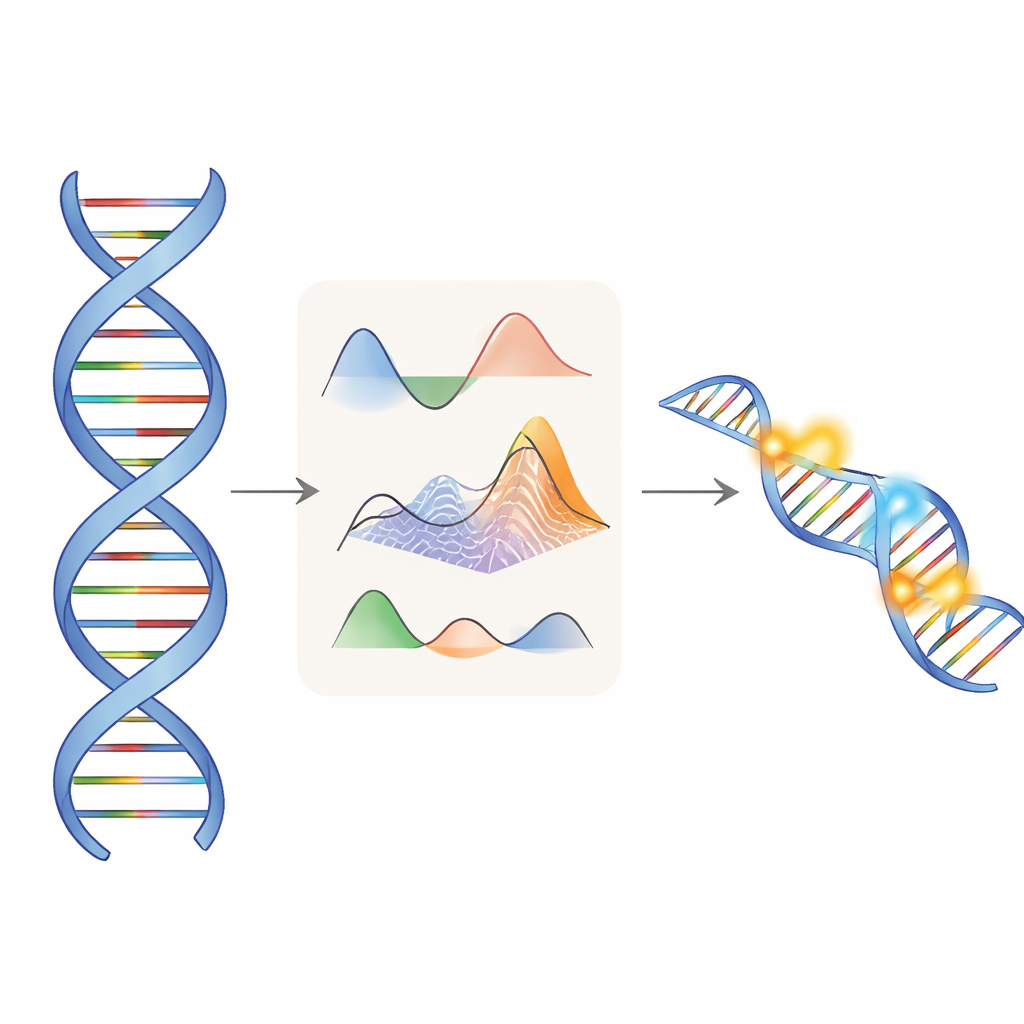
A simplified picture of a double DNA strand
Real DNA is a twisted double helix, but for calculation it is often represented as two parallel chains linked by springs. In this study, the authors work with a double-chain model that tracks two kinds of motion: stretching along the chains and motion across the gap between them. Two variables describe these movements, and the model includes parameters that stand for material stiffness, tension, mass, and the spacing between the chains. To make the problem more manageable, the authors assume that the two strands move in step with one another under small disturbances. This reduces the model to a single effective equation that still retains key nonlinear features needed to describe compact, shape‑preserving waves.
Hunting for shape‑preserving waves
The core of the work is the systematic search for soliton solutions of the reduced equation. Solitons are special waves that keep their shape as they travel, rather than spreading out. Using a technique based on the Riccati equation—a simple but powerful mathematical relation—the authors turn the original complicated equation into one that can be solved in terms of familiar building blocks such as hyperbolic and trigonometric functions and rational expressions. From these pieces they construct families of solutions that correspond to bright pulses, dark dips, and kink‑like steps that connect two different background levels along the DNA chain. These analytical expressions greatly expand the known catalogue of possible wave forms for this type of DNA model.
A neural-network twist on exact solutions
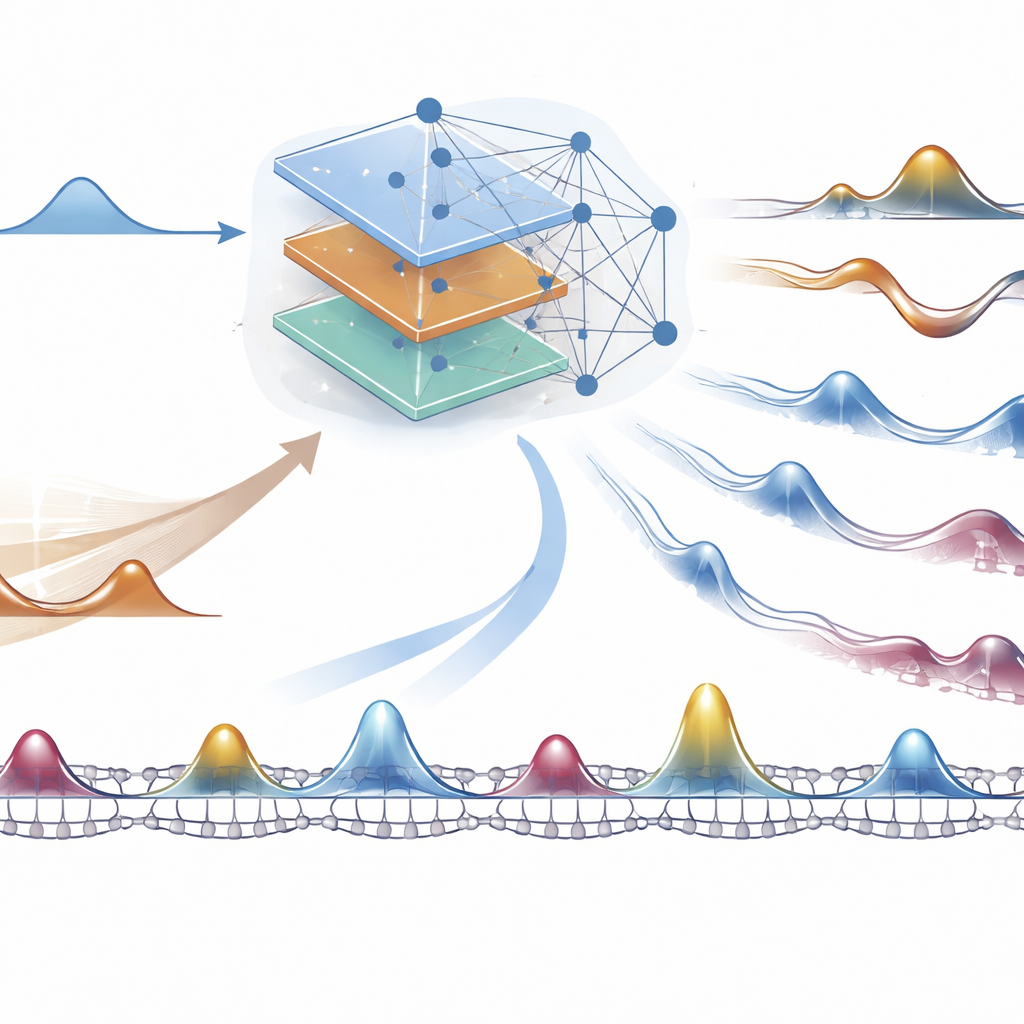
Next, the authors introduce a modified method that borrows the architecture of neural networks but uses it in a purely symbolic way. Instead of training a network on data, they choose the activation functions in the first hidden layer directly from the earlier Riccati solutions. The network output is treated as a clever guess for the DNA displacement. When this guessed form is substituted back into the governing equation, the requirement that the equation hold exactly turns into a set of algebraic conditions on the network weights and biases. Solving these conditions yields new closed‑form wave solutions. By comparing three‑dimensional surfaces, contour plots, and cross‑sections, the authors show that the neural‑network‑based method reproduces and extends the shapes found by the traditional Riccati approach, including kink–antikink pairs, bright and dark pulses, and even singular, sharply peaked structures.
From steady waves to sensitive and chaotic motion
Beyond listing wave shapes, the study asks how these structures behave dynamically and how sensitive they are to starting conditions. The reduced equation is rewritten as a planar dynamical system, where the state of the wave at each point is represented by a point in a two‑dimensional phase plane. By varying initial conditions while keeping physical parameters fixed, the authors observe large changes in the resulting trajectories, highlighting that even tiny differences at the outset can strongly affect the evolution of the wave. They then add a periodic driving term, which mimics an external influence, and compute Lyapunov exponents—numbers that quantify how quickly nearby trajectories diverge. The presence of a positive exponent signals that, in some regimes, the DNA wave dynamics can become chaotic, with long‑term behavior that is effectively unpredictable.
What this means for DNA and future models
In everyday terms, the article shows that a simple double‑chain picture of DNA is capable of supporting a rich variety of traveling disturbances, from smooth steps and localized bumps to extreme, spike‑like events. The hybrid analytical and neural‑inspired methods provide a toolkit for writing down these waves exactly and for probing when they are stable or prone to wild, chaotic shifts. While the work is theoretical, it adds to the idea that energy in DNA can move in organized packets that may aid biological processes such as gene activation. The authors suggest that the same strategy could be pushed further to include more realistic effects—such as varying environments, external forces, or memory of past motion—offering a path toward more faithful mathematical models of the restless life of DNA.
Citation: Majid, S.Z., Sağlam, F.N.K. & Ullah, M.S. Comparison of neural and traditional techniques for soliton structures and dynamical behavior in a double-chain DNA model. Sci Rep 16, 10390 (2026). https://doi.org/10.1038/s41598-026-41229-4
Keywords: DNA solitons, nonlinear waves, neural network methods, chaotic dynamics, mathematical biophysics