Clear Sky Science · en
A wavelet-integrated framework for feature extraction and background refinement in hyperspectral anomaly detection
Seeing the Invisible in Satellite Images
Modern satellites don’t just take pretty pictures; many record dozens or even hundreds of colors of light, far beyond what our eyes can see. Hidden in this "hyperspectral" data are faint clues about unusual objects on the ground, from small aircraft to stressed crops or industrial spills. This paper introduces a new way to sift through these complex stacks of color to find rare, unknown targets more accurately and with fewer false alarms, even in messy real-world scenes.
Why Many Colors Matter
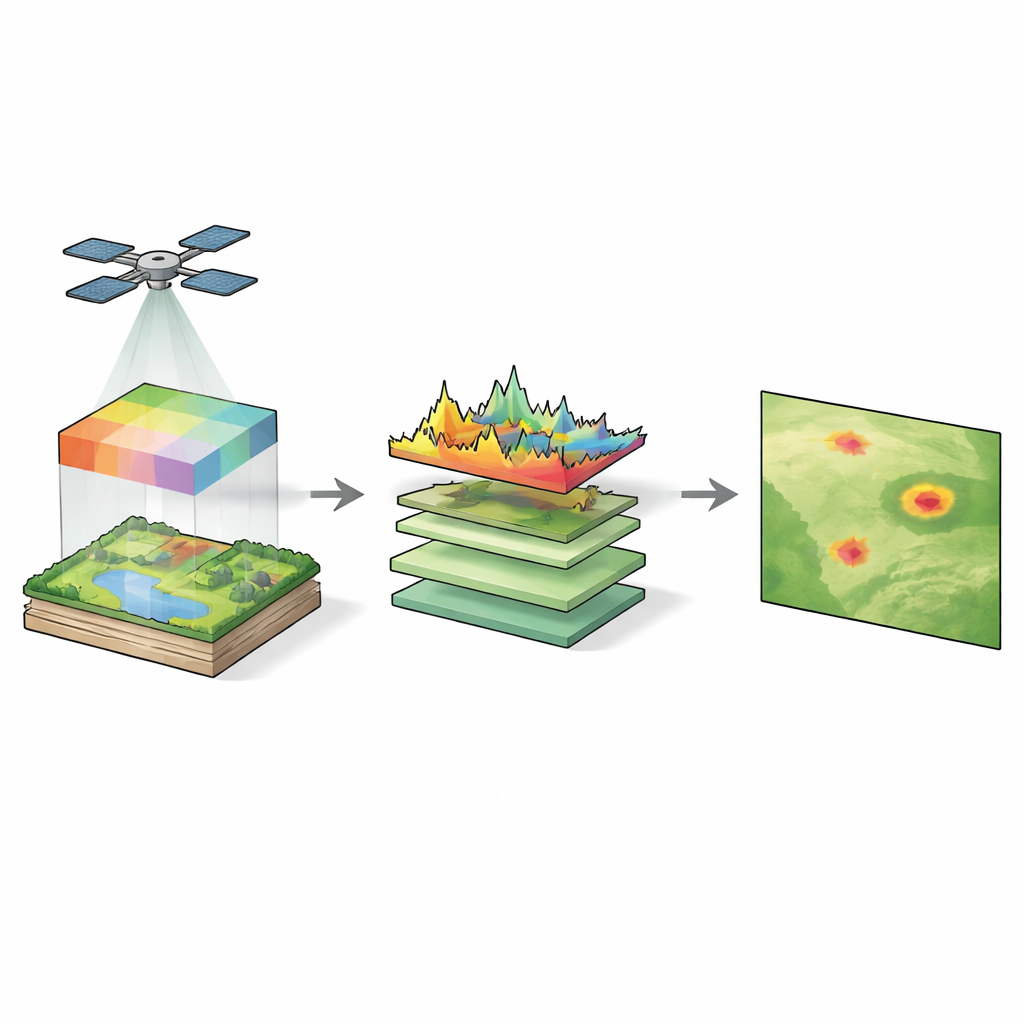
Hyperspectral imaging captures each scene as a three-dimensional block of data: two dimensions for location and one for wavelength. Instead of one red band or one green band, there may be hundreds of very narrow bands, each carrying subtle information about how materials reflect light. This richness allows very fine distinctions between, say, a concrete roof and a metal one, or between healthy and diseased plants. But it also creates a challenge: the data are huge, noisy, and filled mostly with ordinary background, while the interesting objects – the anomalies – may occupy only a handful of pixels. Many existing detection methods assume that the background behaves in a simple, regular way; when that assumption breaks down, they either miss real targets or trigger many false alarms.
The Limits of Current Detectors
Researchers have developed a wide range of strategies to spot anomalies in hyperspectral scenes. Classical statistical methods build a model of the background and flag any pixel that looks statistically different. Other approaches try to express each pixel as a mixture of typical background patterns and call anything that cannot be well reconstructed an anomaly. More recently, deep learning methods use complex neural networks to rebuild or classify the data. However, all of these have weaknesses in practice. Statistical methods are sensitive to outliers and noise and can be fooled when the background itself changes rapidly. Low-rank and sparse "matrix decomposition" methods can struggle when small anomalies are buried inside sharp background variations. Deep learning models often require large labeled datasets, heavy computation, and act as black boxes, which makes them hard to trust in time-critical or unsupervised applications.
Using Ripples in the Spectrum
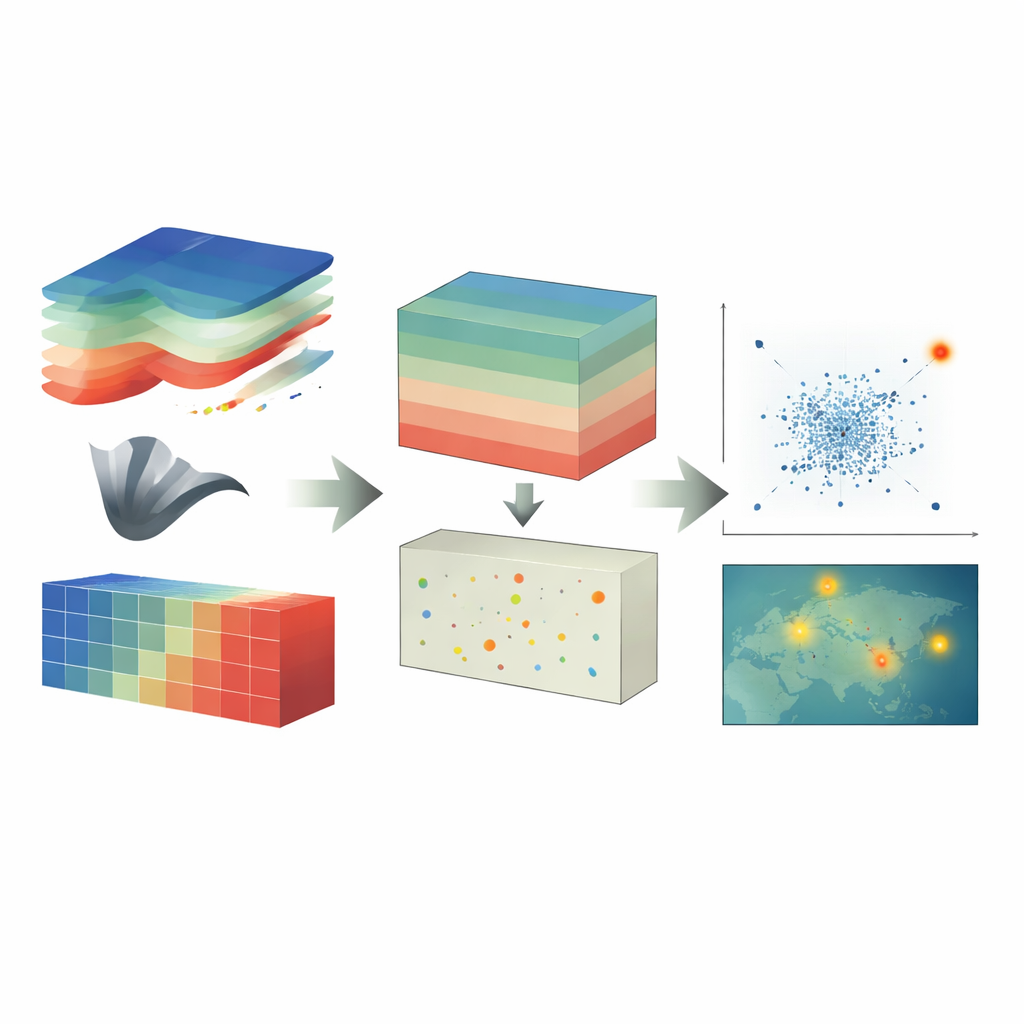
The proposed method, called WTHAD, begins by looking at each pixel’s spectrum with a tool borrowed from signal processing: the wavelet transform. Instead of treating the spectrum as one long curve, the transform breaks it into smooth, low-frequency components that capture overall material behavior and sharper, high-frequency components that often contain noise and tiny irregularities. By carefully retaining the most informative parts and reducing redundant or noisy details, this step makes the background appear smoother and more coherent, while making unusual spectral patterns stand out more clearly. In other words, it reorganizes the data into a form where the ordinary parts of the scene line up neatly and the odd pixels become more distinct.
Separating Background from Oddities
Once the spectra have been reshaped by the wavelet transform, WTHAD applies a fast mathematical technique known as GoDec to split the data into two pieces: a "low-rank" background that captures broad, repeated structures, and a "sparse" part that contains rare deviations. To avoid confusing noise with true targets, the method first uses a simple wavelet-based statistical test to identify a pool of candidate anomaly pixels and restricts the sparse component to those locations. This stabilizes the separation and encourages entire pixels, rather than scattered fragments, to be treated as potential anomalies. After this decomposition, a refined statistical distance measure, the Mahalanobis distance, is computed using the cleaned background. Pixels whose transformed spectra fall far from this background cloud are finally marked as anomalies on a detection map.
Performance in Real Scenes
The authors tested WTHAD on six widely used hyperspectral datasets, including airports, urban areas, farmland, and coastal scenes, collected by different sensors. In each case, a small number of known targets, such as planes, buildings, small man-made objects, or field patches, served as ground truth anomalies. Compared against eight leading detection methods, WTHAD consistently achieved equal or higher detection scores, often by a noticeable margin, while maintaining low false alarm rates. Visual inspection of the resulting anomaly maps showed that WTHAD produced compact, well-localized target spots and cleaner backgrounds than rival techniques, especially in noisy or highly varied environments. The method also demonstrated reasonable computation times, making it more practical than many heavier algorithms.
Clearer Signals from Complex Data
In everyday terms, this work shows how to listen more carefully to a very complicated song: first by separating the deep, steady background tones from the quick, sharp notes, then by focusing on any out-of-place sounds. By combining wavelet-based feature extraction, a structured way to peel off the background, and a robust statistical test, WTHAD offers a stable, interpretable, and efficient way to detect unusual pixels in hyperspectral images without prior knowledge of what to look for. The result is a tool that can more reliably spot small or subtle targets – from hidden objects to environmental changes – within the overwhelming richness of modern remote sensing data.
Citation: Küçük, F. A wavelet-integrated framework for feature extraction and background refinement in hyperspectral anomaly detection. Sci Rep 16, 8862 (2026). https://doi.org/10.1038/s41598-026-41223-w
Keywords: hyperspectral imaging, anomaly detection, wavelet transform, remote sensing, satellite imagery