Clear Sky Science · en
Unveiling cryptic diversity: integrative taxonomy discovers eight new species of moths and exposes biodiversity shortfalls in a Neotropical region
Hidden Variety in Seemingly Similar Moths
To most of us, a small yellow moth flashing past a porch light looks like any other. Yet this study reveals that behind those similar wings lies a surprising wealth of undiscovered life. By taking a closer look at a group of Neotropical moths long thought to be just a few species, the authors show that many distinct species have been hiding in plain sight—and that our current picture of tropical biodiversity is far more incomplete than we realize.
Look-Alike Moths in a Biodiversity Hotspot
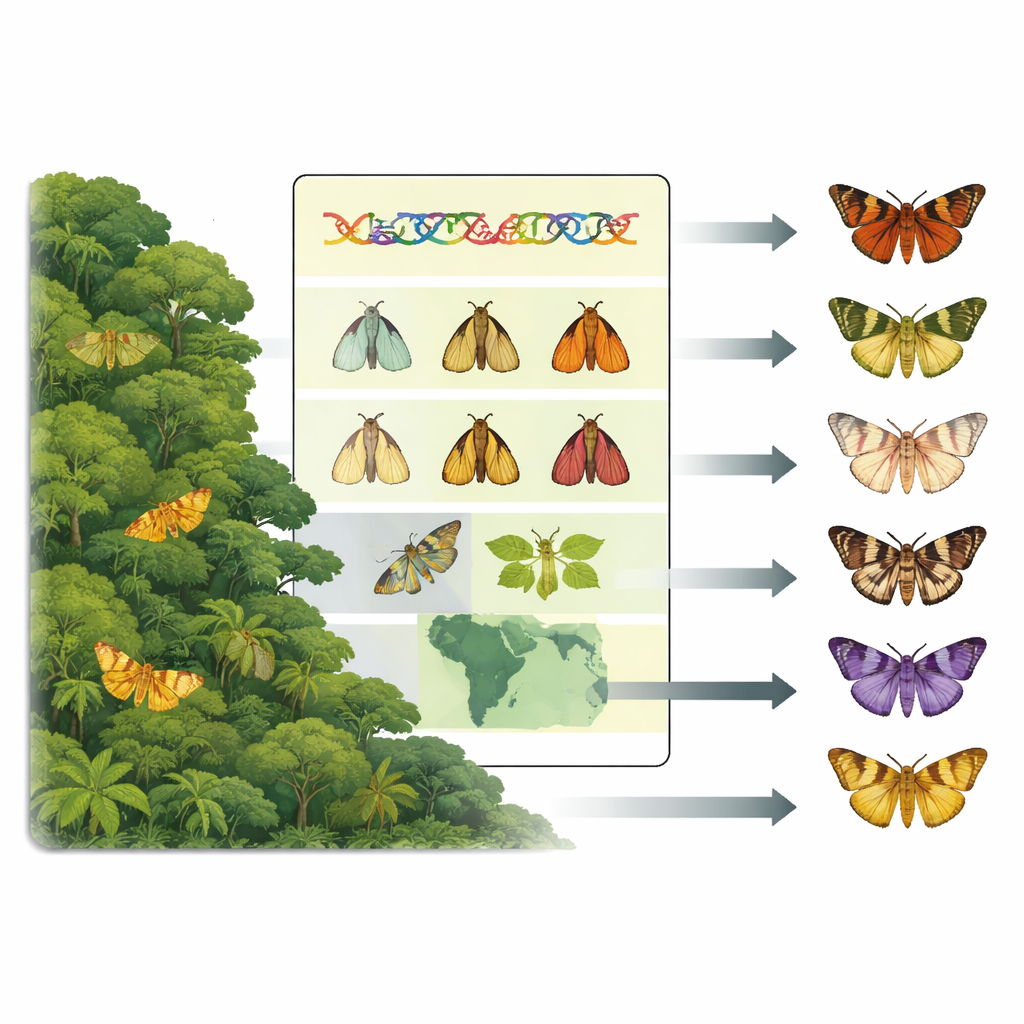
The researchers focused on a genus of small moths called Eois, especially a classic species known for its yellow wings crossed by reddish bands. These moths live in the rich forests of the Neotropics, from Amazonian lowlands to Brazil’s coastal rainforests and wetlands. For over 200 years, the type species, Eois russearia, and a handful of close relatives were treated as a limited set of named species, even though scientists suspected that their varied wing patterns, host plants, and genetic signatures hinted at deeper hidden diversity.
Combining DNA, Bodies, Plants, and Maps
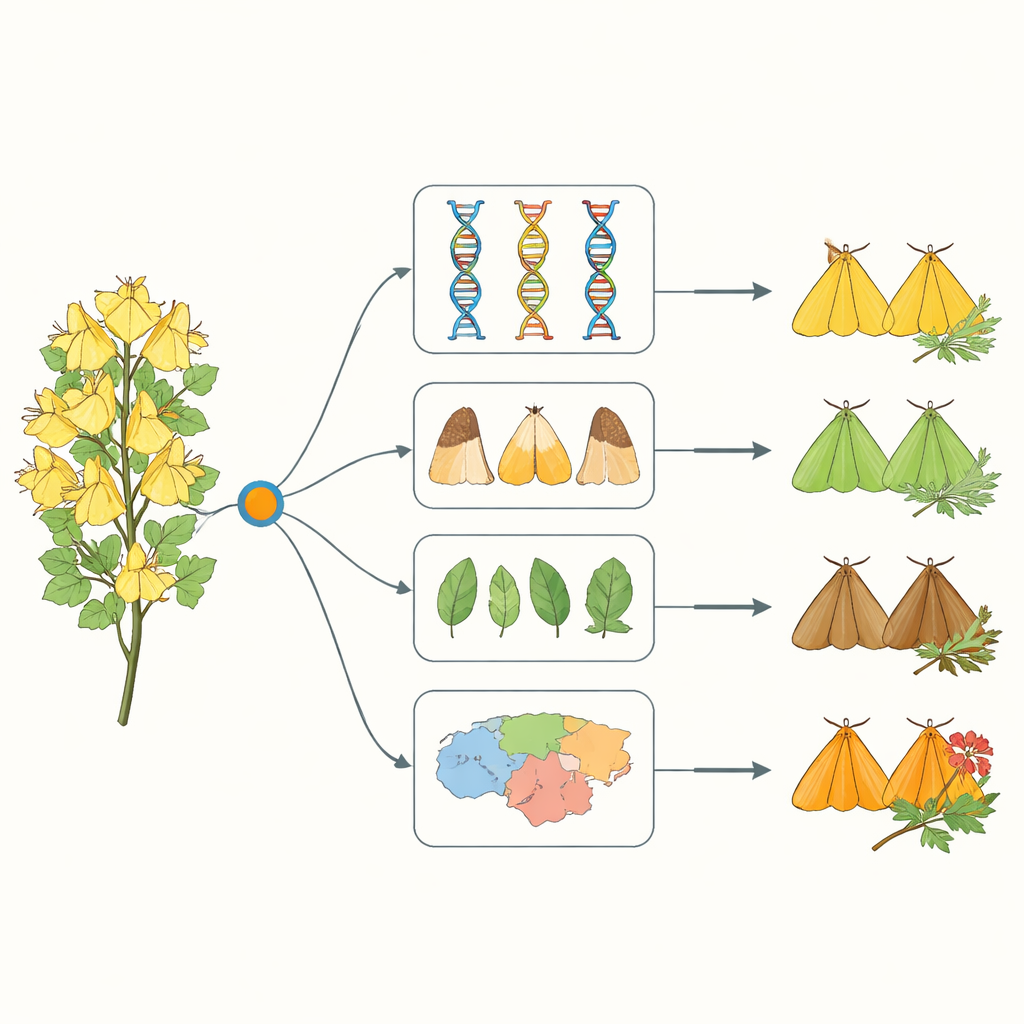
To uncover what was really going on, the authors used an "integrative taxonomy" approach. They collected caterpillars from specific Piper plants—the pepper relatives that these moths specialize on—in three Brazilian regions: Atlantic Forest, Amazon rainforest near Manaus, and the Pantanal wetlands. They reared the caterpillars in the lab, then studied the adults from several angles. First, they sequenced a standard piece of mitochondrial DNA widely used as a species barcode. They then compared subtle wing patterns and carefully dissected male and female reproductive structures, which often hold crucial clues to species boundaries. Finally, they matched each moth to its host plant and mapped where it was found.
Eight New Species Emerge from One Name
Using a DNA-based clustering method called ASAP to group related sequences, the team found multiple genetic lineages within what had been treated as a single species complex. When they cross-checked these clusters with wing details, internal anatomy, host plants, and geography, eight of these lineages stood out as clearly distinct, previously unnamed species. These new species occur in different combinations across lowland Amazonian forests, riverine Atlantic Forest remnants, and the Pantanal, often living side by side but feeding on different Piper species. Intriguingly, the usual go-to traits in moths—like male genitalia—were only subtly different, while female anatomy, larval host choice, and DNA patterns provided stronger evidence that these lineages are truly separate species.
What These Moths Tell Us About Knowledge Gaps
The study goes beyond describing new species to highlight a deeper problem: how much we still do not know about biodiversity, even in well-studied groups like moths. The authors connect their findings to three major "shortfalls" in our knowledge. We lack basic descriptions of many species (the Linnean shortfall), we often do not know exactly where they live (the Wallacean shortfall), and we know even less about which plants and other organisms they interact with (the Eltonian shortfall). Because hyper-diverse groups like Eois are difficult and time-consuming to study, and because there are too few trained taxonomists, these gaps are especially wide in tropical regions of the Global South.
Why This Matters for Nature and for People
By proving that at least eight distinct moth species were hidden inside one traditional name, this work shows that estimates of tropical diversity are likely far too low. Relying only on quick genetic surveys risks generating long lists of anonymous lineages without the detailed, real-world information needed for conservation or ecological understanding. The authors argue that genuine progress requires balancing modern DNA tools with careful study of bodies, behaviors, host plants, museum collections, and geography. Only by turning genetic hints into fully described, named species with known ranges and ecological roles can we "give life" to biodiversity—making it visible and usable for science, conservation planning, and the broader public.
Citation: Moraes, S., Machado, P.A., Stanton, M.A. et al. Unveiling cryptic diversity: integrative taxonomy discovers eight new species of moths and exposes biodiversity shortfalls in a Neotropical region. Sci Rep 16, 12515 (2026). https://doi.org/10.1038/s41598-026-41222-x
Keywords: cryptic species, integrative taxonomy, Neotropical moths, biodiversity shortfalls, host plant specialization