Clear Sky Science · en
Multidimensional coevolution drives predator coexistence
Why many hunters can share one victim
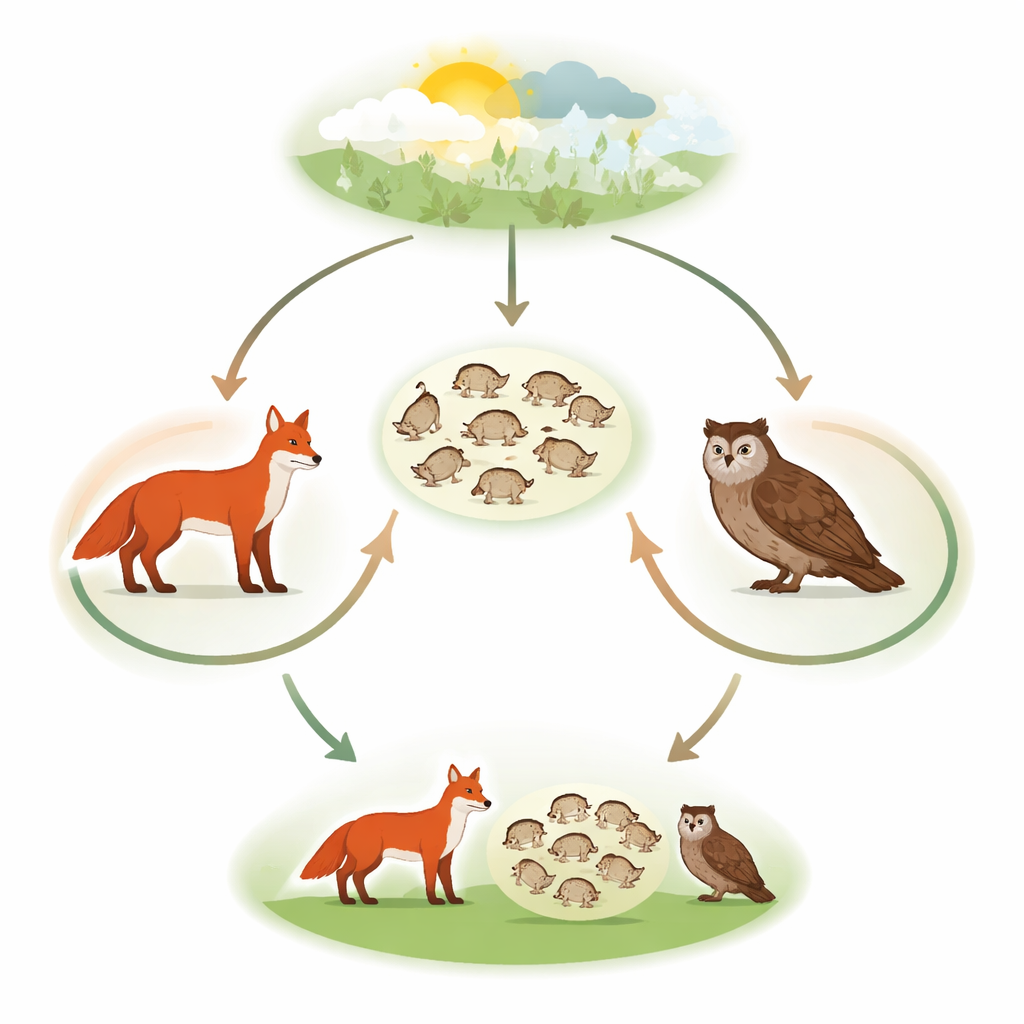
In nature, it is common to find several predators relying on the same kind of prey, such as different fish feeding on one type of plankton or multiple insects eating a single plant species. Classic ecological theory says this should not happen for long: the most efficient hunter ought to win and drive the others away. This study asks how real ecosystems avoid that simple outcome. It shows that when predators and prey can change in more than one way at once—evolving multiple traits together—these shifting battles can actually help different predators share a single prey species over the long term.
Old rules of competition meet living, changing species
Traditional ideas in ecology focus on fixed species with fixed characteristics. Under that view, if two predators eat the same prey in the same way, the one that can survive on less food should eventually exclude its rival. To explain why this is rarely seen in the wild, past work has pointed to predators using different habitats or times of day, or to prey evolving a single defensive trait that reshapes who has the upper hand. However, these explanations usually treat evolution along just one dimension, such as body size or speed, and often ignore that predators and prey respond to one another in an ongoing, back‑and‑forth evolutionary contest.
Many ways to fight, many ways to share
This paper builds a mathematical model in which two predator species and their shared prey all evolve in response to each other. Each species can change either one trait or two traits at the same time, such as different types of defenses in the prey and matching hunting abilities in the predators. The model considers two broad kinds of interaction. In “matching” interactions, predators do best when their traits closely align with the prey’s traits, like a hunter tuned to detect a specific kind of camouflage. In “difference” interactions, predators succeed by outpacing the prey along a trait, as in speed or weapon strength. Importantly, without evolution, the model is set up so that only one predator can persist, mirroring the classic competitive exclusion rule.
Evolution in several directions softens the fight
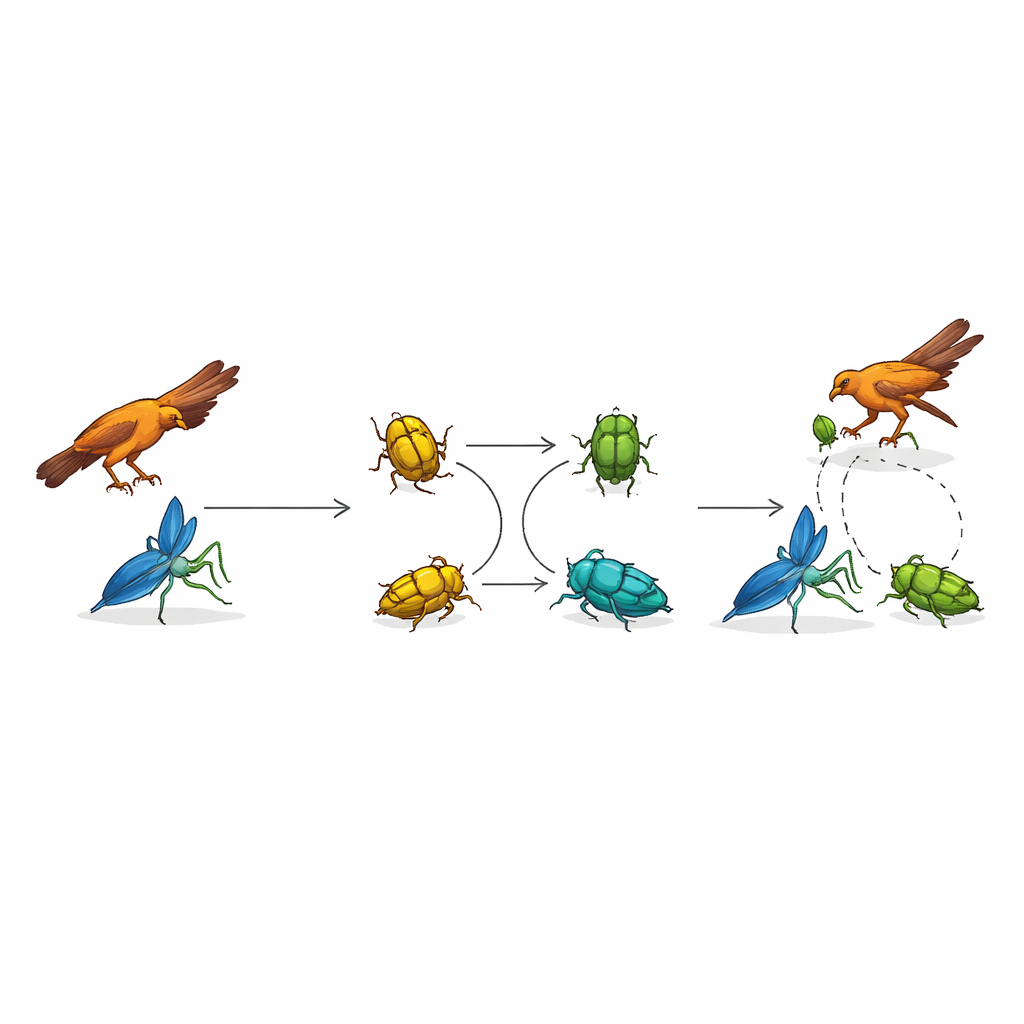
The results show that once evolution is allowed, especially when the prey adapts quickly, both predators can coexist—even though they feed on the same prey. When only one trait evolves, prey and one predator often lock into a strong arms race along that single axis. The other predator survives by staying slightly outside this contest, ending up with different trait values and using the prey in a somewhat different way. When two traits can evolve, the situation becomes richer. The prey can split its defensive effort between traits, which makes any single arms race less extreme. Predators and prey cycle through different combinations of traits over time, with the predators taking turns being more successful as conditions shift. On average, this alternation brings their long‑term resource needs closer together, helping an otherwise weaker predator persist.
Hidden time‑sharing and trait‑space sharing
In the “matching” case, where hunters do best when they resemble the prey along certain traits, two‑trait evolution tends to calm wild population swings. The prey’s ability to spread its defenses across traits leads to staggered cycles: one predator responds quickly with small trait changes, while the other changes more slowly but over a wider range. This creates a form of time‑sharing, where each predator enjoys periods of advantage. In the “difference” case, where success depends on outdoing the prey, two‑trait evolution can either split the battle into separate trait axes—each predator focusing on a different defensive angle—or generate alternating arms races focused mainly on the stronger predator. In both situations, the predators avoid constant, head‑to‑head competition, and coexistence becomes possible over a much wider set of conditions than with a single evolving trait.
What this means for real ecosystems
Overall, the study suggests that the ability of prey and predators to change in several ways at once can be a powerful yet overlooked reason why many predators can share a single prey species. Multidimensional coevolution creates both stabilizing effects, which protect rare species from being wiped out, and equalizing effects, which keep any one predator from being permanently superior. Instead of coexistence relying only on simple niche differences, it can arise from ongoing, asymmetric evolutionary cycles in which species constantly adjust and trade advantages. For a general audience, the key lesson is that the living, evolving nature of species—especially when many traits are in play—can overturn the simple “winner‑takes‑all” prediction and help maintain the rich variety of predators observed in natural communities.
Citation: Mougi, A. Multidimensional coevolution drives predator coexistence. Sci Rep 16, 10119 (2026). https://doi.org/10.1038/s41598-026-41221-y
Keywords: predator coexistence, coevolution, eco-evolutionary dynamics, prey defenses, species diversity