Clear Sky Science · en
Performance analysis over q-Weibull fading channels for symbol error probability evaluation using a tighter Gaussian Q approximation
Why this research matters for wireless connections
Every time you stream a video or join a call, your phone’s signal must fight its way through a messy and unpredictable environment. Buildings, trees, and even people cause the signal to fade in and out, creating errors when information is sent. This paper develops a sharper mathematical lens to predict how often those errors happen in such real-world conditions. By tightening these predictions, engineers can design wireless systems that deliver higher data rates and more reliable links without wasting power or bandwidth.
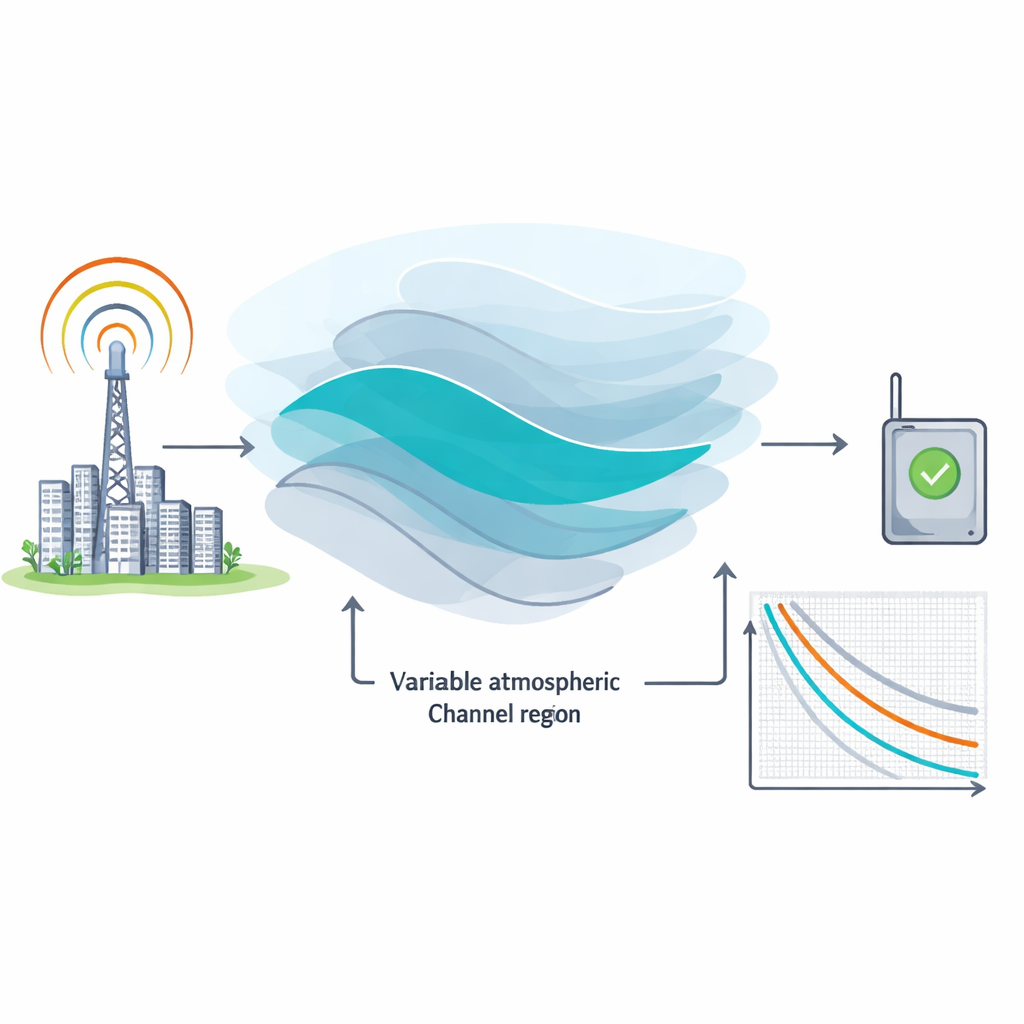
Signals that fade and why they cause mistakes
Wireless signals do not travel through empty space. They bounce, scatter and interfere as they move from a transmitter, like a base station, to your phone. This leads to “fading,” where the signal power randomly rises and falls over time. To judge how well a wireless system copes with fading, engineers track the symbol error probability (SEP), which tells how often a transmitted symbol is received incorrectly. Many mathematical models exist to describe fading, but commonly used ones often match real data only around average conditions and fail to capture rare but important extremes where signals become unusually weak or strong.
A more flexible way to describe tricky channels
The authors focus on a new fading model called the q-Weibull distribution, rooted in ideas from generalized entropy. Unlike classical models, this single distribution can be tuned using two parameters so that it behaves like many different channel types, including long-tailed cases where outliers are common. By adjusting these parameters, the q-Weibull model closely fits synthetic fading signals generated to mimic real wireless environments, outperforming popular composite models that combine several older distributions. This flexibility makes it a promising unified tool for characterizing a wide range of future wireless channels, which are expected to be more non-linear and complex than today’s networks.
Sharpening a key mathematical building block
Predicting SEP requires repeated use of the Gaussian Q-function, a standard mathematical expression for the probability that noise causes a signal to cross an error threshold. However, this function lacks a simple closed form, and many approximations either become inaccurate at low signal-to-noise ratios or are too cumbersome for practical system design. The paper introduces a new, tight approximation based on the Gauss–Legendre four-point rule, a clever numerical integration method. The authors convert the Q-function into a form where this rule can be applied and then express it as a short sum of exponential terms. When compared with several widely used approximations, their method shows the lowest average relative error over the full range of relevant signal strengths, especially in the low-signal region where errors are most sensitive.
Turning better math into clearer performance predictions
With this new approximation in hand, the authors derive analytical expressions for SEP in wireless systems operating over q-Weibull fading channels. Because the Q-function is replaced by simple exponentials, the originally messy integrals become tractable, and for certain parameter choices they even simplify to compact closed forms. Where the math remains more involved, it can be written using standard special functions. The team then validates these formulas through extensive Monte Carlo simulations, showing near-perfect agreement between theory and simulated SEP curves for a wide range of signal-to-noise ratios and parameter values. They also compute two practical measures of how a fading signal evolves over time: the level crossing rate, which counts how often the signal crosses a chosen threshold, and the average fade duration, or how long it tends to stay below that threshold.
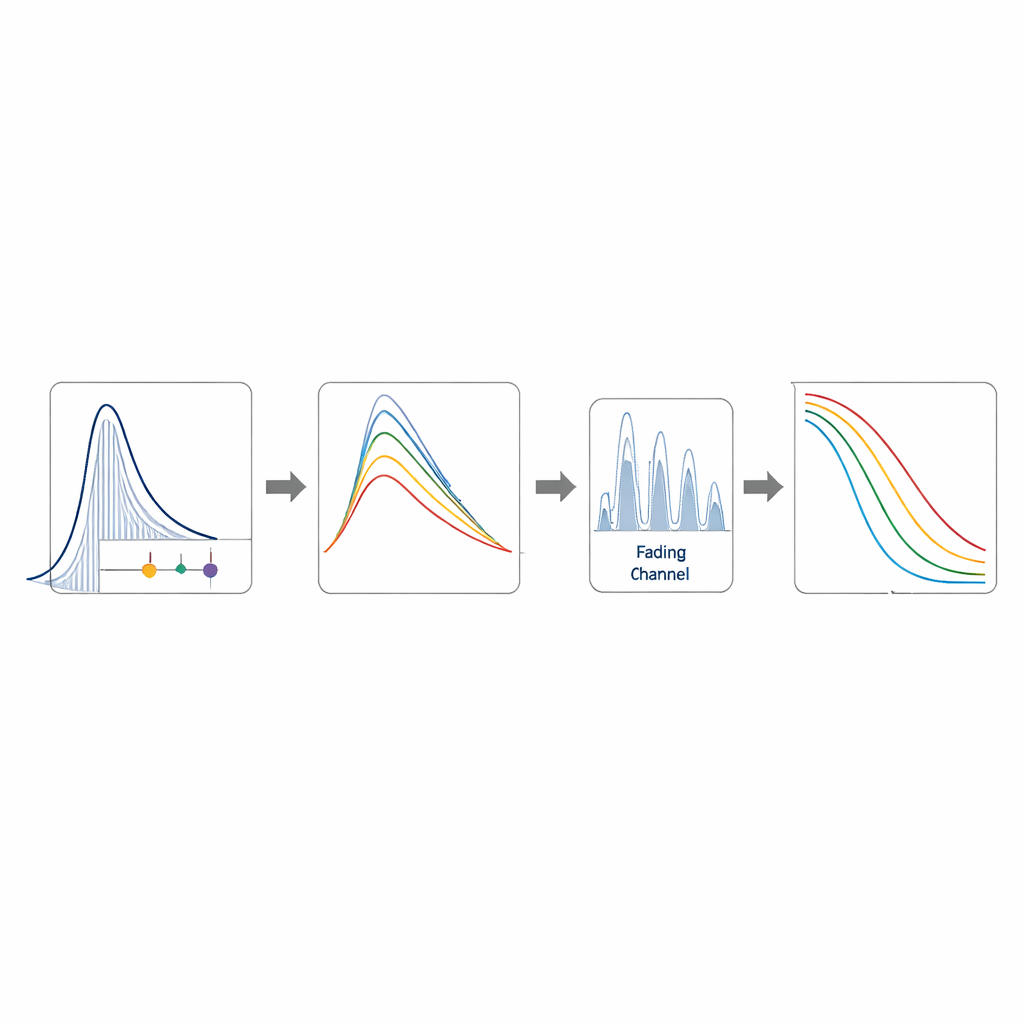
What this means for future wireless systems
Taken together, the work delivers both a more accurate tool for handling a fundamental probability function and a versatile channel model that can mimic many real-world fading behaviors. For a non-expert, the message is that we now have a better calculator for predicting how often wireless signals will stumble under difficult conditions, and that calculator works across many different kinds of environments using one unified model. This makes it easier to design and optimize next-generation wireless networks so that they can support higher data rates and more reliable links even when signals are pushed to their limits.
Citation: Samal, S., Chakravarty, S., Mukherjee, T. et al. Performance analysis over q-Weibull fading channels for symbol error probability evaluation using a tighter Gaussian Q approximation. Sci Rep 16, 10401 (2026). https://doi.org/10.1038/s41598-026-41217-8
Keywords: wireless fading, symbol error probability, Gaussian Q-function, q-Weibull channel, wireless reliability