Clear Sky Science · en
Ponderomotive plasma lenses for holography by Gaussian beams
Shaping Light with a Cloud of Charged Gas
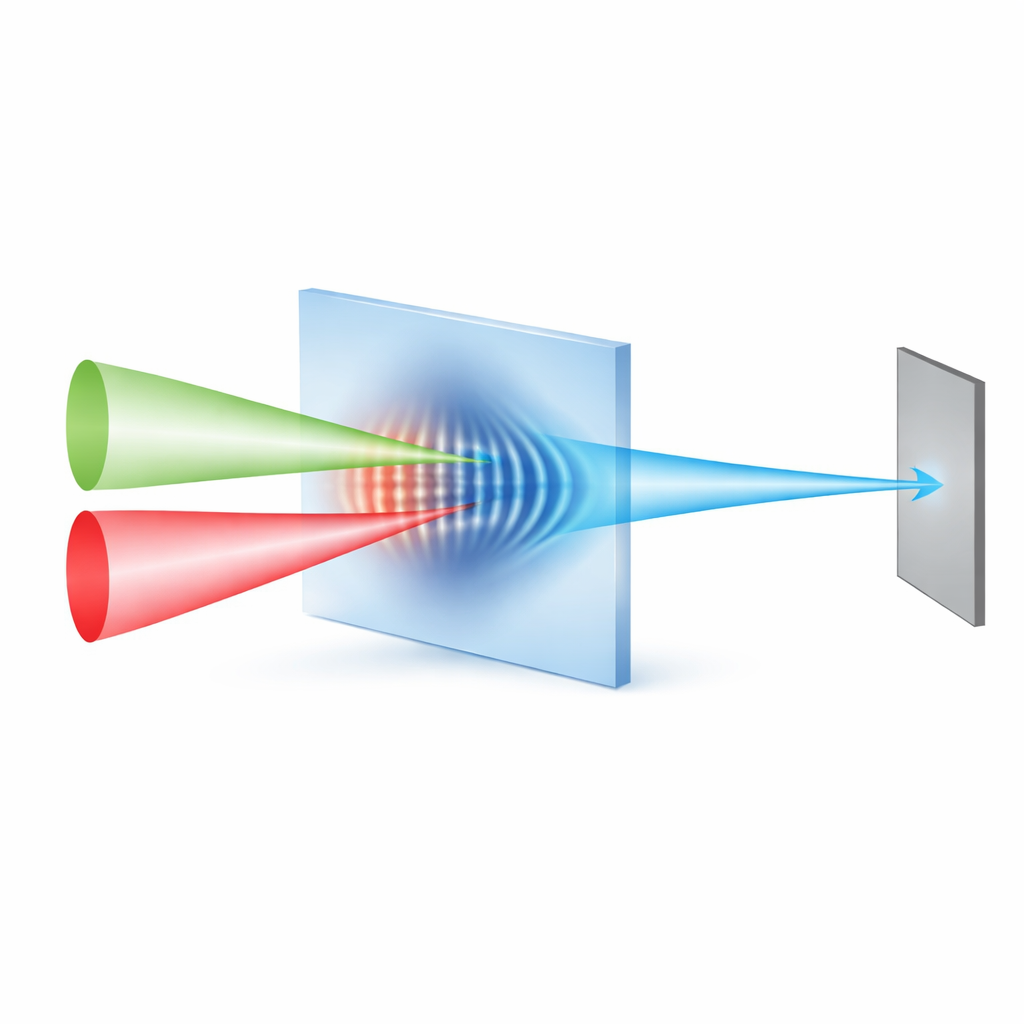
Imagine replacing bulky glass lenses with a shimmering cloud of electrically charged gas that can bend, focus, and record light on demand. This study explores exactly that idea: using a plasma – a gas of free electrons and ions – as a living optical element for holography. By carefully crossing two laser beams inside a plasma, the authors show how to sculpt the plasma’s internal structure so that it acts like a lens and a holographic recording medium at the same time.
From Solid Glass to Living Lenses
Conventional lenses are made of solid materials whose shape and properties are fixed once manufactured. They can crack, heat up, or even melt under very intense light. A plasma lens works differently. In a plasma, the local speed of light depends on how many electrons are packed into each region. When a strong laser beam passes through, slight differences in light intensity push electrons around through a force known as the ponderomotive force. This gentle shove moves electrons away from the brightest regions, changing the local density and therefore the effective “thickness” of the plasma as seen by light. The result is a lens made not from glass, but from a controlled pattern of charge inside the gas.
Drawing 3D Pictures with Interfering Beams
Holography normally relies on the interference between two light waves: a reference beam that stays clean, and a sample beam that interacts with an object. Their overlap creates a fine pattern of bright and dark fringes that encodes the three-dimensional shape of whatever the light has touched. In this work, both beams are Gaussian laser beams – the familiar bell-shaped profile common in laboratory lasers. The authors choose to use two independent lasers rather than splitting a single one, so that they can adjust the width, intensity, and color (or frequency) of each beam separately. When these beams cross inside the plasma, their interference pattern becomes the blueprint that the ponderomotive force follows, carving a matching pattern of electron density into the plasma itself.
How Beam Size and Color Tune the Hidden Pattern
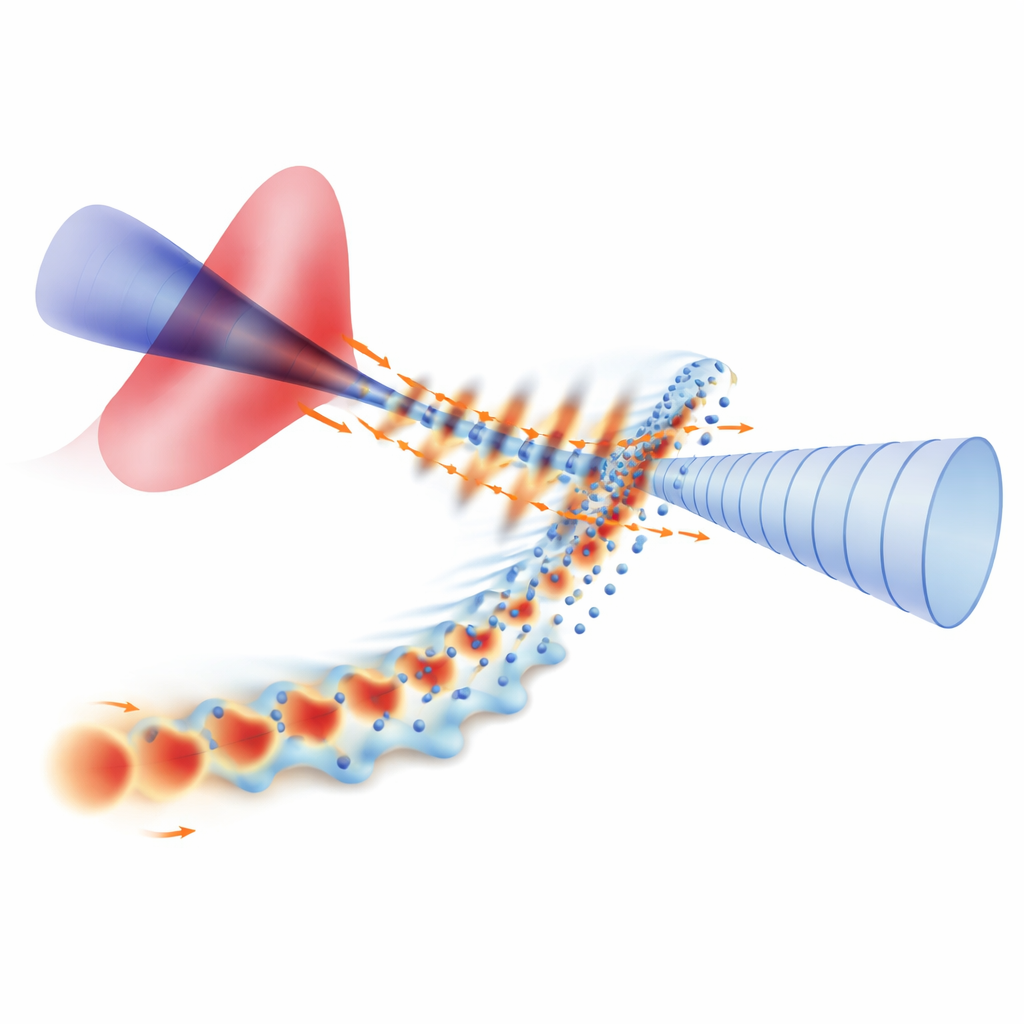
To understand which holograms can be written in plasma, the authors develop a mathematical description of how the interference pattern shapes the charge distribution. They focus on how sharply the light intensity changes across the beam – a feature that depends strongly on beam width and on the detailed ripples set by the lasers’ wave numbers (closely related to their color and fringe spacing). Narrower beams create steeper intensity gradients and stronger pushes on electrons, allowing the plasma to reproduce finer details in the hologram. By studying how a quantity called H(k) – a measure of the holographic signal as a function of the two beams’ wave numbers – behaves, they show when interference is mostly destructive (fringes wash out) and when it becomes constructive and stable, yielding clear, high-contrast patterns.
Balancing Brightness and Sharpness
The study also reveals that balance matters. If the two beams have similar strengths, the resulting fringes are crisp and highly sensitive to small phase shifts, which is ideal for holography. If one beam overwhelms the other, the pattern fades and the “recording” loses detail. Likewise, adjusting the widths of the beams changes which spatial details are emphasized or filtered out: tight beams favor high-resolution but can be more vulnerable to distortions, while broader beams smooth out small features but can be more forgiving. The authors identify parameter ranges – combinations of beam width, intensity, and wave number – where the plasma lens maintains good focusing and holographic quality without being spoiled by unwanted nonlinear effects such as excessive heating or turbulence.
From Theory to Future Light Sculpting Tools
Although the work is theoretical, it uses laser settings that are already common in laboratories, especially solid-state systems like Nd:YAG lasers. The calculations suggest that real experiments could measure the predicted refractive index changes by tracking how a gentle probe beam bends or shifts its interference fringes after passing through the plasma. In plain terms, the paper shows how to “write” and “read” three-dimensional information inside a cloud of charged gas using nothing more than carefully tuned laser beams. If realized in practice, such ponderomotive plasma lenses could enable adaptable, damage-resistant holographic optics for high-power lasers, advanced imaging, and new ways to diagnose and control plasmas themselves.
Citation: Alilou, S., Shahrassai, L. & Sobhanian, S. Ponderomotive plasma lenses for holography by Gaussian beams. Sci Rep 16, 11264 (2026). https://doi.org/10.1038/s41598-026-41214-x
Keywords: plasma holography, ponderomotive lens, Gaussian laser beams, dynamic optics, refractive index modulation