Clear Sky Science · en
Robust sensorless control of high speed PMSM drives under low carrier ratios and parameter uncertainties
Why faster electric motors need smarter control
As electric cars, trains, and industrial machines push for higher power and better efficiency, their motors are spinning faster than ever. Running these high‑speed motors efficiently means switching the power electronics less often to cut energy loss and heat. But this creates a thorny problem: the electronic brain that controls the motor starts to lose its grip on what the rotor is doing, especially when it has to estimate position without a physical sensor. This paper presents a new way to keep such motors stable, efficient, and reliable even under these harsh operating conditions.
The challenge of doing more with less switching
Modern Permanent Magnet Synchronous Motors (PMSMs) are the workhorses of electric vehicles and advanced industrial drives because they are compact and efficient. To squeeze even more performance from them, engineers raise the motor’s electrical frequency (by spinning faster) while lowering the inverter’s switching frequency (to reduce losses). The ratio between these two frequencies, known as the carrier‑to‑fundamental (C/F) ratio, then becomes very small, sometimes as low as six. In this regime, the time between control updates is long compared with the electrical period of the motor, so numerical errors and delays in the digital controller are strongly amplified. Conventional “sensorless” control schemes, which infer rotor position from measured currents and voltages instead of using a physical sensor, become unstable or inaccurate, leading to noisy currents, torque ripple, and even shutdowns.

Watching the motor without a sensor
To eliminate position sensors and their cost, most high‑speed drives rely on mathematical observers that reconstruct the rotor position from electrical measurements. Traditional observers often use a simple feedback loop (based on proportional–integral, or PI, control) to correct estimated magnetic flux inside the motor. These schemes work reasonably well at moderate speeds and comfortable C/F ratios but struggle when parameters like resistance and inductance drift with temperature, or when the numerical discretization used in the microcontroller no longer matches the fast underlying physics. At very low C/F ratios, low‑order numerical methods such as the familiar Euler or Tustin approaches can move the system’s discrete‑time poles outside the safe region, pushing the observer into oscillation or divergence.
A control scheme that cancels disturbances on the fly
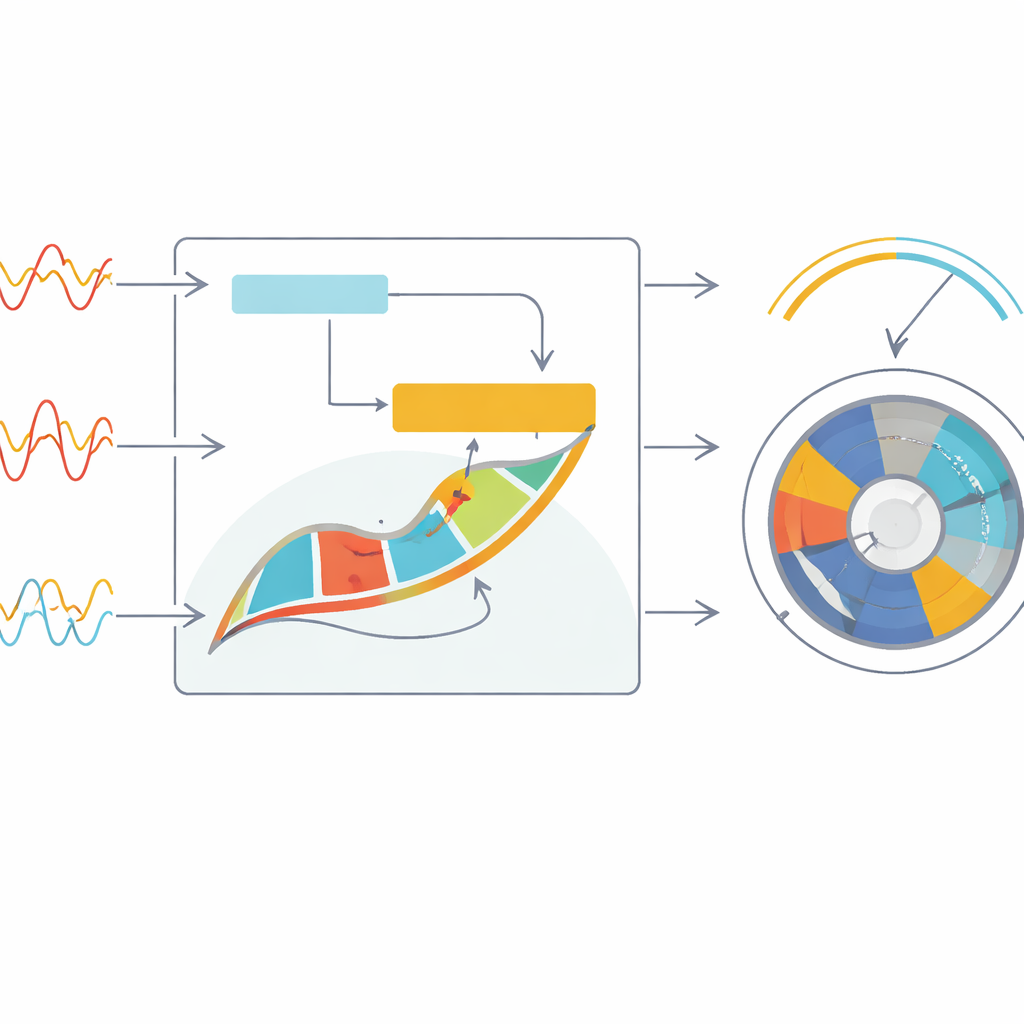
The authors tackle this by redesigning the observer around Active Disturbance Rejection Control (ADRC). Instead of treating parameter errors, load changes, and unmodeled effects separately, ADRC bundles them into a single “total disturbance” and estimates it in real time with an extended state observer. This disturbance estimate is then actively canceled in the control signal, allowing the system to behave like a much simpler, well‑known dynamic. In the proposed Adaptive Compensation Rotor Flux Observer, ADRC is used to continually adjust an internal correction voltage so that the estimated magnetic flux magnitude tracks a desired reference. From this corrected flux, the rotor angle and speed are extracted, providing the crucial position information for field‑oriented control of the motor without any mechanical sensor.
Hybrid numerical methods for real‑time hardware
However, ADRC’s strength comes with a cost: its equations are more complex and normally require a high‑order numerical integration method, such as the fourth‑order Runge–Kutta (RK4), to preserve stability at low C/F ratios. RK4 is accurate but computationally heavy for automotive‑grade microcontrollers that must run many control tasks within microseconds. To solve this, the authors introduce a hybrid discretization scheme that splits the observer into a slowly varying linear part and a fast nonlinear feedback part. The linear component is updated with a lightweight Euler step, while the nonlinear component uses RK4. This hybrid approach preserves RK4‑level accuracy where it matters most, yet reduces the multiplication count by about 30% compared with full RK4 in the ADRC observer, bringing execution time down to roughly 18.5 microseconds per control cycle on a 200 MHz digital signal processor.
Putting the method to the test on an industrial drive
The proposed scheme was validated on a demanding 100‑kilowatt PMSM spinning up to 20,000 revolutions per minute, representative of real electric propulsion hardware. Detailed pole analyses and experiments show that observers based on Euler and Tustin discretization become unstable as speed rises or C/F falls, while those using RK4 or the new hybrid method stay comfortably within the stable region. In practice, the hybrid ADRC observer enables sensorless operation at a C/F ratio as low as six, with current waveforms and torque ripple close to those achieved by a system that uses a physical position sensor. Load step tests reveal faster settling times, smaller overshoot, and better decoupling of current components compared with conventional observers. Even when key motor parameters are intentionally set wrong—doubling the assumed resistance or halving the inductance—the system remains stable, with only modest increases in current ripple and speed ripple on the order of a few parts in ten thousand.
What this means for future electric drives
In accessible terms, this work shows how a smarter “virtual sensor” and a carefully designed numerical engine can keep very fast electric motors under control, even when the electronics switch slowly and real‑world conditions deviate from the textbook model. By combining ADRC’s disturbance‑cancelling observer with a hybrid discretization that fits within tight processor budgets, the authors demonstrate sensorless control that is nearly as clean and robust as sensor‑based control, yet simpler and cheaper to build. This opens the door to more efficient, compact, and reliable drive systems for electric vehicles and other high‑performance applications where every watt and every gram matters.
Citation: Lin, Z., Jin, S., Wang, H. et al. Robust sensorless control of high speed PMSM drives under low carrier ratios and parameter uncertainties. Sci Rep 16, 11269 (2026). https://doi.org/10.1038/s41598-026-41212-z
Keywords: sensorless motor control, high speed PMSM, low switching frequency, active disturbance rejection, hybrid discretization