Clear Sky Science · en
Experimental verification of SAM-OAM coupling of tightly focused elliptically polarized light
Light that twists tiny objects
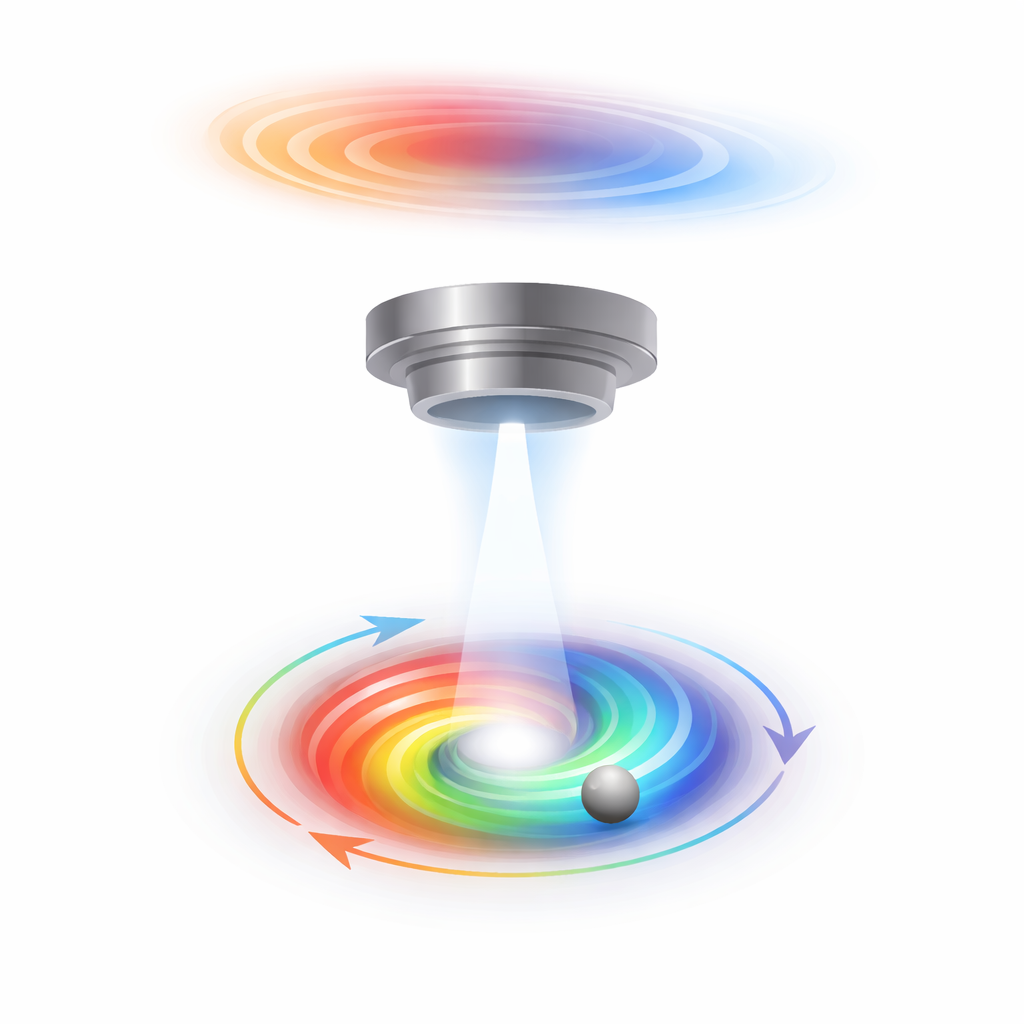
Imagine being able to grab a microscopic bead with a beam of light and make it whirl in a tiny circle, all without touching it. This study shows how a special kind of laser light, whose polarization traces out an ellipse, can not only trap microscopic particles but also set them into smooth, controllable orbital motion by converting one form of light’s angular momentum into another.
Two kinds of twist in light
Light can carry angular momentum in two main ways. One is linked to polarization—the direction in which the electric field of light wiggles—and is called spin angular momentum. The other is tied to how the light wavefront winds through space, like a corkscrew, and is known as orbital angular momentum. In many everyday situations these two types of twist are separate and conserved. However, when a beam is squeezed very tightly by a powerful microscope lens, they can interact, allowing spin to be converted into orbital twist. Until now, this effect had been well explored for purely circular or linear polarization, but much less was known about what happens for the more general case of elliptical polarization, which lies between the two extremes.
Shaping the focus of an elliptical beam
The authors first used detailed simulations to predict what happens when an elliptically polarized Gaussian laser beam is strongly focused by a high–numerical-aperture objective. They found that, at the focus, the component of the electric field along the beam direction develops a ring-shaped intensity pattern with a vortex-like phase that winds around by a full turn. In simple terms, the beam acquires a helical structure associated with orbital angular momentum, even though the original light carried only spin. By tuning how much of the light is polarized along two perpendicular directions (which sets the ellipticity) and adjusting the phase delay between them, they showed that the shape and smoothness of this vortex can be controlled and that the direction of the vortex reverses when the handedness of the elliptical polarization is flipped.

Building a light-based turntable
To test these predictions, the team built an optical tweezers setup using a green laser, polarization optics, and a high-power microscope objective immersed in oil. The laser beam was first made linearly polarized and then passed through a quarter-wave plate to create an adjustable elliptical polarization before being tightly focused into water containing microscopic glass particles. A camera viewed the focal region from below so that the paths of the trapped particles could be recorded. Careful adjustment of the wave plate and beam power created a stable “light trap” in which particles could be captured and observed as they moved.
Particles orbiting in light-made rings
When an irregularly shaped glass microparticle was caught by a right-handed elliptically polarized beam, it spontaneously began to travel in a circular orbit around the focus. Switching the light to left-handed elliptical polarization reversed the direction of the orbit, even though the particles themselves were non-birefringent glass and could not be spun directly by spin angular momentum. Similar behavior was observed for nearly perfect spherical silica beads, ruling out shape-induced optical effects. The orbital paths and their non-uniform speeds matched the simulated patterns of intensity, phase, and torque in the focused beam, confirming that a portion of the spin was indeed being converted into orbital angular momentum that then drove the particle’s motion.
Why these tiny orbits matter
This work demonstrates, both theoretically and experimentally, that tightly focused elliptically polarized light can reliably convert its internal spin into orbital twist and use that twist to guide microscopic particles along circular tracks. For a lay observer, this means that by simply choosing how the light’s polarization rotates, researchers can decide whether trapped particles circle clockwise or counterclockwise and how strongly they are driven. Such finely tunable optical control opens the door to new tools for moving and rotating objects in microfluidic devices, studying the physics of systems out of equilibrium, and probing the mechanics of single molecules and cells—all powered by light that quite literally makes the microscopic world go round.
Citation: Liu, Y., Wu, Y. & Tao, S. Experimental verification of SAM-OAM coupling of tightly focused elliptically polarized light. Sci Rep 16, 10170 (2026). https://doi.org/10.1038/s41598-026-41201-2
Keywords: optical tweezers, elliptically polarized light, angular momentum of light, optical micromanipulation, vortex beams