Clear Sky Science · en
IoT framework for sports activity safety monitoring based on wearable sensors and CRNN spatiotemporal analysis
Why Smarter Sports Gear Matters
Strapping on a fitness watch or sensor-packed shirt is becoming part of everyday training, from casual joggers to serious athletes. But these gadgets don’t just count steps anymore—they can spot risky movements, warn about overexertion, and quietly collect very personal health data along the way. This paper describes a new way to build such systems so they are not only more accurate at understanding what your body is doing, but also fast enough to react in real time and careful enough to protect your privacy.
From Body Movements to Meaningful Signals
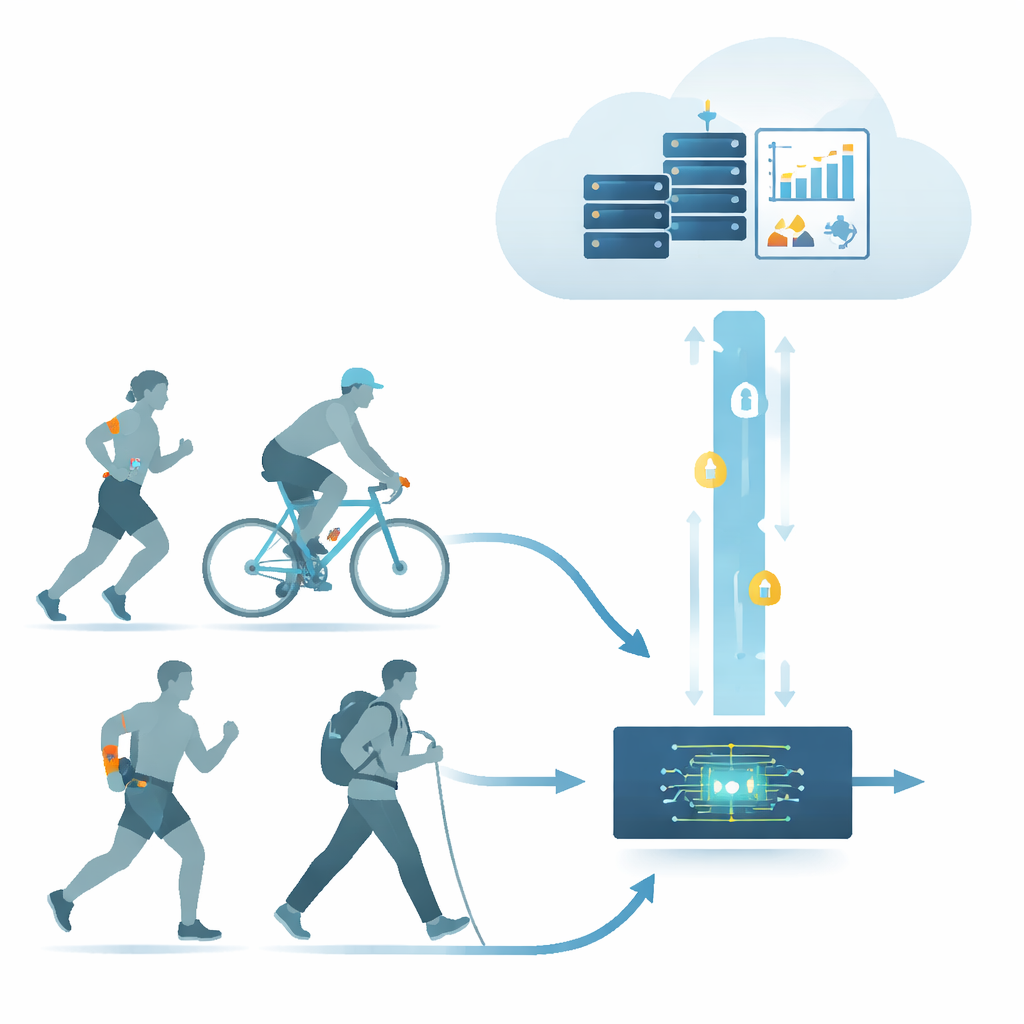
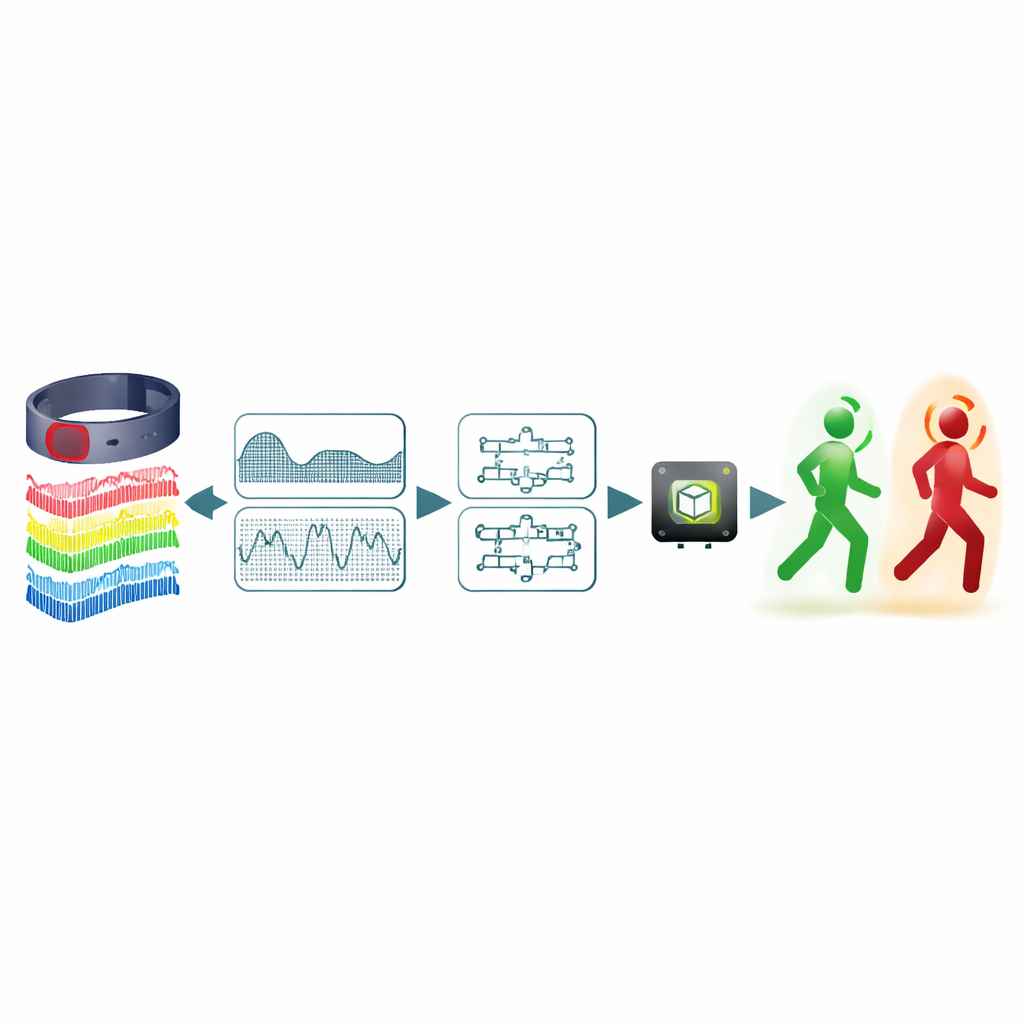
At the heart of the study is a complete framework that follows motion data from the body all the way to cloud-based insights. Small wearable units on the wrist and waist house motion sensors and a heart-rate sensor. These devices capture how your limbs move and how hard your heart is working during activities like running, jumping, squats, or stretching. Before any clever mathematics kicks in, the raw data are cleaned to remove noise and are sliced into short overlapping time windows so that each chunk contains a full movement cycle rather than a meaningless fragment.
How the System Learns Your Movements
To turn these sensor signals into an understanding of what activity you are performing, the authors use a type of deep-learning model that combines two strengths: one part excels at spotting patterns in space, and the other is good at following changes over time. Convolutional layers act like pattern scanners along the time axis, picking up repeated shapes in the signals that characterize, for example, the rhythm of running versus the sharp impact of jumping. These features then flow into a memory-style network that captures how movements unfold second by second. On top of this, an attention mechanism acts like a spotlight, automatically focusing the model on the most informative moments—such as foot-strike and push-off during a stride—while downplaying less important parts of the motion.
Making Powerful Models Fit Tiny Devices
Big neural networks usually live in powerful servers, but sports wearables have tiny processors and limited battery life. To bridge this gap, the researchers shrink their model while trying to keep its “brainpower” intact. They reduce the numerical precision of the model’s internal values so that each weight uses fewer bits, cutting memory and computation. At the same time, they train a smaller “student” model to imitate a larger “teacher” model, preserving much of its skill in recognizing activities. Together, these tricks slash the number of parameters from 2.34 million to 0.58 million and make it possible to run each recognition step on a low-power microcontroller in about 47 milliseconds—fast enough to keep up with real-world motion.
Keeping Sensitive Sports Data Safe
Because motion and heart-rate streams can reveal daily routines, fitness level, and health status, the framework weaves in security from the moment data leave the body. Before information travels over WiFi, 4G, or Bluetooth, it is scrambled with a widely used encryption method and tagged with a digital fingerprint that allows the receiver to confirm nothing has been altered. Tests show that this secure channel adds only a few tens of milliseconds of delay and raises energy use by about 12 percent, while still supporting high data rates and reliable transmission. The authors also compare this approach with more advanced privacy methods that add noise to data or keep training on devices, noting that these can further protect users but often reduce accuracy or demand more bandwidth.
How Well It Works in Practice
The team evaluates their system on three well-known public datasets of everyday activities and on a new sports-focused dataset they collected from 45 athletes doing common exercises. Across all four collections, the framework correctly identifies activities with about 96 percent accuracy—better than standard deep-learning baselines that use only one type of network or do not include attention. In field tests over two weeks of training, the online system maintains more than 94 percent accuracy, even when faced with messy real-world transitions between movements and variations in how people wear their devices. Response times, from sensing to final decision, mostly stay under a tenth of a second, which is suitable for live feedback and safety monitoring.
What This Means for Everyday Athletes
In simple terms, this work shows how future sports wearables can be both smarter and safer. By packing a streamlined yet capable learning model into the device itself, the system can quickly recognize what you are doing and distinguish between similar exercises, opening the door to more precise coaching and earlier warnings about risky technique. At the same time, by encrypting data end-to-end and carefully weighing when to use heavier privacy tools in the cloud, it helps keep detailed records of your movements and heart activity out of the wrong hands. While the authors note that more exercise types, better personalization, and stronger protection for large-scale data analysis are still needed, their framework marks a solid step toward trustworthy, AI-powered sports companions that watch over performance and safety without sacrificing privacy.
Citation: Zhang, SZ., Yang, HZ. & Gao, Y. IoT framework for sports activity safety monitoring based on wearable sensors and CRNN spatiotemporal analysis. Sci Rep 16, 11441 (2026). https://doi.org/10.1038/s41598-026-41195-x
Keywords: wearable sensors, sports monitoring, edge AI, activity recognition, data privacy