Clear Sky Science · en
Temporal evolution of structure property relationship for UV+RH artificially weathered material extrusion additive manufactured PLA
Why sun and moisture matter for 3D‑printed plastics
From phone mounts on bike handlebars to custom clips on garden tools, many people now use 3D‑printed plastic parts outdoors. But the most popular 3D‑printing plastic, polylactic acid (PLA), is known to be sensitive to sunlight and moisture. This study asks a practical question: if you leave 3D‑printed PLA out in harsh conditions for weeks or months, how do its inner structure and strength change over time, and can we follow that damage step by step rather than at just a few arbitrary moments?
How the team stressed everyday 3D‑printed parts
The researchers focused on parts made by material extrusion 3D printing, the desktop method where a thin plastic filament is melted and laid down in lines. They printed standardized tensile test bars from a commercial PLA filament using common hobby‑level printer settings chosen to minimize internal voids. Instead of waiting years for weather to take its toll outdoors, they placed the samples in an accelerated weathering chamber fitted with UV‑B lamps and controlled humidity. The chamber cycled eight hours of ultraviolet light at elevated temperature followed by four hours of warm condensation, mimicking repeated exposure to strong sun and damp air. Some bars were removed every 200 hours, up to a total of 2000 hours—roughly months of harsh outdoor exposure packed into a laboratory test. 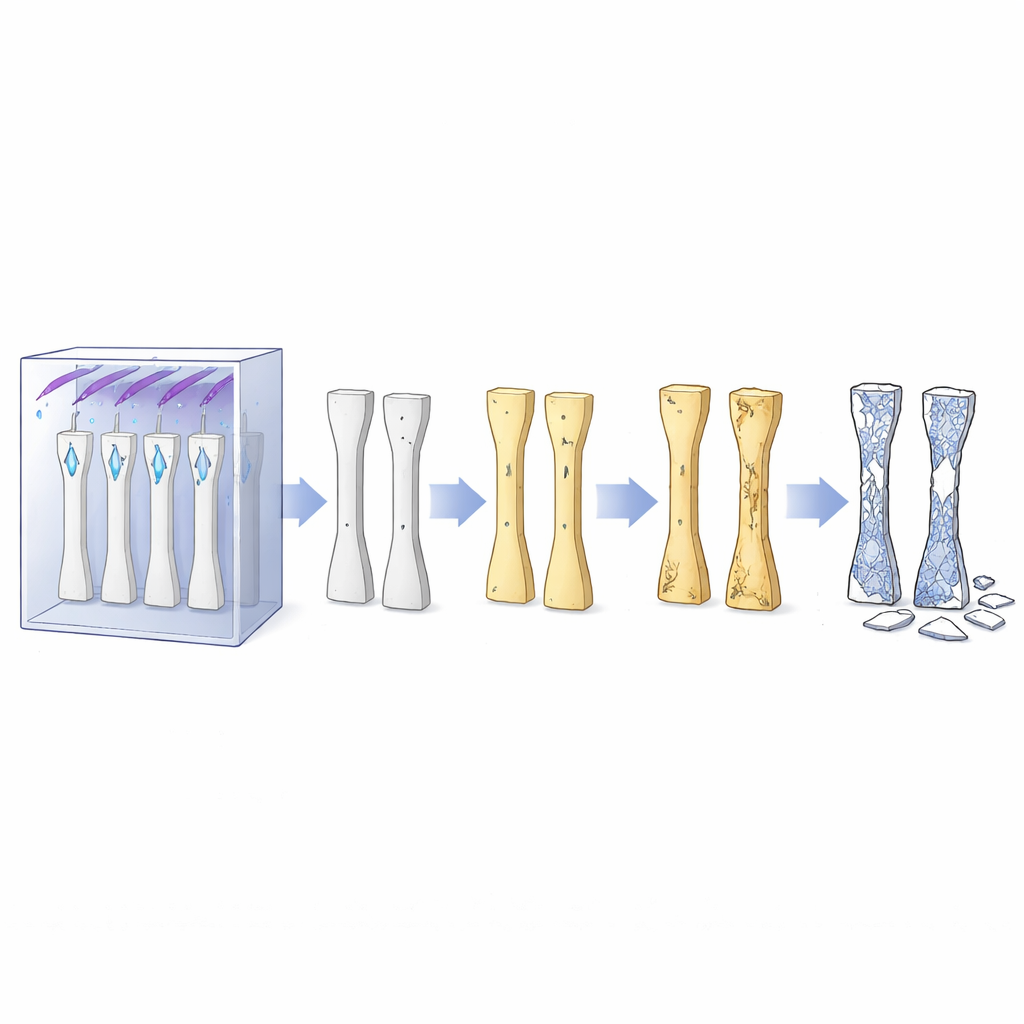
Watching the surface chemistry break down
To see what was happening at the plastic’s surface, the team used infrared spectroscopy, a technique that tracks how chemical bonds absorb light. Over time, they saw signs of water‑driven breakdown and light‑induced bond cutting along the PLA chains. New signals linked to hydroxyl groups appeared, while others tied to the original backbone of the polymer faded or split. After about 1200 hours, features associated with double bonds between carbon atoms grew stronger, indicating that long chains were being chopped into shorter segments and rearranged. These changes match a multi‑step degradation pathway in which ultraviolet light and moisture first generate reactive spots on the chains, then progressively snip and reorganize them, leaving a more oxidized and fragile surface.
From smooth plastic to brittle, crystalline material
Mechanical tests on the weathered bars showed a clear, time‑based trend: tensile strength dropped by about 10% after only 200 hours, then by roughly another 5% with each additional 200‑hour interval. Beyond 1200 hours, the scatter in results increased as the material became more brittle and prone to sudden failure. Surprisingly, the stiffness (tensile modulus) stayed almost constant. To understand this mismatch, the authors turned to X‑ray diffraction and differential scanning calorimetry, which probe how ordered the polymer is and how it responds to heat. These measurements revealed that initially almost amorphous PLA rapidly became much more crystalline: within the first 200 hours, crystallinity exceeded 50%, and continued climbing to about 72% by 2000 hours. At the same time, a thermal signal associated with cold crystallization disappeared, confirming that many previously disordered chain segments had reorganized into ordered regions.
Hidden ordering and its consequences
This increasing internal order is a double‑edged sword. As weathering cuts chains and creates more free ends, the broken pieces can pack together more neatly, forming crystalline blocks. Higher crystallinity tends to preserve stiffness and can even make the material feel harder. But because the long chains that once tied the structure together are now shorter and interrupted, the plastic loses its ability to stretch and absorb energy. The result is a material that may feel rigid yet fails at lower loads and in a more brittle manner, with surface cracks and flakes appearing on heavily aged samples. Thermal measurements also showed shifts in glass transition and melting behavior, consistent with a stiffer, more constrained network that has accumulated internal stress during prolonged exposure. 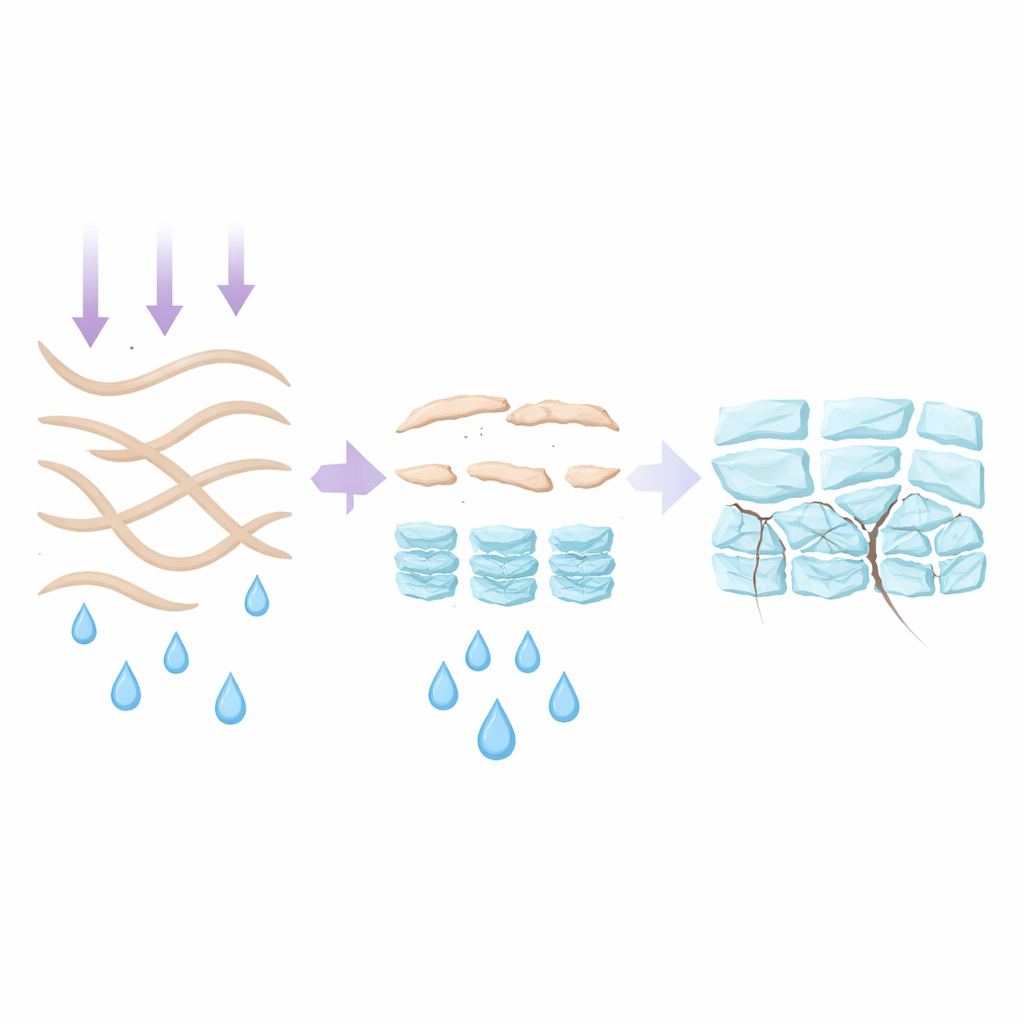
What this means for real‑world 3D‑printed parts
In plain terms, the study shows that 3D‑printed PLA left in strong sun and damp conditions does not just slowly get weaker; it undergoes a coordinated internal makeover. Its molecules are cut apart, its structure becomes more ordered, and its surface grows more damaged, all while its apparent stiffness changes little. The authors emphasize that their tests were done under controlled, intensified laboratory conditions, so the exact timescales will differ outdoors, where temperature, sunlight spectrum, and pollution vary day to day. Still, the step‑by‑step trends they reveal provide a roadmap for predicting how and when printed PLA parts might lose strength, and point toward future strategies—such as protective coatings, stabilizing additives, or alternative print settings—to make everyday 3D‑printed objects more durable in the real world.
Citation: Faizaan, M., Shenoy Baloor, S., Nunna, S. et al. Temporal evolution of structure property relationship for UV+RH artificially weathered material extrusion additive manufactured PLA. Sci Rep 16, 11562 (2026). https://doi.org/10.1038/s41598-026-41192-0
Keywords: 3D printing, PLA degradation, UV weathering, polymer durability, additive manufacturing