Clear Sky Science · en
A single bout of submaximal aerobic functional capacity test acutely promotes endothelial function in long COVID patients
Why this matters for people living with long COVID
Many people recovering from COVID-19 are left with months of fatigue, shortness of breath, and exercise intolerance. These symptoms are often linked to problems in the blood vessels that line our arteries, but there is little evidence about what simple, everyday activities might help. This study asked a practical question: can a single, short stepping test—similar to climbing stairs at home—temporarily improve blood vessel function in people with long COVID?
Lingering illness and tired circulation
Long COVID is more than just feeling tired after an infection. It can involve multiple organs and often includes a reduced ability to exercise. One suspected culprit is the inner lining of blood vessels, which helps arteries relax and deliver oxygen to muscles during activity. When this lining does not work well, blood vessels cannot widen properly, making physical effort feel harder and causing early fatigue and breathlessness. The researchers focused on this vessel lining, known functionally through how well an arm artery widens in response to a brief increase in blood flow.
A simple stepping test as both challenge and check
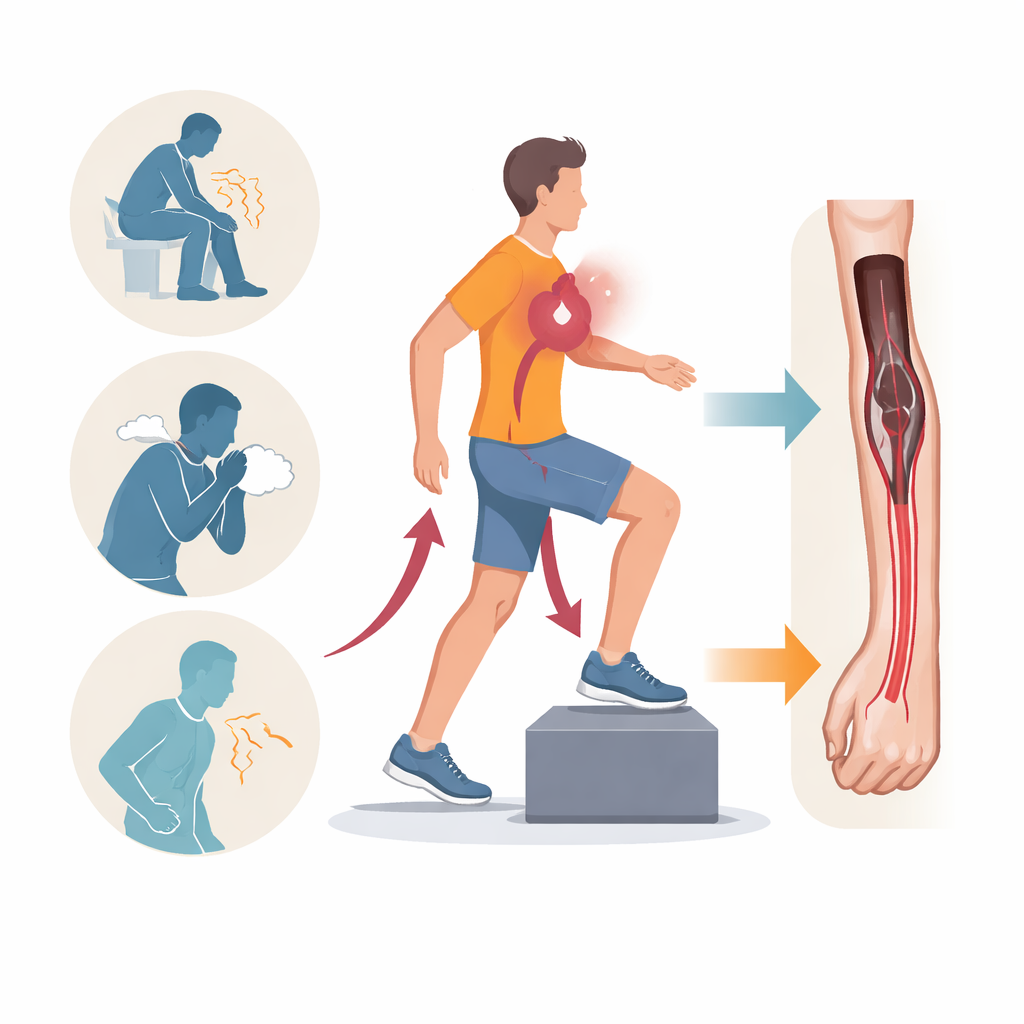
To explore this, the team studied 47 adults: 26 with long COVID symptoms and 21 healthy controls. All participants performed the six‑minute step test, which involves stepping up and down a 20‑centimeter platform at a self‑selected pace for six minutes. Before and about 10–15 minutes after the test, the researchers used ultrasound to measure how much a main artery in the arm widened when blood flow was briefly increased. They also collected detailed information on lung function, body composition, daily activity, heart and breathing responses, and feelings of breathlessness and leg fatigue during the test.
How long COVID changed effort and recovery
Compared with healthy controls, people with long COVID carried more body fat, had more conditions such as high blood pressure and diabetes, and reported common persistent symptoms like fatigue, muscle pain, and shortness of breath. On the step test, they completed far fewer steps and achieved lower oxygen use, showing clearly reduced functional capacity. Their heart rate rose less with exercise, while diastolic blood pressure and leg fatigue were higher. Oxygen levels in the blood dipped more during the test, even though basic lung function at rest was similar between groups. Together, these findings paint a picture of people who work harder, feel worse, and still manage less physical output after COVID-19.
Blood vessels that wake up after gentle effort
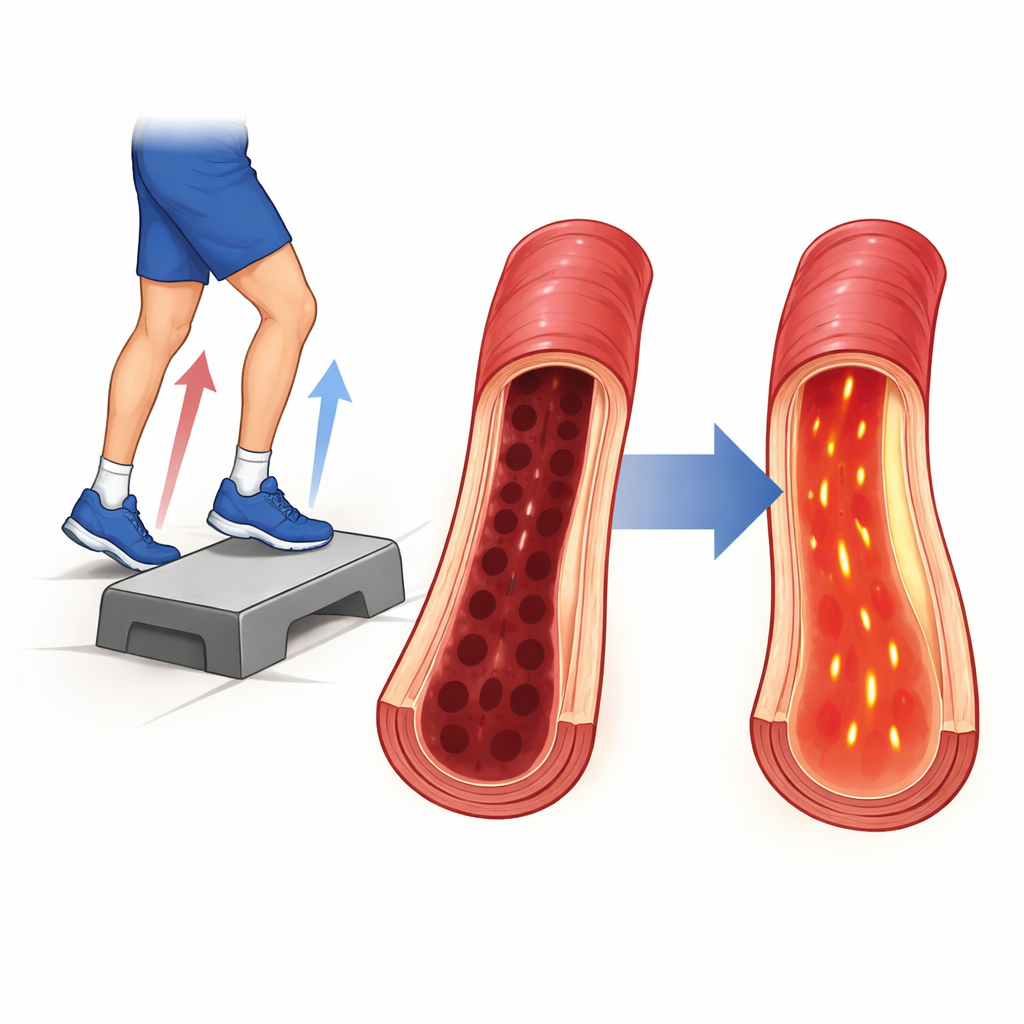
The most striking finding concerned the arm artery measurements. At baseline, long COVID participants had clearly poorer vessel widening than healthy controls, indicating impaired vascular function. Yet after just one six‑minute stepping bout, their artery response improved significantly—the vessel widened more after the test than before it. Even so, their vessels still did not reach the response seen in the healthy group. When the researchers looked for explanations, they found only a modest link between the improvement in vessel widening and how much oxygen the participants used at peak effort. Once age, artery size, body fat, and health conditions were considered, cardiorespiratory fitness no longer independently predicted the vascular response. This suggests the immediate benefit was not simply a matter of being “fitter” or “fitter people doing better,” but may relate to how long COVID affects blood vessels themselves.
What this could mean for everyday life
The study shows that in people with long COVID, even a brief, self‑paced stepping effort can temporarily sharpen how their arteries behave, despite their lower exercise capacity and higher blood pressure response. For patients and clinicians, this hints that short, manageable bouts of activity might help support vascular health without requiring intense workouts that many long COVID patients cannot tolerate. The work does not prove long‑term benefits, and it cannot establish cause and effect, but it offers cautious optimism: simple movements like stepping—performed safely and under guidance—may nudge sluggish blood vessels toward healthier function, one small effort at a time.
Citation: Santos-de-Araújo, A.D., de Oliveira Garcia, B.R., Bassi-Dibai, D. et al. A single bout of submaximal aerobic functional capacity test acutely promotes endothelial function in long COVID patients. Sci Rep 16, 10439 (2026). https://doi.org/10.1038/s41598-026-41182-2
Keywords: long COVID, exercise testing, endothelial function, vascular health, rehabilitation